
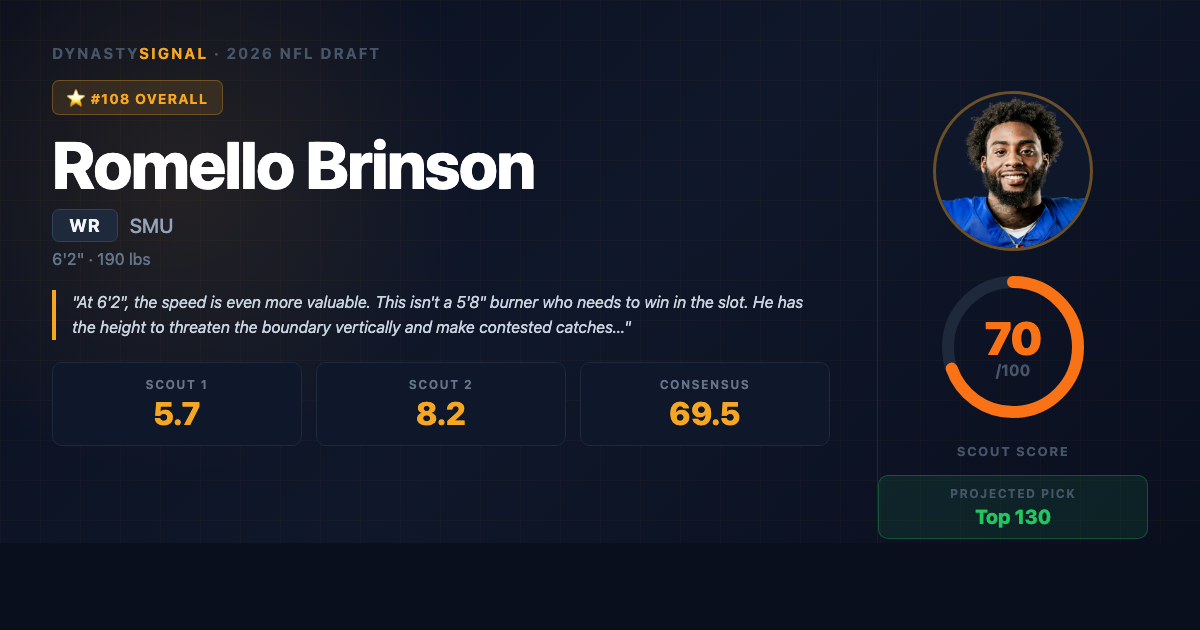
Romello Brinson is the kind of name that dynasty managers should be circling before the 2026 NFL Draft. A 6'2" perimeter receiver with a confirmed track background and legitimate speed that plays on tape, Brinson spent his 2025 season as SMU's go-to target in their inaugural ACC campaign — producing 43 catches for 638 yards and 3 touchdowns at 14.8 yards per reception. Those aren't gaudy volume numbers, but that YPC average tells the real story: SMU used him as a chunk-play weapon, not a dump-off safety valve, and he delivered when it counted against ranked competition.
What makes Brinson compelling isn't just the speed — it's the size-speed combination that's genuinely rare. At 6'2" with a track athlete's stride and body control, he gives NFL teams something different from the typical developmental WR pool. He showed out in marquee moments, contributing in a road win at Clemson and facing the secondary of a top-10 Miami team that was stacked with NFL draft prospects. A 2024 injury year wiped nearly a full season, but a healthy 2025 showed a receiver who had matured into a lead role at the Power 4 level. The 2026 draft class has no shortage of tall developmental wideouts, but few of them run like this.
STRENGTHS
Brinson's most bankable trait is his straight-line speed, and it is absolutely real on film. Against #10 Miami — a secondary filled with future NFL players — he created two to three yards of separation on vertical routes against defenders paid to close angles. His long, fluid stride is a track athlete's stride: he doesn't churn to accelerate, he opens up and glides past coverage. At 14.8 yards per catch across 43 receptions, his explosive play ceiling is something NFL coaching staffs will absolutely notice. His YAC profile is equally impressive — once the ball is in his hands in open space, he accelerates out of contact range rather than absorbing it, turning short gains into genuine chunk plays.
His hands and body control are legitimate NFL-grade attributes. The diving touchdown catch against Baylor — going fully parallel to the turf and maintaining possession on ground contact — is the kind of play that ends up in pre-draft evaluation rooms. He shows consistent ball security through contact, tucking the football even when absorbing hits from ACC-caliber defensive backs. Back-shoulder tracking, adjusting to off-target throws mid-route, and catching in traffic with defenders draped on him are all demonstrated skills across the film. For a speed receiver who could easily be dismissed as a one-trick athlete, the hands are a genuine secondary strength that adds real value to his dynasty profile.
His route running is functional for what he does. Brinson predominantly operates as an outside perimeter threat, and while his route tree isn't deep, he understands leverage and situation — he gets off the line with urgency on third downs, shows clean releases against press coverage, and tracks back-shoulder throws with good spatial awareness. Both scouts noted his ability to win in traffic on slants and digs with crisp breaks and explosive first steps out of cuts. He's not a polish-first technician, but he's not a straight-line-only speedster either — there's a real receiver underneath the raw athleticism.
CONCERNS
The concerns are real and shouldn't be papered over. First: 185 lbs is thin for an outside boundary receiver at the NFL level. He'll need to add 10-15 functional pounds to survive NFL press coverage consistently, and the clock on that development is already running — he's a 6th-year player who will arrive at training camp older than most of his draft class. The transfer path (Miami FL → SMU) and a 2024 season largely lost to injury add additional flags. Seven touchdowns on 84 career receptions is modest for a receiver with his size profile; he hasn't been a consistent red-zone threat the way a 6'2" target should be.
The route tree is also a legitimate concern for dynasty managers projecting him into a WR3 role. His stems can be rounded and telegraphed against zone coverage, and there's limited evidence of him working extended option routes or complex releases from the slot. His blocking grade is below average — not unexpected for a speed archetype, but it limits usage flexibility in condensed run situations. The level-of-competition concern is real: E Texas A&M and Charlotte share the highlight reel with Miami and Clemson, and the elite-opponent film shows contributions in competitive games, not dominant performances.
SCOUT GRADES
Scout 1 grades Brinson at 57/100 with a Day 3 projection of Round 6 (picks 190-220). That evaluation leans heavily on the durability concerns, the modest production ceiling, and the lack of route-running refinement — characterizing him as a lottery-ticket lottery speed receiver in a developmental WR class with similar archetypes. The comp drawn is Dontayvion Wicks (UDFA, Green Bay 2023) — a 6'2" speed WR from the ACC who made a roster on athleticism and grew into a functional #4 option. Scout 1 sees a floor of practice squad / special teams gunner and a ceiling of Quez Watkins-type deep threat if everything clicks in the right system.
Scout 2 is significantly more bullish, grading Brinson at 82/100 with a projected pick range of Round 3 (picks 70-90). That evaluation prioritizes his elite YAC ability, his hands-in-traffic grade (9/10), and his body control (9/10), projecting him as a Day 2 steal who is being overlooked because the raw stat lines don't jump off the page. The ceiling comp is Xavier Legette — a physical slot weapon with explosive RAC and high-end hands — with a floor of Roman Wilson as a scheme-dependent YAC grinder. The two scouts are miles apart on draft range, which reflects genuine disagreement about how much the polish gap matters and whether his age/injury history is disqualifying or manageable.
PROJECTION
For dynasty managers, Brinson is a high-upside stash in the later rounds of 2026 rookie drafts. If Scout 2's evaluation proves closer to reality and he lands in Day 2, he immediately becomes a value pick. If Scout 1's read wins out and he slides to Day 3, he could be grabbed late in rookie drafts for almost nothing and develop on your bench. Either way, the landing spot will define his dynasty ceiling more than almost any other variable. An air-raid offense that deploys motion-heavy formations and gets the ball to speed players in open grass — think teams like Kansas City, Philadelphia, or Miami — dramatically raises his floor. A run-heavy team that demands perimeter blocking and a traditional route tree from its WRs tanks it.
Year 1 looks like a rotational role — 30-50 targets, special teams contributions, and developing rapport in a professional offense. The real dynasty investment thesis is Years 2-3, where a healthy, heavier (195+ lbs) Brinson in the right scheme could emerge as a legitimate WR3 with a weekly role and 700-900 yard upside. He's not a safe pick, and the scouts disagree enough that you need to be comfortable with volatility. But in dynasty leagues where the late rounds of rookie drafts are essentially free, the size-speed combination and film-verified explosiveness make Brinson one of the more interesting developmental receivers in this class.
View Romello Brinson's full player profile, measurables, and scouting breakdown →
🎬 All-22 Film Analysis Update
*Updated after All-22 film review by Scout1 and Scout2.*
Film Score: 69.5/100 (→ No change from base score of 69.5)
Composite Score: 69.5
Scout1 Assessment Romello Brinson is a long-striding, speed-first perimeter receiver who brings legitimate 6'2" height and a confirmed track background to a 2026 class that has no shortage of similarly-built developmental WRs. He was SMU's number one receiver in their inaugural ACC season — producing 43 catches for 638 yards and 3 TDs — and showed up in marquee moments against ranked Miami and in a road win at Clemson. The case against him is real, though: the frame is still lean (185 lbs), he's been around colle...
Scout2 Assessment Day 2 steal overlooked for gaudy stats—stash for YAC dynasty leagues; trade up in R3 if you love motion weapons.
*Film analysis is based on All-22 footage reviewed independently by two scouts. Scores reflect on-field evidence and may differ from pre-film model projections.*