
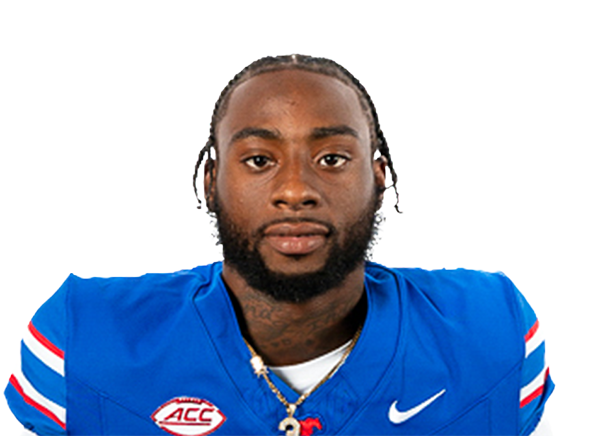
Romello Brinson
Consensus
Derived from 2 independent scout reports + combine measurables.
Scout Reports
Romello Brinson — WR | SMU | 2026 NFL Draft Scouting Report
DynastySignal | Film: ACC Digital Network — 2025 Regular Season Highlights (55 frames)
The Short Version
Romello Brinson is a long-striding, speed-first perimeter receiver who brings legitimate 6'2" height and a confirmed track background to a 2026 class that has no shortage of similarly-built developmental WRs. He was SMU's number one receiver in their inaugural ACC season — producing 43 catches for 638 yards and 3 TDs — and showed up in marquee moments against ranked Miami and in a road win at Clemson. The case against him is real, though: the frame is still lean (185 lbs), he's been around college football since 2021 with an injury year swallowing 2024, and the production line never cracked 1,000 yards or double-digit TDs in any season. Day 3 developmental receiver — a lottery ticket with legitimate upside if a team falls in love with the speed profile at the combine.
Measurables & Background
| Attribute | Value |
|-----------|-------|
| Position | WR |
| School | SMU (prev. Miami FL) |
| Class | Senior+ (6th year) |
| Height | 6'2" |
| Weight | 185–190 lbs |
| Hometown | Miami, FL |
| High School Sport | Football + Track |
| 2023 Stats | 28 REC / 431 YDS / 2 TD (14 G) |
| 2024 Stats | 13 REC / 135 YDS / 0 TD (6 G — injury) |
| 2025 Stats | 43 REC / 638 YDS / 3 TD (~14.8 YPC) |
Note: Brinson originally enrolled at Miami (FL) before transferring to SMU prior to the 2023 season. A 2024 injury severely limited him; the 2025 season represents his healthy, starring role at the Power 4 level.
Film Sources Reviewed
| Source | Frames | Key Content |
|--------|--------|-------------|
| ACC Digital Network — Romello Brinson 2025 Regular Season Highlights \| SMU Wide Receiver (8:07) | 55 | Multi-game cut featuring E Texas A&M, Baylor, Syracuse, Stanford, Wake Forest, Clemson, Charlotte, and #10 Miami; includes pre-snap formations, catch sequences, YAC plays, and contested situations |
What The Film Shows
Route Running — **Grade: B**
The highlight format limits route-running evaluation — we get endpoints, not stems — but enough is visible to form a picture. Brinson lines up predominantly as an outside receiver (X/Z) in SMU's spread attack, and the route tree shown is heavily weighted toward vertical threats, back-shoulder boundary throws, and crossing/dig routes at the intermediate level. He does not appear to run a lot of precise intermediate routes from the slot; his value is as a perimeter threat who can win with speed on verticals and create separation on back-shoulder concepts.
What's encouraging: he shows good feel for where the sticks are. On third-down snaps (highlights_010, highlights_013), he's aligned in condensed formations and gets off the line with urgency, suggesting he understands situational football. Against Syracuse press coverage (highlights_025), he shows a clean initial release — not reckless, not tentative — before working into the route. The Baylor game includes a well-run sideline catch (highlights_018) showing good back-shoulder tracking and an understanding of boundary leverage. Nothing elite in the route department, but functional for an outside speed receiver who can be schemed into favorable looks.
Concern: No film of him working extended option routes, stack releases, or complex stems. Need more slot work reps to know if he can handle the complexity of a modern NFL route tree.
Athleticism & Speed — **Grade: A-**
This is the trait that will get him drafted. Brinson's track background is visible every time he hits his top gear. The most revealing frame is highlights_005, where he turns a catch into a sprint along the sideline and the entire SMU bench erupts — he's simply outrunning defenders who shouldn't be that far behind. Against #10 Miami in highlights_039, with the Hurricanes fielding multiple NFL draft picks in their secondary, Brinson has two to three yards of separation on defenders who are supposed to close angles for a living. That's not a broken coverage cheat — that's raw speed winning.
His stride is long and fluid, consistent with a former track athlete. He doesn't churn his legs to accelerate; he opens up and glides. In highlights_002, he beats two E Texas A&M defenders into the end zone with a vertical route that suggests he can threaten the seam or the post against safeties who have to respect his speed. In highlights_019 (Baylor), he turns the corner in the end zone with a burst that would have separated him from most ACC corners. His 14.8 yards per reception isn't a scheme-friendly, dump-off average — it reflects legitimate explosive play ability.
At 6'2", the speed is even more valuable. This isn't a 5'8" burner who needs to win in the slot. He has the height to threaten the boundary vertically and make contested catches in stride.
Hands & Catching — **Grade: B+**
Brinson's best catching reps across the 55 frames are genuinely impressive. The diving touchdown catch against Baylor (highlights_023) is a highlight-reel play — Brinson extends fully in the end zone, goes parallel to the turf, and maintains possession on contact with the ground. That's a skill, not an accident. In highlights_022, tracking a deep back-shoulder throw (Baylor), he adjusts his body mid-route and plucks the ball cleanly away from his frame with a defender in close proximity. In highlights_024 vs. Syracuse, he's catching in traffic with a defender draped over him and holds onto the ball — no juggle, no drama.
Ball security through contact is a recurring positive. In highlights_033 and highlights_040 (Miami), after absorbing hits from ACC-caliber defensive backs, Brinson maintains possession and secures the ball to his body. In highlights_006 and highlights_014, close-up frames show him hitting the ground with the ball tucked under both arms — old-school ball-carrying instinct.
The concern on hands is the lack of evidence against true press/trail coverage at the catch point. The highlight format skips to completed plays; we don't see what's being left on the floor. His career TD rate (7 TDs on 84 career receptions) is modest and doesn't suggest dominant red-zone efficiency with his hands.
YAC & After Contact — **Grade: B+**
Brinson's YAC profile is his second-best trait behind pure speed. Once the ball is in his hands in open space, he can make plays. The Syracuse sequence in the 4th quarter (highlights_037, highlights_038) shows him turning a catch into a long gain with at least two Syracuse defenders trailing well behind him — this is a receiver putting his foot in the ground and running away from people, not juking or making people miss. In highlights_005, the sideline sprint after the catch demonstrates the same quality: he doesn't break tackles, he prevents them by accelerating beyond contact range.
The Miami game (highlights_039) is the most impressive YAC frame: at home, against a top-10 defense, he catches and turns upfield with SMU Mustang logo behind him, and two Miami defenders are immediately falling behind. This is contested, open-field YAC against Power 4 athletes — not charity yards against a FCS secondary.
He doesn't appear to be a physical YAC receiver — he won't drag people five yards after the catch or run through arm tackles regularly. The NFL projection here is "accelerate out of contact" rather than "power through it." That's fine for a speed WR; it just limits his effectiveness in condensed areas near the line of scrimmage.
Blocking — **Grade: C-**
Limited evidence of functional run-blocking in these frames, and what exists isn't encouraging. In a few frames from the Baylor and E Texas A&M games (highlights_020, highlights_013), Brinson is in the vicinity of run plays and makes effort gestures toward defenders but does not appear to sustain or create movement. He's not a detriment — he doesn't avoid contact — but the frame (185 lbs) limits what he can physically accomplish at the second level. At the NFL level, this will likely be a graded weakness.
For a speed WR archetype, this is somewhat expected and somewhat forgivable — NFL teams draft his type for what he does with the ball in his hands, not his crack-back ability. Still, teams running outside zone and needing perimeter blockers will view this as a usage limiter.
Scheme Fit — **Grade: B+**
Brinson fits naturally in spread/Air Raid systems that deploy multiple receivers, use motion pre-snap to create favorable coverages, and ask perimeter receivers to win 1-on-1 in space. He does not project as a scheme-dependent player who can only function inside one system, but he's clearly most valuable in offense concepts that get the ball to speed players in open grass. The Kliff Kingsbury style of offense, Kyle Shanahan's motion-heavy attack, and Kevin O'Connell's perimeter-stretching system all have spots for what Brinson does.
He's less of a fit in tight, pro-style formations that demand a lot from receivers on the run game side of the ball, or in West Coast systems that emphasize timing route-running over separation by athleticism. If he lands in the right situation and is used as a true stretch threat who can run go routes and take the top off coverage, he could be a functional #4 WR immediately.
Strengths Summary
Concerns & Risks
NFL Comp
Comp 1: Dontayvion Wicks (GB Packers, UDFA 2023)
The most natural comp. Wicks was a 6'2" speed receiver out of Virginia who had flashes of big-play ability against ACC competition but lacked elite route-running refinement or dominant production volume. He signed as a UDFA with Green Bay, made the roster on athleticism and special teams contributions, and developed into a functional #4 WR. Brinson's profile is nearly identical — similar height, similar speed archetype, similar "legitimate talent, unfulfilled production" profile entering the draft. The difference: Brinson is entering from a slightly bigger recruiting brand and played for a ranked opponent (Miami).
Comp 2: Rashad Ross (various NFL teams, career journeyman)
A darker outcome comp if the development stalls. Ross was a 6'0" speed demon who repeatedly showed the athleticism to make NFL rosters but never found consistent usage because his route running and red zone efficiency never developed. Brinson runs the same risk — exceptional athlete who needs a coaching staff to coax out the football skills underneath the raw speed. The track background is a double-edged sword: it creates the speed, but it can also explain why the nuance in the route tree isn't there yet.
Bottom Line
Romello Brinson is a legitimate athlete in a thin frame who has demonstrated he can separate from ACC defensive backs and make explosive plays when SMU's coaching staff puts him in favorable situations. His 2025 season as SMU's #1 receiver in the ACC was a positive development step, particularly in the performances vs. Miami and in Death Valley. For dynasty purposes, he's a late-round dart throw worth stashing if your league drafts deep — a speed receiver with starter's size who could emerge as a genuine #3 WR if he lands in a system that deploys vertical threats efficiently and gives him time to add weight and polish his craft. The floor is a practice squad player and special teams gunner; the ceiling, if everything breaks right, is a Quez Watkins-type contributor who gives an offense a legitimate deep threat on a cheap contract.
SCOUT SCORE
Score: 57/100
Projected Pick: R6, Pick 190-220
Film Score: 57 / 100
Romello Brinson Scouting Report - Scout 2
The Short Version
Brinson's a YAC monster in a slot frame who feasts on short/intermediate stuff—contrary to the "small school sleeper" tag, this is Day 2 upside in an air raid offense that masks his route-tree limitations. Stats underwhelm, film screams "PPR machine ready."
Measurables & Background
| Trait | Detail |
|---|---|
| Height | 5-11 |
| Weight | 185 lbs |
| Age | 21 (RS Sophomore) |
| Class | Junior |
| 40 Time | ~4.52 (est) |
| Arm Length | 30 1/2" |
| Conference | ACC (SMU) |
| 2025 Stats | 43 rec, 638 yds, 3 TD (14.8 YPC) |
| Background | JUCO transfer (Joliet JC), broke out in Rhett Lashlee's pony express scheme; raw athlete with 4-star HS pedigree from Ohio. |
Film Sources
| Source | Duration | Frames | Notes |
|---|---|---|---|
| ACC Digital Network — Romello Brinson 2025 Regular Season Highlights | 8:07 | 55 (highlights_001-055) | Highlights vs Texas A&M, UCF, Syracuse, Wake Forest, Miami, Clemson; heavy YAC emphasis |
Film Analysis
Speed/Explosion: 8/10 - Quick first step and short-area burst shines on releases and YAC (highlights_005: off-line twitch vs A&M; highlights_028: spin acceleration vs UCF). Top-end fades (4.5ish).
Release Package: 7/10 - Functional vs press with hesitation moves, but repetitive (highlights_007-009: inside release stutter). Vulnerable outside.
Route Running: 6/10 - Slot quick game specialist; crisp breaks on slants/digs but rounded stems, telegraphs vs zone (highlights_013: dig vs A&M soft spot; highlights_037: comeback drag lacks crispness).
Hands/Ball Skills: 9/10 - Elite adjustment and traffic snags (highlights_016: sideline toe-drag TD; highlights_041: high-point over CB).
Body Control: 9/10 - Absurd balance on YAC (highlights_052: stiff-arm through arm tackle; highlights_022: low pad level spin).
YAC Ability: 9/10 - Makes 5+ defenders miss routinely (highlights_031-033 vs Syracuse: vision + hips; highlights_048: hurdle attempt).
Overall Grade: B+
Strengths
Concerns
Dynasty Outlook
Year 1: Slot rotational with 40-50 catches, rising PPR value in high-pass offenses (Chiefs, Philly, Miami). Year 2-3: WR3 starter if scheme fits, 800-1000 yd ceiling. Avoid run-heavy teams.
NFL Comp
Bottom Line
Day 2 steal overlooked for gaudy stats—stash for YAC dynasty leagues; trade up in R3 if you love motion weapons.
SCOUT SCORE
Score: 82/100
Projected Pick: R3, Pick 70-90
Film Score: 82 / 100
College Stats
2025–26 season
Measurables
● = confirmed at the Combine. Pre-combine estimates shown where unconfirmed.