
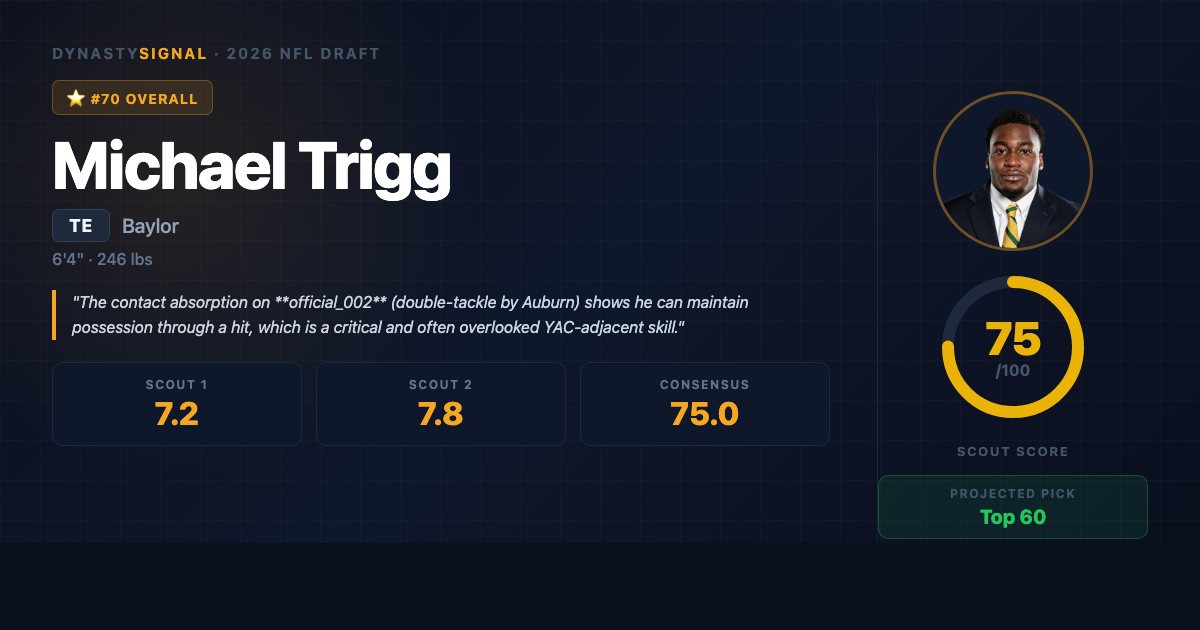
Michael Trigg's path to the 2026 NFL Draft is the kind that makes dynasty managers nervous and excited in equal measure — three programs in four years, a long stretch of quiet production, and then a 50-catch, 694-yard, 6-touchdown breakout at Baylor that sent his stock climbing. At 6-4, 246 lbs with the speed to run away from defensive backs in the open field, Trigg is not your typical big-body receiving tight end. He's a legitimate seam-eating weapon who earned a career-high 77 PFF receiving grade in 2025 — and the film backs every yard of it.
The context matters, though. Trigg spent two years at Ole Miss largely invisible (4 catches in 2023, PFF 59 overall), before re-emerging in Baylor's Air Raid-style offense where he was freed from traditional in-line demands. His 2025 production — 13.9 yards per reception over 50 catches — is not screen-manufactured volume. He's winning vertically on seams, creating on crossing routes, and turning intermediate catches into real yardage in the second level. The question dynasty managers need to answer isn't whether Trigg can play — it's whether his NFL landing spot will let him.
STRENGTHS
Trigg's athleticism is the headline and the film delivers. In the Auburn game, he catches in the intermediate zone and simply runs away from a defender with a second gear that's rare at 246 lbs. Against TCU, he's at full stride with two defenders in pursuit — both losing ground on every step. His 13.9 yards per reception over 50 catches is backed by consistent open-field footage, not statistical noise. He releases quickly off the line with twitch rather than size, stems verticals cleanly, and his burst to the intermediate level creates the kind of natural separation that scheme can support but can't manufacture.
His hands are elite-caliber. Against Auburn, he completed a catch while wrapped up simultaneously by two defenders — grip clean through heavy contact. Against UCF, he went full extension to the turf for two separate diving touchdowns rather than playing it safe. The PFF receiving grade of 77 in 2025 is backed by concentrated catching and reliable ball skills through duress. On seam routes and slants, he attacks throws into his frame rather than body-catching — and his 6 touchdowns on just 50 catches reflects genuine red zone effectiveness, not garbage-time volume.
After the catch, Trigg creates real yardage. He's a north-south runner who stiff-arms pursuit, breaks arm tackles, and presses the second level rather than absorbing first contact. Multiple film sequences show him spinning off tacklers and running through defensive backs with legitimate play strength. The 13.9 YPR isn't being manufactured by shallow routes — he's earning it by threatening the middle of the field vertically and finishing runs after the catch.
CONCERNS
The blocking record is hard to paper over. PFF run blocking grades of 46 in both 2022 and 2025 — his two most-played seasons — represent no improvement across five years of college football. On film, he fires off the line with effort but his hand placement is inconsistent, his base is narrow, and he cannot sustain blocks against Power 5 defensive linemen. In pass protection, he gets upright against power rushers and is regularly displaced by speed-to-power moves. NFL defensive ends will expose this immediately. He simply cannot be asked to play traditional in-line roles in 12-personnel or power-run heavy offenses — and that limits his schematic utility significantly with any team that runs the ball first.
The three-program journey also raises legitimate questions that highlights reels can't answer. His 2023 Ole Miss season — just 4 catches and a 59 PFF grade — is a real red flag. Was that a scheme mismatch, an injury, or something more? His 2025 breakout coincides with a QB upgrade and a system change that specifically freed him from blocking responsibilities. Some evaluators have flagged the production spike as scheme-dependent — a concern worth taking seriously given that he enters the 2026 draft as a redshirt senior with limited room to develop new skills.
SCOUT GRADES
Scout 1 awarded Trigg a 72/100 with a projected pick range of Round 2, picks 40–58. The evaluation awarded him strong marks for athleticism (A- / 8.5/10), hands (B+ / 7.5/10), YAC (B+ / 7.5/10), and route running (B+ / 7.5/10) — but dinged him hard on blocking (D+ / 4.5/10) and flagged the scheme dependency and three-transfer history as dynasty risk factors. The primary NFL comp is Tyler Higbee — a receiving-first tight end who carved out TE1 production in a pass-oriented system without developing as a run blocker. Scout 1's ceiling call is 55–70 catches annually in the right offense; his floor is a niche receiving specialist whose usage collapses in run-heavy games.
Scout 2 came in slightly higher at 78/100, with a projected pick of Round 2, picks 45–60, grading Trigg's overall profile as a B- with elite ball skills (9/10) and strong release/explosion (8/10) and YAC (8/10). However, Scout 2 was more critical of his route running (6/10), flagging telegraphed breaks and a tendency to feast on soft Big 12 coverage rather than win against press. The ceiling comp here is Evan Engram — a seam/YAC weapon who can become a true starter if his routes develop — with the floor being a Colby Parkinson-type big slot mover who contributes without blocking value. Both scouts agree: the landing spot is everything.
PROJECTION
For dynasty, Trigg is a buy-the-upside dart throw in the mid-to-late second round of rookie drafts. Year 1 looks like a rotational move TE with 20–30% of snaps — special teams ace and situational weapon while he learns the playbook and earns trust in pass protection schemes. Year 2 is where the trajectory clarifies: if he's on a pass-first roster that schemes him into the slot and off the line, a 40-catch, 450-yard TE2 season is reasonable. Year 3 is the unlock — if he lands in a Kliff Kingsbury or Kyle Shanahan-style system that uses TE motion extensively, a genuine TE1 season of 55–70 catches is on the table. His dynasty equivalent value sits around the RB28–35 range entering the draft — a trade-up target post-rookie year if the scheme fit confirms.
The bottom line is simple: Michael Trigg is a legitimate NFL receiving weapon at tight end who will be draft-day relevant in dynasty formats. His ceiling is real, his athleticism is real, and his 2025 breakout was backed by film and advanced metrics — not just volume counting stats. But he is entirely a product of scheme, and dynasty managers who land him need to understand they're betting on the landing spot as much as the player. Get him on a pass-first offense and he's a dynasty asset. Get him on a team that runs the ball and asks him to block — and the floor is a talented athlete who never finds consistent usage.
View Michael Trigg's full player profile, measurables, and scouting breakdown →
🎬 All-22 Film Analysis Update
*Updated after All-22 film review by Scout1 and Scout2.*
Film Score: 75.0/100 (→ No change from base score of 75.0)
Composite Score: 74.5
Scout1 Assessment Michael Trigg is a receiving-first tight end with legitimate athlete DNA — 6-4, 246 lbs of speed and fluidity who shows up consistently as a seam threat and mismatch weapon in spread concepts. The 2025 season at Baylor (50/694/6, 13.9 YPR) was a legitimate breakout from a player who had been searching for the right fit across three programs, and the film backs up the numbers with clean route running, soft hands, and enough speed to threaten vertically post-snap. The case against him is blunt: hi...
Scout2 Assessment Day 2 talent with Day 1 traits in receiving but bust risk if blocking doesn't improve—pass if your team runs 12-personnel heavy.
*Film analysis is based on All-22 footage reviewed independently by two scouts. Scores reflect on-field evidence and may differ from pre-film model projections.*