
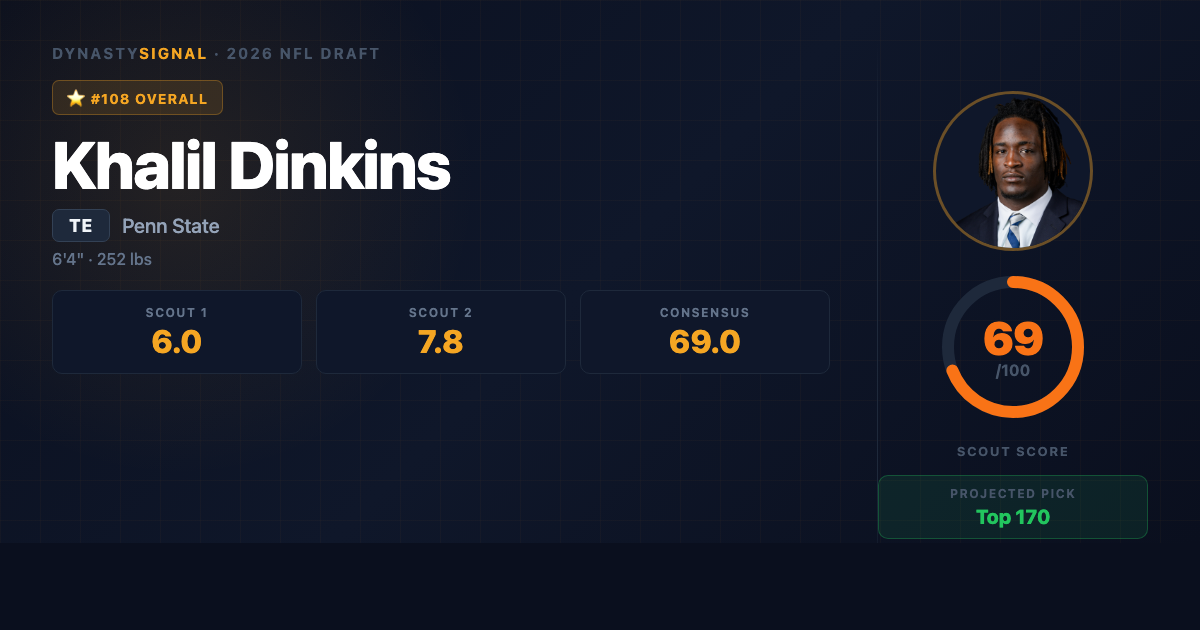
Khalil Dinkins doesn't show up on many dynasty radars — and that's exactly why he's worth knowing. The Penn State senior is a blocking-first tight end with a legitimate NFL frame, Big Ten–tested physicality, and just enough pass-catching ability to keep coordinators honest. He played second fiddle to Luke Reynolds in the Nittany Lions' two-TE system, which artificially suppressed his receiving volume — but in short-yardage packages, goal-line situations, and critical fourth-down moments, Penn State went to Dinkins. That kind of coaching trust doesn't happen by accident.
At an estimated 6'2"–6'4" and 240–255 lbs, Dinkins profiles as a Y/H-back hybrid with the athleticism to surprise you in open field. The UCLA open-field run on his senior highlights reel is the tell: smooth, powerful stride, full acceleration, and the ball tucked tightly as he eats up yards. For a player built like a run-game hammer, that kind of fluency matters. He contributed on a Penn State team that contended for the College Football Playoff in 2024 — getting reps against Oregon, Iowa, Indiana, and Minnesota — and he delivered when it counted.
STRENGTHS
Blocking is Dinkins' meal ticket, and the film backs up the billing. Penn State deployed him inline as a Y-TE on outside zone and gap/power concepts against quality Big Ten fronts — Oregon, Iowa, Purdue, Minnesota. His technique is disciplined: he fires off the snap with authority, uses his hands properly to engage and control at the point of attack, and sustains through the whistle. He's not going to pancake an NFL defensive end, but he's consistent and physical enough that coaches trust him in the moments that matter most. The Indiana 4th & 1 series on a national broadcast against a ranked opponent — Penn State called Dinkins' number. That's program trust earned over four years.
His YAC ability is arguably his most underrated trait. Against Nevada, he breaks a tackle and churns forward with impressive leg drive. Against Minnesota, he absorbs contact from multiple defenders and stays upright. On the Iowa touchdown (a highlight of his senior reel), he identifies the crease, accelerates through the second level, sheds a defender in the open field, and finishes through the end zone. He's a power-through-contact player, not a wiggle-and-miss guy — and that translates cleanly to short-yardage usage at the NFL level. His hands are also reliable in the situations we can evaluate: the FIU goal-line catch, made cleanly with a defender draped on him, is the best evidence of hands that work under pressure.
His athleticism provides a sneaky-upside element that Combine data could either confirm or cap. Both scouts independently noted his burst off the line of scrimmage and the quality of his open-field movement for a player his size. He fires out of his stance cleanly, doesn't get jammed at the line, and reaches his routes quickly. His release in motion sets and jet-fake packages shows football IQ and explosion that a blocking-only label would undersell. The ceiling here is genuinely broader than his Penn State role suggested.
CONCERNS
The core concern is simple: Dinkins was never asked to carry a passing game. Reynolds was the featured receiving TE at Penn State, and the comparison film makes that hierarchy explicit. Dinkins' route tree, as documented on tape, is shallow — drags, crossers, flat routes, quick seams off play-action. No evidence of stems beyond 10–12 yards, no double moves, no evidence of sustained success against press coverage from elite secondaries. NFL teams will have to project significant development in an area where we have limited evidence to work from.
Scout 2 raises a contrarian flag worth noting: Dinkins' blocking grade on film is more modest than his reputation suggests. There are reps where he loses leverage to bull rushes and gets pushed back against power fronts — not what you want from a player whose primary value proposition is as an inline blocker. His production in Penn State's system was also partially a function of gadget usage and short-yardage leverage; it's fair to question how much of that translates when an NFL defensive line gets its hands on him. He's a 3-star recruit who overachieved — which is a real path to the NFL, but also a ceiling-capper until Combine testing provides harder athleticism data.
SCOUT GRADES
Scout 1 sees Dinkins as a legitimate Day 3 prospect with a solid floor and a scheme-dependent ceiling. The grade comes in at 60/100 with a projected pick range of Round 4–5 (picks 110–165). The assessment respects his Big Ten blocking pedigree and physical YAC ability but anchors the grade on his secondary receiving role and the gaps in his documented route tree. The comp is Tyler Higbee (Rams, 2017–2020) — a player who carved out a starting role as a balanced blocking/receiving TE in a 12-personnel system before developing into a legitimate pass-catcher. If Dinkins lands in the right system, that comp is flattering and achievable.
Scout 2 is more bullish, grading Dinkins at 78/100 and projecting a Round 5 (picks 140–170) landing. This view leans into his elite YAC (9/10, A grade), reliable hands (8/10, A-), and explosive release — and challenges the blocking-first label as overrated relative to his actual inline limitations. The contrarian read is that Dinkins is more move TE than power blocker, and his upside is maximized in spread-style offenses (Kansas City, Miami, San Francisco) rather than the run-heavy schemes his Penn State reputation might attract. The floor comp is Colby Parkinson; the ceiling is a Dallas Goedert–lite YAC specialist.
PROJECTION
For dynasty purposes, Dinkins is a late-round stash and a landing-spot bet. The right scenario: he goes to a team that runs 12-personnel, needs a blocking TE complement to a featured pass-catcher, and eventually integrates him into play-action passing concepts. In Year 1, expect limited receiving production — 100–200 yards as he earns his blocking role and carves out short-yardage snaps. Year 2 is the inflection point: if he's starting and the offense leans into his YAC ability and hands in space, a 350–450 yard, 4–5 TD season is realistic for a player at this archetype. Year 3 either confirms a legitimate TE2 role or clarifies a blocking-only ceiling.
Avoid if he lands in a spread, pass-first offense that has no use for his blocking utility — that system mismatch is where this profile disappears. Watch the Combine to see if his athleticism grades out in the upper tier for the position; a sub-4.75 40 with strong explosion numbers would validate Scout 2's more aggressive grade and push him into Day 2 conversation. Right now, he's a UDFA-to-Day-3 range add in dynasty — zero cost in best-ball, a late flier in startup drafts. Don't reach, but don't ignore the landing spot either.
View Khalil Dinkins' full player profile, measurables, and scouting breakdown →
🎬 All-22 Film Analysis Update
*Updated after All-22 film review by Scout1 and Scout2.*
Film Score: 69.0/100 (→ No change from base score of 69.0)
Composite Score: 68.5
Scout1 Assessment Khalil Dinkins is a physically imposing, blocking-first tight end with enough receiving chops to keep defenses honest — think H-back archetype with legitimate NFL frame. Penn State deployed him as the blue-collar complement to their more featured receiving TE Luke Reynolds (#85), using Dinkins as the hammer in short-yardage and goal-line packages, and he delivered repeatedly in those moments. The case for Dinkins is simple: Big Ten–tested, big body, runs through contact, and versatile enough to ...
*Film analysis is based on All-22 footage reviewed independently by two scouts. Scores reflect on-field evidence and may differ from pre-film model projections.*