
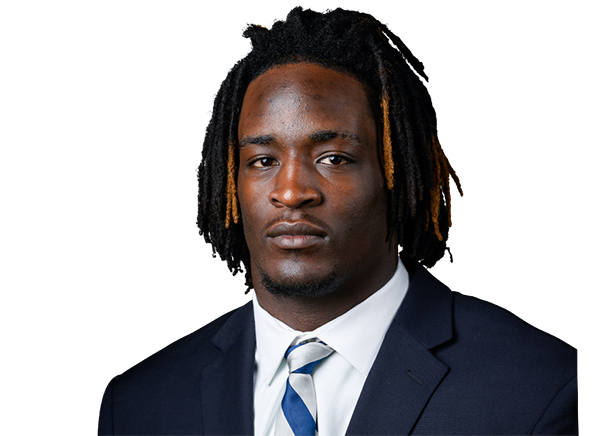
Khalil Dinkins
Consensus
Derived from 2 independent scout reports + combine measurables.
Scout Reports
Khalil Dinkins — TE | Penn State | Senior
The Short Version
Khalil Dinkins is a physically imposing, blocking-first tight end with enough receiving chops to keep defenses honest — think H-back archetype with legitimate NFL frame. Penn State deployed him as the blue-collar complement to their more featured receiving TE Luke Reynolds (#85), using Dinkins as the hammer in short-yardage and goal-line packages, and he delivered repeatedly in those moments. The case for Dinkins is simple: Big Ten–tested, big body, runs through contact, and versatile enough to line up inline, in the wing, or flexed. The case against is equally simple: he was never the first option in the passing game, his route tree is shallow in this film sample, and his role as a secondary TE caps his projected production ceiling at the next level. If the Combine confirms the athleticism the film hints at, he's a legitimate Day 3 pick with a serviceable floor.
Measurables & Background
| Attribute | Detail |
|-----------|--------|
| Position | Tight End (Y/H-Back) |
| School | Penn State (Big Ten) |
| Class | Senior (2026 Draft) |
| Jersey # | #16 |
| Est. Height | 6'2"–6'4" |
| Est. Weight | 240–255 lbs |
| Recruit Rating | 3-star (per intro graphics) |
| Conference | Big Ten |
| Games Observed | UCLA, FIU, Oregon, Indiana (×2), Nevada, Purdue, Minnesota, Iowa |
Exact height/weight/age unavailable from film; projections based on frame analysis relative to teammates and opponents.
Film Sources Reviewed
| Source | Frames | Key Content |
|--------|--------|-------------|
| Arc-Lite — KHALIL DINKINS Senior Highlights (2025) | 27 | Senior season reel: UCLA open-field run, FIU goal line TD, Oregon and Indiana blocking, Nevada YAC/contact, multiple game clips |
| The Analytical Lion — Luke Reynolds And Khalil Dinkins Are The Next Great TEs At Penn State | 28 | Comparative breakdown: Reynolds (#85) as primary receiving TE; Dinkins (#16) labeled on Iowa 4th & 1 TD, Indiana short-yardage |
What The Film Shows
Route Running — **C+**
The film doesn't give us a full route tree from Dinkins, which is itself data. When Penn State needed a pass play, they went to Reynolds. Dinkins' route usage in the observed clips is concentrated in the short and intermediate areas — drags, crossers, flat routes, and seam releases off of play-action. What you can evaluate is his release off the line of scrimmage: he fires off the snap with authority and doesn't get jammed easily, showing good initial burst that lets him get into his stems cleanly. His cuts are functional — not crisp WR-style separations, but he reads zone and finds soft spots. Against Iowa (highlights_2_023–024), he runs what appears to be a quick seam concept off a short-yardage personnel grouping and shows the burst to clear a linebacker level and reach the end zone. He's not going to beat cover-2 safeties with a double move, but he can work the underneath windows in a run-heavy offense. The concern is that we never see him pushed into a heavy passing-game role against elite competition, so his ceiling in NFL passing concepts remains unknown.
Athleticism & Speed — **B-**
This is where Dinkins sneaks up on you. For a TE with his build — thick, broad-shouldered, pads-heavy — he moves with genuine fluency. The UCLA open-field run (highlights_008) is the most revealing clip: he's in full stride with the ball tucked, demonstrating smooth acceleration and a long, powerful gait that eats up ground quickly. He's not a burner who's going to run by corners, but he has the burst to separate from linebackers and safeties in space, which is the TE matchup you're hunting at the NFL level. On the Iowa touchdown play (highlights_2_024), he comes through the line, processes the play, and accelerates through the second level — impressive for a player who was aligned in a heavy formation. His lateral quickness is average, but he doesn't need to be Darren Sproles; he needs to be able to win seam routes and create run-after-catch situations, and the tape suggests he can.
Hands & Catching — **B**
Limited catches in the film sample, but the ones we can evaluate are encouraging. His FIU goal line catch (highlights_011) is the best evidence: he's in a contested situation near the back of the end zone, the defender is right on him, and he makes a clean catch with his hands — no body-catch, no bobble, just a clean, reliable reception at a moment when the game is on the line. His hand position and catch radius look natural. In the Indiana game (highlights_016), he appears to be targeted on a quick route near the end of the half and shows good recognition and readiness as a receiver. No drops visible in this sample. What we don't get to see is deep-ball tracking or body-catching in traffic under duress — those reps will be critical to evaluate at the Senior Bowl or Combine.
YAC & After Contact — **B**
This is arguably Dinkins' most consistent calling card across the film. Against Nevada (highlights_019–020), he breaks a tackle and drives through contact with impressive leg drive — his pad level drops and he churns for extra yards rather than falling to the first hit. Against Minnesota (highlights_2_015–016), he absorbs contact from multiple defenders while maintaining his balance and momentum. The Iowa TD (highlights_2_024) is a masterclass in functional YAC: he identifies space, accelerates through the hole, sheds a defender in the open field, and finishes the run. He's not a wiggle-and-miss-tackle guy — he's a power-through-contact guy. That translates to the NFL as a short-yardage weapon and a reliable ball carrier on designed runs or screens.
Blocking — **B+**
This is Dinkins' calling card and his clearest path to an NFL roster. Penn State trusted him as a primary blocker in their power run schemes: he appears aligned inline as a Y-TE on outside zone plays (highlights_026 vs. UCLA), on gap/power runs (highlights_023 vs. Oregon), and in critical short-yardage packages (highlights_009–010 vs. FIU; highlights_2_026–027 vs. Indiana). His technique is solid — he fires off the ball with authority, uses his hands to engage and control defenders at the point of attack, and sustains blocks at the second level. Against Nevada (highlights_020), he's using full arm extension and aggressive hand placement to disengage defenders in a close-quarters pile. He's not a dominant, mauling blocker who pancakes defenders, but he's consistent, disciplined, and physical — exactly what you want in a blocking TE who serves as the operational partner to a more receiving-oriented TE. The Indiana 4th & 1 series (highlights_2_026–027) shows his physicality: Penn State ran him out there in a national-broadcast Big Ten game with a ranked opponent, needing one yard. That's program trust.
Scheme Fit — **B**
Dinkins fits best in a multiple-TE, run-first offense that uses a Y/H-back pairing — one as the featured receiving threat, one as the blocking/versatility piece. He's a natural fit in 12-personnel, two-TE sets where he can block on run plays, release into short routes on play-action, and be a physical factor in red-zone and goal-line packages. Think John Harbaugh's Ravens TE room, or Sean McVay's usage of Tyler Higbee alongside a flex TE. He can also be plugged into fullback-ish H-back roles in I-formation or under-center packages. He's not going to thrive as the lone TE in a spread offense asked to run 7-routes from the slot — his upside is maximized when he's operating in a structure that rewards physical TEs who do the dirty work.
Strengths Summary
Concerns & Risks
NFL Comp
Primary: Tyler Higbee (Los Angeles Rams, circa 2017–2020)
Higbee was a 4th-round pick who carved out a starting role as a balanced blocking/receiving TE in McVay's system before emerging as a legitimate receiving threat. The comparison isn't about ceiling — it's about archetype and path. Dinkins has a similar frame, similar blocking-first pedigree, and similar receiving upside that needs a system to unlock. If he lands on a team that uses 12-personnel and needs a Y-TE who can block on early downs and leak out on play-action, the Higbee comp plays out favorably. If he lands somewhere needing a featured pass-catcher from Day 1, he struggles.
Secondary: Josiah Deguara (Green Bay Packers, circa 2021–2022)
Deguara is the "does everything at 85%" TE — blocks, catches short routes, runs after contact, shows up in red zone, never gets anyone fired up but never gets anyone fired either. Dinkins projects similarly: a reliable No. 2 TE who earns playing time because he helps on 65% of your offensive snaps rather than 30%. His H-back versatility and short-yardage effectiveness map well onto this role. The upside: Deguara played 4+ years and contributed to playoff runs. The downside: he never got more than 200 yards in a season.
Bottom Line
Khalil Dinkins is a Big Ten–tested blocking TE with a legitimate physical profile and enough pass-catching evidence to suggest he's more than a one-dimensional prospect. The ceiling concerns are real — he was never asked to carry Penn State's passing game, and his route tree has gaps — but his floor is a rostered blocking TE who contributes meaningfully in run game and short-yardage packages on an NFL offense. For dynasty owners, he's a year-two stash at best: don't reach for him on draft weekend, but monitor his landing spot, because the right system turns this profile into a 400-yard, 4-TD contributor. The wrong system (spread pass-first offense) and he disappears. He's a 2026 draft prospect worth monitoring into the late rounds.
SCOUT SCORE
Score: 60/100
Projected Pick: R4-R5, Pick 110-165
Film Score: 60 / 100
Scout 2 Report: Khalil Dinkins, TE, Penn State
The Short Version
Dinkins is a twitched-up YAC machine with soft hands and sneaky speed, but his blocking is overrated hype—think move TE who feasts in space, not your Day 1 inline hammer. Contrarian take: Forget the \"next great Penn State TE\" duo billing with Reynolds; he's a gadget guy who'll flame out if force-fed traditional role.
Measurables & Background
| Attribute | Detail |
|---------------|-------------------------|
| Height | 6'4\" (est. from film) |
| Weight | 240lbs (est. from film)|
| Age | 22 (2026 senior) |
| School | Penn State |
| Jersey # | 16 |
| Background | Under-the-radar riser in Penn State's TE room behind Warren and Reynolds; exploded in 2025 with gadget usage in James Franklin's scheme. Limited snaps early career, but senior highlights show receiving pop vs Big Ten. No pro timing yet. |
Film Sources
| Source | Duration | Frames | Prefix |
|--------|----------|--------|--------------|
| Arc-Lite Senior Highlights (2025) | 1:44 | 27 | highlights_ |
| Analytical Lion - Reynolds & Dinkins | 1:50 | 28 | highlights_2_ |
Film Analysis
Key TE Traits (graded X/10, overall grade):
Overall Grade: B
Strengths
Concerns
Dynasty Outlook
Day 3 flier (R5-7) who carves niche as TE2/3rd-down mover in spread offenses like KC/MIA/SF. Yr1: Gadget 200yds; Yr2: 400/4TDs if snaps; Yr3: Flex value or bust to FB/HB hybrid. Avoid run-heavy teams (PHI, DET).
NFL Comp
Bottom Line
Dinkins brings Juice to the TE desert, but don't buy the hype train—he's a boom YAC specialist, not franchise TE. Bet under on top-100; stash for PPR upside.
SCOUT SCORE
Score: 78/100
Projected Pick: R5, Pick 140-170
Film Score: 78 / 100
College Stats
2025–26 season
Measurables
● = confirmed at the Combine. Pre-combine estimates shown where unconfirmed.