
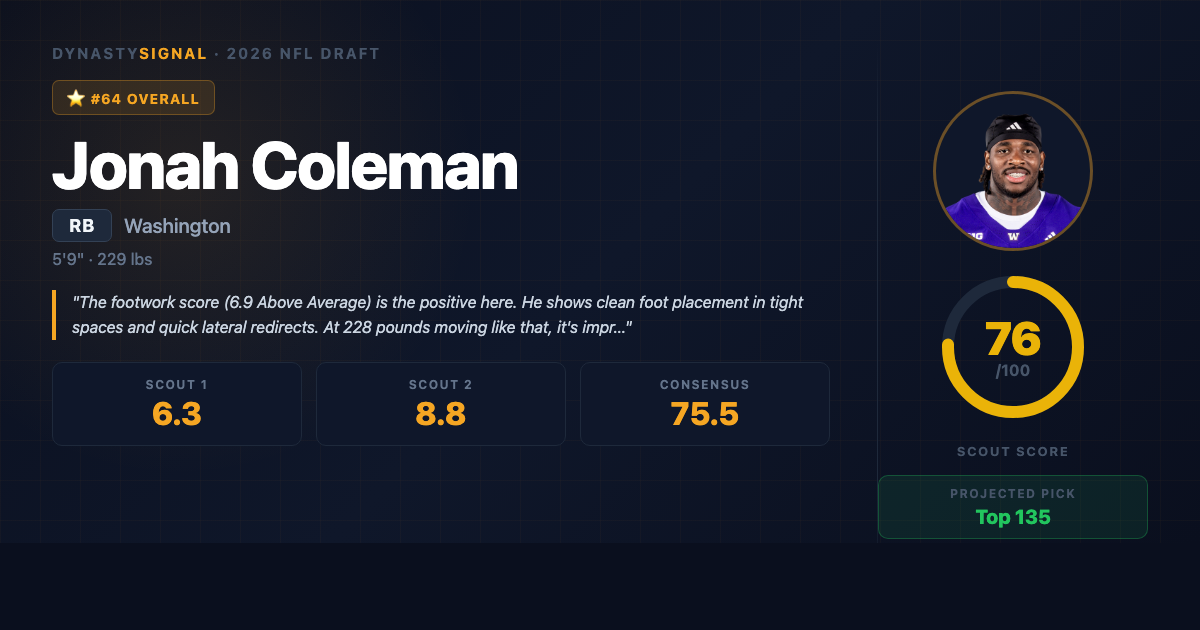
When Washington made the leap to the Big Ten in 2025, nobody gave Jonah Coleman much of a chance to thrive against the big boys. He answered anyway. The 5'9", 228-pound running back from Washington carried the ball 156 times for 758 yards and 15 touchdowns — not eye-popping numbers on paper, but earned against a weekly gauntlet that included Ohio State, Michigan, Maryland, and Illinois. He also caught 31 passes for 345 yards, quietly building a case as one of the more complete backs in this draft class. Coleman doesn't wow you on the surface. He wins you over on tape.
What makes Coleman interesting for dynasty is the combination that scout evaluators routinely undervalue: plus vision at 228 pounds, a stiff arm that's a genuine NFL-caliber weapon, and a receiving profile that isn't just a token dump-off line. He transferred from Michigan and immediately became Washington's feature back — trusted in short-yardage, trusted in the passing game, and trusted when the game was on the line. His landing spot will define his ceiling, but the traits are real, and the production held up in the country's toughest conference.
STRENGTHS
Coleman's vision and patience are the foundation of everything he does. He reads pre-snap alignment, identifies the weak side of the front before the ball is snapped, and lets the mesh point develop without false-stepping or overcommitting. That processing speed — rare in backs who also carry 228 pounds — shows up on film at Indiana, Illinois, and in the LA Bowl against Boise State. He sets up blocks with veteran awareness and cuts decisively once the lane appears. It's the kind of feel that doesn't always translate to the box score but makes offensive coordinators trust him with the rock on third-and-one.
The stiff arm deserves its own paragraph. This isn't a finesse shove — Coleman throws a full, violent extension that redirects incoming tacklers sideways. In the JWAC Gridiron film breakdown, multiple clips show him deploying it at exactly the right moment: one arm to ward off a pursuer, the other driving his shoulder into the contact zone. Combined with his low pad level and compact frame, he's a remarkably difficult tackle in the open field for a player who doesn't grade out as a speedster. He ran through arm tackles consistently against Big Ten competition, and his body control after being hit — shoulders square, pad level maintained — is among the best in this RB class.
His receiving profile is a genuine NFL differentiator. Thirty-one receptions for 345 yards is not a garbage-time stat line for a 228-pound back — Washington schemed him into multiple alignments: traditional backfield, split wide, and in pre-snap motion. His hands grade out clean with no visible drops in the film review, and his route versatility gives him a real three-down projection in the right system. He's not just a swing-pass valve; he's a back coordinators actually want involved in the passing game.
CONCERNS
The ceiling-capper is speed, plain and simple. Coleman's long-speed grades as average — he cannot pull away from NFL safeties in open space, which means splash plays will require scheme assistance rather than raw athleticism. His 4.9 YPC in a spread-RPO system designed to generate easy reads is adequate but not explosive; there's no home-run threat lurking if the right hole opens. In the biggest games — Ohio State, Michigan, Maryland — Washington's offense struggled and Coleman's impact was muted. That pattern of diminished production against elite fronts is worth monitoring as he faces NFL athleticism every week.
Scheme dependency is a real risk for dynasty purposes. His vision and patience are custom-built for zone-based read systems — Kyle Shanahan-tree offenses, Andy Reid-adjacent schemes — where a back is rewarded for processing rather than power. In a single-gap power scheme, he projects as neutral at best. Pass protection also remains a question mark; he wasn't hidden from those packages at Washington, but the film angles don't allow a clean technical evaluation, and 228-pound backs routinely need development time against NFL edge speed. Landing spot will make or break his value.
SCOUT GRADES
Scout 1 graded Coleman at 63/100 with a projected pick range of Round 4, picks 110–135. The evaluation is grounded and honest: vision at 6.8 (above average), patience at 7.1 (good), hands at 7.9 (approaching great), footwork at 6.9 (above average) — but long speed at just 5.2 (average) is the limiting factor. Scout 1 comps him to Kareem Hunt (primary) and Damien Harris (secondary), profiling Coleman as a reliable RB2/flex in the right scheme rather than a true bell-cow. The overall assessment: a legitimate Day 3 selection who contributes, with upside capped by athleticism and scheme dependency.
Scout 2 is considerably more bullish, grading Coleman at 88/100 with a Round 2, picks 40–60 projection. The film grades here are strong across the board — vision 9/10, patience 9/10, contact balance 9/10, burst/acceleration 8/10 — and Scout 2 argues that Coleman's 228-pound power is being undervalued due to height bias among traditional evaluators. The comp offered is a Nick Chubb lite ceiling with an Isaiah Pacheco floor. Scout 2's contrarian take: Coleman is a top-60 talent with three-down potential who will fall further than he should, making him a prime Day 2 steal for a zone-scheme team. The scouts diverge sharply on draft capital — a reminder that Coleman is one of the most polarizing evaluations in this RB class.
PROJECTION
For dynasty, Coleman's value lives and dies by landing spot. In a Shanahan-style zone offense (49ers, Rams, Dolphins) or an Andy Reid-adjacent system, he has legitimate RB2 upside with 30-40 target floors in the passing game — that's a flex-with-upside profile in the first year and a potential 1,000-yard ceiling by Year 2 in a featured role. His short-yardage reliability, receiving integration, and durability (228 lbs with above-average footwork) give him the traits to hold a three-down job if opportunity arrives.
The risk is a bad landing. Buried on a depth chart or dropped into a power scheme, Coleman's dynasty value evaporates quickly. At 22 years old, he doesn't have the age-curve runway of a younger prospect — he needs to contribute early to build dynasty equity. Target him in rookie drafts as a late-second or early-third pick, buy cheap in dynasty leagues if he falls, and monitor his team placement above all else. The tape says he can play. The rest is circumstance.
View Jonah Coleman's full player profile, measurables, and scouting breakdown →
🎬 All-22 Film Analysis Update
*Updated after All-22 film review by Scout1 and Scout2.*
Film Score: 75.5/100 (→ No change from base score of 75.5)
Composite Score: 75.5
Scout1 Assessment Jonah Coleman is a compact, thick-bodied power-speed hybrid who plays bigger than his height suggests and wins with patience, a violent stiff arm, and genuine receiving chops out of the backfield. He led Washington in rushing during their first Big Ten season, serving as the clear RB1 on a team that faced elite competition weekly — and he held up. The case against him is straightforward: his top-end speed is average at best, his production metrics in marquee losses (Ohio State, Michigan, Marylan...
Scout2 Assessment Coleman's game translates immediately—size queens will let him fall, but he's a top-60 talent with 3-down potential. Buy the hype.
*Film analysis is based on All-22 footage reviewed independently by two scouts. Scores reflect on-field evidence and may differ from pre-film model projections.*