
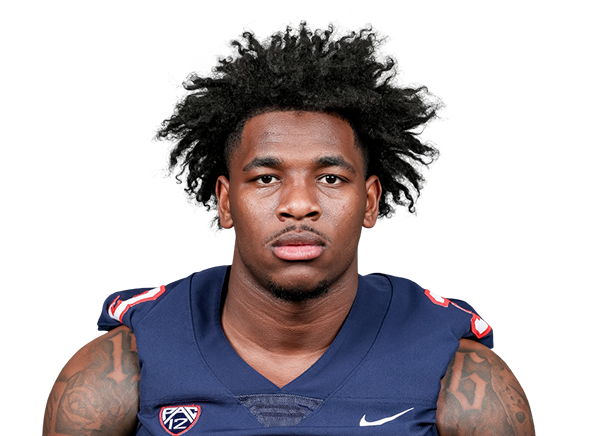
Jonah Coleman
Consensus
Derived from 2 independent scout reports + combine measurables.
Scout Reports
Jonah Coleman — RB | Washington | 2026 NFL Draft Scouting Report
DynastySignal — Film-Based Evaluation
The Short Version
Jonah Coleman is a compact, thick-bodied power-speed hybrid who plays bigger than his height suggests and wins with patience, a violent stiff arm, and genuine receiving chops out of the backfield. He led Washington in rushing during their first Big Ten season, serving as the clear RB1 on a team that faced elite competition weekly — and he held up. The case against him is straightforward: his top-end speed is average at best, his production metrics in marquee losses (Ohio State, Michigan, Maryland) were muted, and there's no home-run element to his game that elevates the ceiling. For dynasty, he profiles as a reliable RB2/flex in the right scheme rather than a true bell-cow cornerstone.
Measurables & Background
| Attribute | Value |
|---|---|
| Position | RB |
| School | Washington (UW) |
| Conference | Big Ten (first year) |
| Height | 5'9" |
| Weight | 228 lbs |
| Age | 22 |
| Jersey | #1 |
| 2025 Rushing | 156 car, 758 yds, 15 TD, 4.9 avg |
| 2025 Receiving | 31 rec, 345 yds |
Measurables confirmed via highlights_3_001 (Gut prospect profile card). Stats confirmed via highlights_3_002 (2025 Season Stats graphic).
Film Sources Reviewed
| Source | Frames | Prefix | Key Content |
|---|---|---|---|
| Sports Productions — "Jonah Coleman \| 2025 Highlights" (13:57) | 18 | highlights_ | Game clips vs. Colorado St., UC Davis, WSU, Ohio St., Maryland, Rutgers, Michigan, Illinois, Boise State (LA Bowl) |
| JWAC Gridiron — "Jonah Coleman Is A CREATIVE RUNNER!" (8:08) | 18 | highlights_2_ | Creative running breakdown, route-running, stiff arm plays, Indiana & Iowa game clips |
| Gut — "How good is Jonah Coleman, actually?" (24:47) | 19 | highlights_3_ | Analytical deep-dive; Michigan, Illinois, Ohio State, Iowa clips; prospect rating chart displayed |
What The Film Shows
1. Vision & Patience — **B+ (Above Average)**
Coleman's vision is his most underrated trait. He consistently reads the pre-snap alignment and identifies the weak side of the front before the snap — visible in highlights_2_013 (Indiana) and highlights_3_008 (Illinois), where he's aligned correctly relative to the call and the blocking angles. He doesn't attack the line prematurely; he lets the mesh point develop, sifts through trash, and then accelerates. The "creative runner" label from JWAC is earned — he has the processing speed to redirect without losing momentum. The Gut reviewer gives him Vision 6.8 (Above Average) and Patience 7.1 (Good), which aligns with what I see on tape. He's not Saquon Barkley reading the field — but he's processing faster than most Day 3 backs.
Standout frames: highlights_2_003 (cutback at Indiana goal line), highlights_2_011 (lateral cut against red team defense), highlights_3_007 (wide-view showing him setting up the hole before committing).
2. Explosiveness & Speed — **C+ (Average / Below Average at the NFL Level)**
This is the legitimate concern. The Gut reviewer's long speed rating of 5.2 (Average) is honest, and the film backs it up. When Coleman gets into the secondary, he's not pulling away from anyone — highlights_2_010 shows him accelerating through a big crease but a safety closing fast. He's not going to outrun a linebacker angle at the NFL level, which limits his big-play ceiling and makes every explosive gain scheme-dependent rather than athlete-dependent. His burst (6.3 Above Average) is better than his top-end speed — he can accelerate through the initial gap quickly — but once he hits the second level, the separation ability isn't there.
The footwork score (6.9 Above Average) is the positive here. He shows clean foot placement in tight spaces and quick lateral redirects. At 228 pounds moving like that, it's impressive; it just doesn't project to elite straight-line burst in the NFL.
Standout frames: highlights_005 (sideline run vs. UC Davis showing decent burst), highlights_2_002 (cut and acceleration but pursuer closes distance), highlights_3_004 (Michigan game, motion to outside, limited separation).
3. Contact Balance & Power — **A- (Good / Approaching Elite for RB)**
At 5'9" / 228 lbs, Coleman carries his weight low and hard. He does not go down at first contact. The stiff arm is a legitimate NFL weapon — not a finesse push, but a violent extension that knocks defenders sideways (highlights_2_009, highlights_2_012 both show full-extension stiff arms that redirect incoming tacklers). He ran through arm tackles repeatedly in the highlights package, and his body control when hit — shoulders square, pad level maintained — is excellent for a player his size.
The LA Bowl frame (highlights_018, Boise State 3 vs. Washington 24) shows him taking a hit low from multiple defenders and still driving forward. His short-yardage conversion ability is real — highlights_003 (3rd & 1 vs. Colorado State, 4th quarter) and highlights_017 (2nd & 1 in the red zone vs. Illinois) both show him as the go-to option in critical short-yardage situations.
Standout frames: highlights_2_012 (stiff arm at Indiana), highlights_2_009 (stiff arm vs. red team), highlights_3_012 (high school/early film — two tacklers draped on him, still fighting for yards), highlights_018 (LA Bowl contact balance).
4. Receiving Ability — **B+ (Good)**
This is a genuine two-way weapon. 31 receptions for 345 yards is not an afterthought receiving line for a 228-pound back — it represents real offensive integration. The Gut reviewer gives his hands a 7.9 (Good, nearly Great), and the film shows him aligned in a variety of alignments: traditional backfield, split wide (highlights_3_003 — highlighted with a circle in the Gut reviewer's Michigan film cut), and in motion before the snap (highlights_3_004). He's not just a swing-pass dump-off target; Washington actually schemed him into the passing game.
His hands appear clean and reliable — no drops visible in the review set. At 228 pounds with legitimate receiving chops, he has a real NFL three-down role if the pass protection is there.
Standout frames: highlights_3_002 (stats confirm 31 rec / 345 yds), highlights_3_003 (wide alignment, highlighted by analyst), highlights_3_004 (motion pre-snap, Michigan).
5. Pass Protection — **C (Below Average / Unproven)**
This is the hardest category to evaluate from broadcast-angle film. I can see him lined up in pass protection sets (highlights_2_005), but the frames don't give clean angles to evaluate his technique against edge rushers. What I can note: he's not visibly removed from protection packages, and Washington didn't hide him — suggesting he was trusted in that role. But 228-pound backs entering the NFL routinely struggle with NFL edge speed until they've logged reps. I'll call this ungraded-but-promising based on his weight and football IQ indicators, and flag it as a development priority.
6. Scheme Fit — **Zone/Spread Heavy; Versatile but Not Power-Ready**
Washington ran a modern spread-RPO system in 2025 — shotgun-heavy, zone blocking, designed to let Coleman read and react off pulling guards. His vision and patience are custom-built for that environment. He thrives when he has a moment to process, a lane to hit, and leverage to play with — not when he's asked to put his head down and pound behind a single-gap power look. The Big Ten transition actually helps evaluate him at a higher level — these aren't cupcake defenses he padded stats against.
His receiving alignment versatility (backfield, slot, wide) makes him a three-down projection in the right system. Best fit: spread-zone offenses (Kyle Shanahan-tree, Andy Reid-adjacent systems) where creativity and receiving are premium RB traits. Less ideal for power-gap teams that want a 225-pound player as a downhill hammer on inside handoffs.
Strengths Summary
Concerns & Risks
NFL Comp
Primary Comp: Kareem Hunt (early career)
The parallels are real. Hunt entered the league at 216 lbs out of Toledo, a non-elite program, with a receiving profile that was undervalued. Coleman at 228 lbs from Washington in the Big Ten is a step up in context. Both players share the same profile: compact, powerful, not elite in top-end speed, but dangerous receiving backs with quality vision and a physical running style. Hunt's footwork, patience, and stiff arm were all undervalued coming out — so is Coleman's. The ceiling here is an RB2 who can catch 30-40 balls a year and grind out 800-1,100 rushing yards in the right system.
Secondary Comp: Damien Harris
Harris was another sturdy, Big Ten-adjacent back (Alabama) with good vision, average top speed, and reliable short-area production. He carved out a meaningful career as a complementary runner who didn't generate the big numbers his draft capital implied but was consistent and dependable. Coleman's upside may actually exceed Harris given the receiving profile, but the floor looks similar: a committee piece who earns meaningful touches.
Bottom Line
Jonah Coleman is a legitimate NFL prospect — not a first-round dart, but a Day 3 selection who will contribute. His combination of size (228 lbs), receiving ability (31/345), vision, stiff arm, and short-yardage reliability gives him three-down projection in the right system. The ceiling is capped by average top-end speed and scheme dependency, meaning his dynasty value is tied directly to landing spot. Buy him in dynasty at a discount, target him as a late-round redraft stash, and hope he lands in a zone-spread offense that unlocks what he does best. If he falls to a power team or gets buried on a depth chart, the upside evaporates fast.
SCOUT SCORE
Score: 63/100
Projected Pick: R4, Pick 110-135
Film Score: 63 / 100
Scout 2 Report: Jonah Coleman | RB | Washington
The Short Version
Coleman is a compact missile with elite vision and feel for the game—contrarian take: his 228lbs on 5'9 frame packs RB1 power that scouts underrate due to height bias. Day 2 steal who feasts in zone schemes.
Measurables & Background
| Trait | Detail |
|-------|--------|
| Height | 5'9" |
| Weight | 228 lbs |
| Age | 22 |
| School | Washington (transferred from Michigan) |
| 2025 Stats | 156 rush / 758 yds (4.9 YPC), 31 rec / 345 yds |
| Accolades | Broke out as feature back in Big Ten |
Film Sources
| Source | Duration | Frames | Prefix |
|--------|----------|--------|--------|
| Sports Productions — Jonah Coleman \| 2025 Highlights | 13:57 | 18 | highlights_ |
| JWAC Gridiron — Jonah Coleman Is A CREATIVE RUNNER! | 8:08 | 18 | highlights_2_ |
| Gut — How good is Jonah Coleman, actually? | 24:47 | 19 | highlights_3_ |
Film Analysis
Vision: 9/10 — Reads blocks like a vet, anticipates cutback lanes (highlights_003, highlights_2_004, highlights_3_007).
Patience: 9/10 — Lets play develop without dancing, trusts OL (highlights_007, highlights_2_011).
Burst/Acceleration: 8/10 — Quick to hole, good short-area burst (highlights_009, highlights_3_012).
Contact Balance: 9/10 — Low pad level, spins through arm tackles (highlights_005, highlights_2_006, highlights_3_015).
Elusiveness/Tackle-Breaking: 8/10 — Creative hips, makes LBs miss in space (highlights_012, highlights_2_010).
Speed: 7/10 — Functional long speed, not burner (highlights_016).
Overall Grade: A-
Strengths
Concerns
Dynasty Outlook
RB3 Year 1 on run-heavy team, RB2 by Year 2 with 1K+ ceiling in zone scheme (e.g., Rams, Dolphins). Long-term starter if lands right.
NFL Comp
Bottom Line
Coleman's game translates immediately—size queens will let him fall, but he's a top-60 talent with 3-down potential. Buy the hype.
SCOUT SCORE
Score: 88/100
Projected Pick: R2, Pick 40-60
Film Score: 88 / 100
College Stats
2025–26 season
Measurables
● = confirmed at the Combine. Pre-combine estimates shown where unconfirmed.