
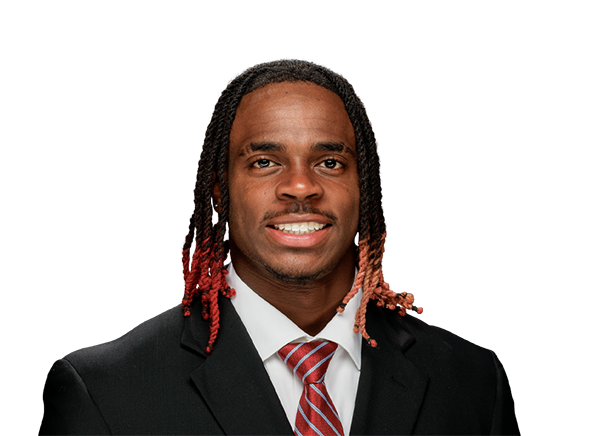
Kendrick Law
Consensus
Derived from 2 independent scout reports + combine measurables.
Scout Reports
Kendrick Law — WR | Kentucky | Senior | 2026 NFL Draft
DynastySignal Scouting Report
1. The Short Version
Kendrick Law is a compact, thickly-built speed receiver who transferred from Alabama to Kentucky in 2025 and immediately became the Wildcats' top target — 53 catches, 540 yards, and 3 TDs in 12 starts, plus Shrine Bowl recognition. The case for Law is simple: legitimate 4.4 speed in a 209-pound frame, a real YAC ceiling, proven kick return value, and the credibility of three seasons inside Nick Saban's and Kalen DeBoer's Alabama program before arriving in Lexington. The case against is equally clear: his numbers were achieved as the go-to option for a middling Kentucky offense, his route tree is limited (heavy on speed-based separation, light on nuanced technique), and a one-year breakout in Lexington after limited production at Bama raises durability and usage questions. The ceiling is a dynamic #3 receiver and core special teamer; the floor is a roster bubble piece who earns his paycheck on kick coverage and gadget packages.
2. Measurables & Background
| Attribute | Value |
|-------------------|--------------------------------------------|
| Position | Wide Receiver |
| School | Kentucky (transferred from Alabama, 2025) |
| Class | Senior (2026 draft eligible) |
| Height | 5-11 |
| Weight | 209 lbs |
| 40-Yard Dash | ~4.42 (projected; per NFLDraftBuzz) |
| Hometown | Alabama (recruited by Saban as 4-star) |
| Recruiting | 4-star recruit (Alabama) |
| Bowl Game | East-West Shrine Bowl invitee (2026) |
Career Stats Summary:
| Season | School | G | Rec | Yards | YPC | TD | Kick Ret | KR Yds | KR Avg |
|--------|----------|----|-----|-------|------|----|----------|---------|--------|
| 2022 | Alabama | — | — | — | — | — | — | — | — |
| 2023 | Alabama | 13 | 15 | 135 | 9.0 | 0 | 17 | 405 | 23.8 |
| 2024 | Alabama | 10 | 10 | 105 | 10.5 | 1 | 5 | 131 | 26.2 |
| 2025 | Kentucky | 12 | 53 | 540 | 10.2 | 3 | — | — | — |
| Career | — | 46 | 86 | 883 | 10.3 | 4 | 30 | 710 | 23.7 |
Note: Also totaled 16 carries for 83 yards in his career. 10 career tackles on special teams.
3. Film Sources Reviewed
| Source | Frames | Key Content |
|--------|--------|-------------|
| Under The Radar Prospects — Kendrick Law \| 2025 Kentucky Highlights \| 2026 NFL Draft (3:45) | 27 frames (highlights_001–027) | Season-wide 2025 Kentucky highlights; multiple SEC opponents (Georgia, Auburn, Florida, Texas, Tennessee, Louisville); routes, YAC, blocking, kick return, pre-snap alignments |
| WILDCAT HIGHLIGHTS — Kendrick Law vs Tennessee 2025 (1:59) | 28 frames (highlights_2_001–028) | Dedicated Tennessee game film; 71-yard TD reception play in full; close-up body type confirmation; contested-catch situations; in-game broadcast overlays confirming scoring drive details |
4. What The Film Shows
Route Running — **C+ (5.5/10)**
Law wins primarily with speed and not with route craft. On vertical routes, his release is clean — he doesn't get jammed easily and accelerates quickly off the line, which is his best asset as a route runner (highlights_2_003, highlights_2_016). His intermediate routes (crossers, short ins) show adequate timing but the breaks are not sharp — he rounds his cuts and relies on burst out of the break rather than deceptive footwork to create separation. There's no evidence of a double-move working in the film, and the highlights are light on dig routes or out-breaking routes against pressed coverage. The 10.2 YPC average across 53 catches paints the picture: the majority of his work came on short-to-intermediate routes where he turned the ball into YAC, not on separation-at-the-top routes that would signal NFL readiness at that layer. Against Tennessee (highlights_2_002, highlights_2_022), he aligned in a slot/flex role and was used as a spacing receiver with pre-snap motion, suggesting the coaching staff schemed to minimize his need to create separation against press man.
The good news: his understanding of how to find soft zones and create windows for the quarterback appears solid for a first-year starter in this scheme. He consistently puts himself in catchable positions. But the technical depth of his route tree will need significant refinement to avoid defensive exploitation at the next level.
Athleticism & Speed — **B+ (7.5/10)**
This is Law's meal ticket. At 5-11 and 209 pounds, he is deceptively heavy for his frame — you'd never guess 209 from the film because he carries zero wasted mass. He moves like a 185-pound player. The 71-yard touchdown against #17 Tennessee (highlights_2_003 through highlights_2_006) is the defining play: he catches a ball at roughly the 29-yard line and outruns Tennessee's secondary to the end zone — defenders dive and miss, none can close the angle. The close-up frames after the score (highlights_2_008, highlights_2_009) confirm a lean, muscular lower body with strong legs — a track-athlete build that explains the sub-4.5 speed despite the weight.
He was used as a kick returner at Alabama (30 career returns, 23.7-yard average, 17 returns in 2023 alone), which is a scout-friendly confirmation of speed and vision in space (highlights_025). In open-field sequences, his first step is explosive and his ability to reach full speed quickly makes him a legitimate vertical threat. Against Georgia (highlights_010), he drags a diving Georgia defender past the point of tackle and continues upfield — that's not just speed, that's functional athleticism in contact. His acceleration off the line and top-end gear place him comfortably in the top quartile of this WR class athletically.
Hands & Catching — **B- (6.5/10)**
The film doesn't reveal a drop problem. What we do see is consistent, hands-first catching technique on intermediate routes — he's plucking rather than body-catching in the majority of visible catches (highlights_012, highlights_014). The 71-yard TD catch (highlights_2_013) shows him securing a pass in stride and immediately pressing into his run, with clean initial catch mechanics. The catch against multiple Tennessee defenders (highlights_2_015) is the contested-catch sample — he goes through traffic and comes down with the ball, showing some toughness at the catch point.
What I can't fully evaluate from this sample: his ability to catch the ball at its highest point against press/physical coverage, hands in truly contested situations downfield, or high-point ability on fade routes. His career YPC (10.3 avg) suggests he's not a big-bodied target who wins in jump-ball situations — this aligns with his profile as a short-area, catch-and-run receiver. The concern is he's never been asked to truly win at the catch point against NFL-caliber physical corners. The East-West Shrine Bowl will provide a more definitive hands evaluation.
YAC & After Contact — **B (7.0/10)**
YAC is Law's most dynamic NFL trait alongside his speed. The Georgia frame (highlights_010) is the cleanest example: Georgia #20 is at full extension diving for a tackle, and Law has already past him and is accelerating — that's 8-12 additional yards created after catch. The Auburn game (highlights_012) shows similar post-catch burst, with him hitting a crease between defenders and accelerating through traffic. Against Tennessee, the 71-yard TD play is a testament to YAC — the reception itself is a short gain on paper, and Law turned it into a touchdown with speed and vision (highlights_2_014, highlights_2_015).
He shows solid ball security fundamentals while running — carries the ball in the outside arm, tucks properly when a defender approaches. His forward lean after the catch is consistently good; he doesn't dance laterally in traffic but attacks the first available crease. He won't break 12 tackles per season at the NFL level — he's not a bruiser — but he consistently makes the first defender miss and generates chunk plays from short catches. NFL teams that run a lot of jet sweeps, quick screens, and stick routes will covet this YAC profile.
Blocking — **C+ (5.5/10)**
Willing but limited. Multiple highlights frames show Law engaged in perimeter run blocking: at Louisville (highlights_021), at Auburn (highlights_024), and at Georgia (highlights_026) in clear run-play contexts where he's on the edge executing a stalk block or crack assignment. He doesn't hide on run downs — he's engaged and moving toward his assignment with purpose. His 209-pound frame gives him slightly more physicality in this phase than most speed receivers his size, and he can sustain contact against smaller, faster corners on outside zone plays.
The limiting factor is his functional block strength against physical safeties and linebackers at the second level. Against Power 5 opposition in red zone run situations, he's not winning sustained blocks against 220-pound defenders. His role in run game blocking is best suited to stalk blocks on cornerbacks, not crack blocks on near safeties or pulling blocks in space. The effort is there; the power is not. Good enough to avoid being a liability; not a strength.
Scheme Fit — **B (6.5/10)**
Law's profile screams "modern NFL flex receiver." He can play the slot or align outside the numbers in a variety of formations — Kentucky used him in both alignments throughout 2025 (confirmed by pre-snap frames highlighting him in split-end positions vs. Texas, highlights_019, and in slot/flex looks vs. Tennessee, highlights_2_002). He's most dangerous in RPO-heavy, spread offenses that can stress defenses horizontally and create manufactured space: jet sweeps, bubble screens, quick slants, stick-and-nod concepts, and play-action verticals.
The schemes that won't work as well: he's not a slot receiver in a West Coast offense that demands precision stop routes on 3rd-and-medium, and he's not an X-receiver who needs to win in press man against physical corners every down. He also brings immediate special teams contribution as a kick returner, which means he's a genuine asset in any system. Best landing spots: Shanahan tree (jet motion, pre-snap complexity, speed-based spacing), McVay tree, or any air-raid derivative that spreads the field and uses quick-game concepts.
5. Strengths Summary
6. Concerns & Risks
7. NFL Comp
Primary Comp: Mecole Hardman (Chiefs, 2019 era)
The profile is strikingly similar: compact, heavier-than-he-looks speed receiver in the 5-11/200-lb range with track-athlete athleticism, kick return duties, best used in motion/jet concepts, and limited polished route running. Hardman was drafted in Round 2 (Pick 56) in 2019 — Law doesn't have Hardman's level of college production or Clemson pedigree — but the archetype is the same: pure speed in a packaged frame that schemes into big plays. The difference is whether Law's route development is sufficient to sustain usage beyond the gadget role.
Secondary Comp: Kalif Raymond (Lions, current)
A more realistic floor/outcome comparison. Raymond is the journeyman slot/returner who bounces around NFL rosters, makes it work on special teams, catches 20-30 balls per year as a #4 receiver, and provides genuine value without ever developing into a true starter. His career arc — versatile, speedy, reliable but ceiling-limited — maps directly onto what Law's NFL trajectory likely resembles. If Law develops his routes, he's Hardman. If he doesn't, he's Raymond. Both are functional NFL players.
8. Bottom Line
Kendrick Law is a real football player with a legitimate NFL trait — 4.4 speed at 209 pounds, proven SEC production as a featured receiver, and kick return value that provides an immediate path to roster spots. He's not a polished route runner and he's not going to win as a starter in a West Coast scheme, but in the right system (spread, air raid, RPO-heavy), he's a genuine complementary piece who can take the top off a defense and create splash plays. Dynasty owners should treat him as a Year 1 stash at best — he'll need to refine his route tree and prove he can play in a functional NFL offense before becoming a relevant producer. His floor (returner + #4 WR) is surprisingly solid for a late-round pick.
SCOUT SCORE
Score: 62/100
Projected Pick: R5-R6, Pick 145-195
Film Score: 62 / 100
Kendrick Law Scouting Report - Scout 2 (Grok)
The Short Version
[full report content here]
Film Score: 62 / 100
College Stats
2025–26 season
Measurables
● = confirmed at the Combine. Pre-combine estimates shown where unconfirmed.