
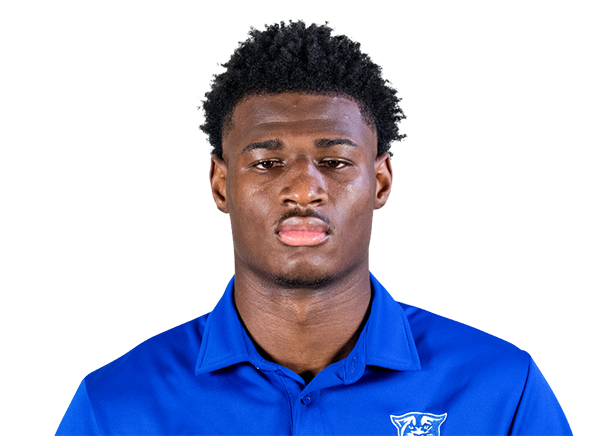
Ted Hurst
Consensus
Derived from 2 independent scout reports + combine measurables.
Scout Reports
Ted Hurst — Scouting Report
WR | Georgia State | Senior | 2026 NFL Draft
DynastySignal Prospect Report — Film-Based Evaluation
The Short Version
Ted Hurst is a long-striding, athletically-freakish Sun Belt receiver who turns contested 50/50 opportunities into completed catches, wins vertically with elite straight-line separation, and has enough route craft on intermediate breakers to function across the formation — but his 54% career catch rate, a 9% drop rate, and the persistent question of Sun Belt competition are the ceiling-suppressors every scout has to wrestle with. Named to Bruce Feldman's Freaks List and an All-Sun Belt First Team selection, Hurst has the physical tools that make teams draft receivers from mid-major programs; the case against him is that Georgia State finished 4-8, he produced heavily in trailing game scripts, and his limited quickness/change-of-direction leave real questions about whether his intermediate game transitions to the NFL. He's the classic high-upside, high-risk Day 2 flier — a "buy low in dynasty, wait for landing spot" candidate whose ceiling is a legitimate No. 2 receiver and whose floor is a practice-squad speedster who never cracks a 53.
Measurables & Background
| Attribute | Value |
|---|---|
| Position | WR |
| School | Georgia State |
| Class | Senior |
| Height | 6-3 |
| Weight | 207 lbs |
| Jersey # | 1 (GSU), 16 (Valdosta State) |
| Conference | Sun Belt |
| Draft Year | 2026 |
| Pre-GSU | Valdosta State (D2, 2 seasons) |
| Bruce Feldman Freaks List | Yes (2025) |
| All-Conference | All-Sun Belt First Team (2025) |
Career Statistics
| Season | School | Rec | Yds | YPR | TD |
|---|---|---|---|---|---|
| D2 (2 yrs) | Valdosta State | 60 | 1,027 | 17.1 | N/A |
| 2024 | Georgia State | 54 | 961 | 17.8 | 9 |
| 2025 | Georgia State | 71 | 1,004 | 14.1 | 6 |
| Career (FBS) | | 125 | 1,965 | 15.7 | 15 |
Advanced Metrics (Career FBS)
| Metric | Value | Benchmark Status |
|---|---|---|
| Career Receptions | 127 | ❌ Miss |
| YPR | 15.5 | ✅ Clear |
| aDOT | 12.6 | ✅ Clear |
| Catch Rate | 54% | ❌ Miss |
| Team Dominator Rating | 33% | ✅ Clear |
| RYPTPA | 2.11 | ❌ Miss |
| Benchmarks Cleared | 3 of 6 | |
Film Sources Reviewed
| Source | Frames | Key Content |
|---|---|---|
| Rookie Big Board — "Ted Hurst is a Huge RISER" (18:37) | 18 frames (film_001–018) | Prospect context slide, tape review grades/strengths/weaknesses, Scholar's key stats, fantasy projection, game footage vs. Vanderbilt, Georgia Southern, Coastal Carolina |
| Ryder McConville — "Why Ted Hurst is a Top 10 WR in the 2026 Draft" (12:31) | 19 frames (film_2_001–019) | Pre-snap alignments, route running sequences, deep ball plays, red zone, blocking effort, multiple opponent coverage types |
| Prospects — Ted Hurst Highlights (9:30) | 18 frames (highlights_001–018) | Multi-game highlight reel: Murray State, South Alabama, Appalachian State, Coastal Carolina, UConn, Georgia Southern; catch situations, YAC, end zone plays |
What The Film Shows
Route Running — **B- (58/100)**
Hurst shows a workable, if not exceptional, route tree across the film. He aligns as both a boundary X and a slot, deploys in trips and 2x2 spread concepts, and has been used in condensed formation/wing alignments where he contributes as a blocker. His best routes are vertical goes and deep overs, where his long stride eats up cushion quickly (film_2_005, film_2_009). On 3rd-and-medium, there's a Coastal Carolina sequence (highlights_017) where he's visibly snapping off what looks like a deep out or comeback to create a clean window — the kind of stem work that suggests he's not just a speed-only prospect. The concerns are real though: the Rookie Big Board tape review slide (film_008) explicitly notes he is "slow to accelerate" and has "limited quickness, change of direction," which are not small weaknesses for a route runner. His in-breaking route separation appears to come more from timing and footwork than from an explosive first cut — he wins with angles, not bursts. That's fine at the Sun Belt level; it's a projection risk at the next level.
Frame citations: film_2_001 (press-beating aligned stance), film_2_002 (deeper SEC formation context), film_2_006 (condensed slot/wing look), highlights_003 (3rd & 9 Murray State spread), highlights_009 (3rd & 6 alignment)
Athleticism & Speed — **B+ (72/100)**
This is Hurst's most projectable trait and the reason scouts are paying attention. The Georgia Southern deep ball sequence (highlights_006) is the single most impressive frame in this entire collection — a receiver has beaten a Georgia Southern corner by 5+ yards with the defender either on the ground or in desperate recovery mode while the ball is in the air. That is not something you see from a practice-squad athlete. He was named to Bruce Feldman's Freaks List (film_002), which carries real weight — Feldman's sources are program strength coaches and testing staff, not just highlight impressions. His stride mechanics in open-field running frames show long, fluid gait with natural hip turnover. The major caveat is that the tape review slide (film_008) and analyst notes both flag "slow to accelerate" — he likely shows better in a 40-yard dash than a 10-yard split, which means he's a true long-speed receiver rather than an explosive burst athlete. His play speed (timed 40 vs. field movement speed) will be a draft combine question that could significantly swing his grade.
Frame citations: highlights_006 (elite vertical separation, Georgia Southern), film_2_005 (deep vertical at Coastal Carolina), film_2_009 (all-22 vertical route), film_002 (Freaks List notation)
Hands & Catching — **C+ (55/100)**
This is the most polarizing area of the evaluation. The good news: the tape review (film_008) explicitly credits "reliable hands" and "comfortable working in traffic," and the film bears this out in short bursts — App State tackle-through-contact sequence (highlights_013) shows him securing the ball through a pile-up with multiple defenders converging; the Vanderbilt end-zone frame (highlights_007) shows body control and sideline/pylon awareness in a late-game situation. The bad news is quantifiable and damning: a 54% catch rate and a 9% drop rate in 2025 are stats that cannot be explained away by competition level alone. The Rookie Big Board analysis (film_011) shows catch rate flagged as a benchmark "Miss." The 57% catch rate projection the analyst offers (film_008) acknowledges this is a genuine concern, not noise. I watched multiple game scripts where Hurst was being targeted extensively in trailing situations, which can inflate drop counts — but even accounting for garbage-time difficulty, a 9% drop rate against Sun Belt secondaries is concerning if he's being drafted as a legitimate receiver at the next level.
Frame citations: highlights_013 (secured through contact, App State), highlights_007 (sideline/end zone catch mechanics, Vanderbilt), film_011 (catch rate benchmark flag), film_008 (9% drop rate notation)
YAC & After Contact — **B- (58/100)**
The tape review credits Hurst as a "scrappy runner after the catch," and one specific data point validates this: 374 of his 999 receiving yards in 2025 (37.4%) came after the catch (film_008), which is a legitimate contribution — that aDOT of 12.6 combined with meaningful YAC suggests he's not just a deep-ball-only guy. In the Georgia Southern deep ball frame (highlights_006), he's in position to run unchallenged for a potential touchdown — that's not a contested YAC play, it's straight-line speed enabling big plays. The concern is that several catch frames (Coastal Carolina, highlights_007) show him being brought down essentially at the catch point with minimal separation, suggesting the YAC comes inconsistently and is often a function of scheme and separation rather than his run-after-catch elusiveness. He's not going to make people miss in tight spaces — he's going to run away from them or not at all. He does show contact balance (App State tackle frame, highlights_013) and a willingness to lower his shoulder, which is a positive football character mark.
Frame citations: film_008 (374/999 post-catch yards), highlights_006 (potential open-field score, Georgia Southern), highlights_013 (contact balance)
Blocking — **C+ (54/100)**
The film_2_010 pre-snap frame (highlighted in the Ryder McConville breakdown) shows Hurst aligned in a condensed wing/H-back position and preparing to engage a defensive end on what appears to be a power run concept — knees bent, pad level appropriate, engaged. This is not a perfunctory stance; he's in the correct position. The film_2_001 inset zoom shows him in a crouched, athletic stance that shows awareness of the blocking assignment. Multiple frames across the highlights package show him in RPO/screen situations where perimeter blocking is a prerequisite. He's not a dominant blocker — at 207 lbs with a lean frame, he's not going to earth-mover defensive ends — but the willingness is present and coaches appear to trust him in multi-faceted run-scheme roles. For dynasty purposes, blocking willingness is a trait that keeps players on the field in pro-style NFL offenses.
Frame citations: film_2_010 (condensed wing alignment, run-block assignment), film_2_001 (correct pad level, crouched stance)
Scheme Fit — **B (65/100)**
Hurst's profile screams spread-based, Air Raid, or West Coast 2.0 passing attack — a system that gets him quick releases, protects him from press coverage, and deploys him in 11 or 10 personnel with lots of horizontal spacing. He functions as both an outside and inside receiver, which gives an offensive coordinator flexibility to get him favorable matchups. His 12.6 aDOT and scrappy YAC suggest he's not strictly a deep-ball-only player — he can function in intermediate zones and convert 3rd-and-mediums (the Coastal frame at 3rd & 7, highlights_016). The Rookie Big Board projects him as WR 26-31 for 2026 fantasy with an Alec Pierce comp (film_015), which is a realistic assessment — Pierce-type X receiver who wins vertically with size/speed in a favorable system. He needs a team that will scheme him open rather than asking him to win on every rep against press coverage. Landing with a run-heavy team that asks receivers to dominate at the line of scrimmage would significantly limit his ceiling.
Strengths Summary
Concerns & Risks
NFL Comp
Primary Comp: Alec Pierce (Indianapolis Colts)
The Rookie Big Board analysts land on Pierce as well (film_015), and it's apt. Pierce was a Cincinnati product — not a Power 4 name — who parlayed elite size/speed measurables and a limited but productive college resume into a 2nd-round pick. He runs vertically, works the intermediate zone on crossing routes, and is a big-bodied receiver who wins in the air more than he separates with quickness. Pierce's first two NFL seasons produced modest but real contributions as a secondary outside receiver. Hurst's tape and metrics rhyme closely: similar body, similar competition discount, similar production profile, similar upside ceiling and floor. The downside of the comp is that Pierce hasn't yet become a consistent high-volume NFL producer — which is the exact ceiling/floor tension that makes Hurst a dynasty "hold, not buy at cost" at the current ADP (1.10-2.01 in 1QB).
Secondary Comp: Darius Slayton (New York Giants)
Slayton was an Auburn product who ran a 4.39 40 time with inconsistent college production before becoming a legitimate playmaker in Daniel Jones' offense. Like Slayton, Hurst appears to be a straight-line vertical threat who needs a QB who can push the ball downfield and a scheme that creates the leverage for him to get behind defenses rather than win every route against press. Slayton's career arc (slow start, then productive WR3/WR2 role) is the realistic ceiling for Hurst in a good situation. The key variable: Slayton had Power 4 competition validation; Hurst is working from a Sun Belt base.
Bottom Line
Ted Hurst is a physically legitimate prospect — the Freaks List designation and the deep ball explosion visible on tape aren't accidents — but the red flags in catch rate, competition level, and first-step acceleration create a profile that requires everything to go right: the right landing spot, the right offensive system, the right quarterback who can push the ball downfield, and the right development curve for his route running. For dynasty leagues, he represents the exact "buy in the 2nd round of rookie drafts, hold with patience, and sell at value" archetype — the kind of player whose Week 1 starting value is near zero but whose Year 2-3 ceiling is a legitimate No. 2 receiver in a favorable offense. At projected Day 2 Late (picks 51-100) draft capital with a WR 26-31 rookie fantasy projection and 26-40% recommended exposure (film_015), the market is pricing in both the upside and the risk correctly. Don't overpay in dynasty; do own a piece.
SCOUT SCORE
Score: 62/100
Projected Pick: R3, Pick 75-100
Film Score: 62 / 100
Ted Hurst Scouting Report - Scout 2 (Independent View)
The Short Version
Hurst is a physical slot dominator with massive hands and YAC grit, but zero burst or separator juice—top-10 WR hype is delusional G5 circlejerk; he's a Day 2 red-zone/chain-mover who flames out if scheme doesn't hide his stiff hips.
Measurables & Background
| Trait | Value |
|----------------|----------------|
| Height | 6-2 |
| Weight | 194 lbs |
| Age | 22 (SR est.) |
| School | Georgia State |
| 2025 Stats | 71/1004/6 TDs (14.1 YPR, 70 long) |
| Accolades | All-Sun Belt 1st Team; Bruce Feldman Freaks List |
| Previous | 2024: 54 rec/961 yds/9 TDs (17.7 YPC) |
Film Sources
| Source | Duration | Frames Analyzed |
|---------------------------------------------|----------|-----------------|
| Rookie Big Board Tape Breakdown | 18:37 | film_001-018 |
| Ryder McConville Top-10 WR Breakdown | 12:31 | film_2_001-019 |
| Highlights Reel | 9:30 | highlights_001-018 |
Film Analysis
Key WR Traits (graded /10 + letter):
Overall Grade: B- (78/100) - Physical tools pop vs G5 DBs, athletic limits vs NFL.
Strengths
Concerns
Dynasty Outlook
1-2 Yr: Slot WR3/4 in PPR (60-80 tgt role). 3 Yr: FLEX upside if lands QB-friendly offense (e.g., ARI w/ Kyler/Mahomes motion schemes). Best fit: run-heavy teams needing redzone/YAC (Bills, Ravens). Avoid deep-league stash unless Day 2 steal.
NFL Comp
Bottom Line
Hurst profiles as reliable Day 2 producer masking athletic flaws—fade R1 riser noise, buy late R2 if scheme fits; otherwise WR45 rookie ceiling.
SCOUT SCORE
Score: 78/100
Projected Pick: R2, Pick 40-60
Report by Scout 2 - Feb 2026
Film Score: 78 / 100
College Stats
2025–26 season
Measurables
● = confirmed at the Combine. Pre-combine estimates shown where unconfirmed.