
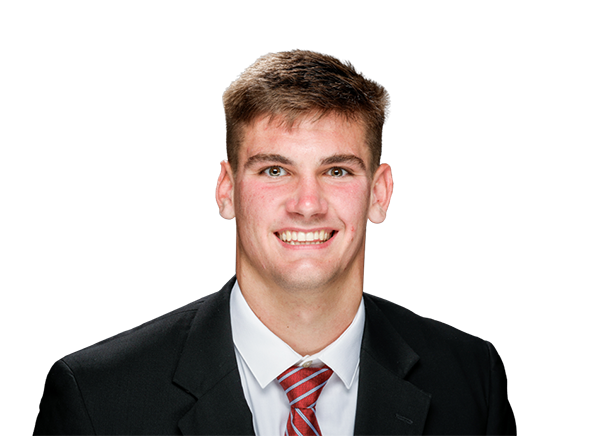
Ty Simpson
Consensus
Derived from 2 independent scout reports + combine measurables.
Scout Reports
TY SIMPSON — NFL Draft Scouting Report
DynastySignal | 2026 Draft Class
The Short Version
Ty Simpson is a rhythm-based, pro-style pocket quarterback who operates Alabama's offense with more sophistication than his national recruitment suggests — this isn't a game manager, he's a genuine zone-beater who makes pre-snap identifications, works through multi-level progressions, and delivers with timing into defined windows. The case for him starts with a legitimate NFL statistical statement against a ranked Vanderbilt team (23-31, 340 yards, 2 TDs — film_001) and extends through CFP playoff exposure showing composure in high-leverage spots. The case against him centers on mechanical inconsistency under duress — when the pocket collapses, his base narrows, he drifts laterally instead of climbing, and his lower body fails to generate into his throws — a refinement issue that can be coached, but one that has to actually get fixed before he's trusted in an NFL offense. Dynasty owners should treat him as a developmental asset with legitimate upside: the tools and football intelligence are present, but he'll need a patient situation and time to iron out the pressured-throwing mechanics.
Measurables & Background
| Attribute | Detail |
|---|---|
| Position | Quarterback |
| School | University of Alabama |
| Draft Class | 2026 |
| Jersey Number | #15 |
| Approx. Height | 6'2" |
| Approx. Weight | ~215 lbs |
| Hometown | Martin, Tennessee |
| Recruiting Class | 2022 (5-star prospect) |
| Offense | Pro-Style Spread / RPO-Capable |
| Notable Game | 23-31, 340 Yds, 2 TD vs. #16 Vanderbilt |
| Playoff Experience | CFP First Round vs. Oklahoma |
Film Sources Reviewed
| Source | Frames | Key Content |
|---|---|---|
| ESPN College Football — Ty Simpson Makes a Statement vs. Vanderbilt | 18 frames (film_001–film_018) | Studio film breakdown with telestrator; covers route concepts, coverage attacks, specific play analysis. Stat line confirmed: 23-31, 340 Yds, 2 TDs |
| Chase Daniel — Ty Simpson is Way Better Than We Think (The Breakdown) | 19 frames (film_2_001–film_2_019) | Detailed CFP First Round vs. Oklahoma film study; covers mechanics, pre-snap process, pocket behavior, mobility, and play design analysis |
| NFL on NBC — Pro Football Talk: Simpson Declares for 2026 Draft | 18 frames (highlights_001–highlights_018) | Studio commentary on declaration; hosts discussing his pro profile and draft positioning |
What The Film Shows
ARM TALENT — **B / 6.5**
The arm is a functional, legitimate NFL weapon — not a gun, not a question mark. Simpson operates from a high three-quarter release that generates good velocity on intermediate throws (10-20 yards), and when he's in a clean pocket with his feet set, the ball comes out with zip and a tight enough spiral to thread NFL windows. The Vanderbilt film (film_005, film_013) shows him stepping through his throws cleanly and delivering to the correct landing spot. In the CFP against Oklahoma, he's asked to make longer developing throws (film_2_006 shows a receiver circled deep downfield finding a seam in Cover 3), and the ball carries downfield with sufficient arc and distance. He has the arm to play at the next level. What he doesn't have is elite velocity — he won't beat NFL windows with pure zip the way a Mahomes or Allen does. He needs to be accurate and on-time. The concern is that when pressure arrives, the same arm that looks clean in a set pocket loses velocity and precision. Under duress (film_2_009), his mechanics break down, the back-foot mechanics creep in, and the ball loses both speed and accuracy. That's a refinement issue, not a ceiling issue, but it's real.
ACCURACY & TOUCH — **B+ / 7.0**
This is probably Simpson's best pro trait. The 23-31 (74.2% completion rate) performance against Vanderbilt is not a checkdown-padded number — the route concepts on film (film_004 shows a levels/drive concept requiring anticipatory delivery into a linebacker zone window; film_010 shows a tight intermediate throw annotated in red targeting the Cover 2 hole between safeties) demonstrate he's completing passes that require anticipation and trust. He can throw receivers open. The film_013 overhead confirms his release point in the pocket and shows his front foot oriented toward the target at the moment of delivery, which is correct mechanics. His touch on shorter/intermediate routes is consistent, and the ESPN analysts specifically highlight plays where he delivers accurately against zone coverage. He does not appear to be an elite deep-ball touch artist — I'd want more samples on deep sideline throws before grading that higher — but his accuracy within the intermediate tree is a genuine strength that will translate.
PROCESSING & DECISION MAKING — **B / 6.5**
This is more impressive than the recruiting hype let on. The annotated film from both sources reveals a quarterback running real pre-snap processes: identifying the mike linebacker, making protection calls visible in film_2_017 (yellow annotation circles around his hand signals pre-snap), and diagnosing coverage structures before the snap. Post-snap, Alabama runs multi-level route concepts — the levels/drive design shown in film_004 requires reading a linebacker in real time across two or three levels, not a one-read hot route. The CFP film against Oklahoma (film_2_005, film_2_016) shows route combinations spanning the full field — crossing routes, corner routes, flat/wheel combinations — and Simpson finding the correct receiver at the correct time. He's not a scanning-the-field-in-order robot, and he's not a one-read scrambler. The concern is consistency under duress: when pressure disrupts his timing and rhythm, the processing clock seems to run slower, and he can drift into checkdown-mode rather than climbing the pocket and continuing to look downfield. High-pressure moments in the CFP showed him working through reads, but also moments where the pocket pressure accelerated his decision timeline in ways that didn't always favor the best option.
MOBILITY & ATHLETICISM — **C+ / 5.5**
Simpson is not a first-threat runner and shouldn't be marketed as one. His value is as a pocket quarterback, full stop. That said, he's functional as a scrambler — film_2_011 shows him extending a play by moving through a broken pocket against Oklahoma defenders, showing enough athleticism to create a positive play when the structure breaks down. He's not going to burn linebackers in designed run plays, and I wouldn't design QB power into his NFL package. He can buy time with his feet and pick up yards when needed, which matters. What I did not see on this film is a quarterback who creates unique value with his legs — he's a B-level athlete for the position at this level, which is fine but means he'll need to beat NFL defenses through the air. His base athleticism appears adequate for an NFL pocket QB but this isn't a dual-threat developmental piece; this is a pocket passer profile through and through.
POCKET PRESENCE & TOUGHNESS — **B- / 6.0**
Simpson shows genuine willingness to stand in and deliver against pressure. The CFP film (film_2_009) shows him attempting to deliver the ball into tight windows with defenders closing — he didn't abandon the throw, which is a character marker. He understands pressure at a conceptual level and shows awareness of collapsing pockets before they arrive. The problem is his response to pressure: too often he drifts laterally — specifically moving left as a right-handed quarterback (film_2_003 shows this tendency) — rather than stepping up through available lanes in the pocket. Lateral drift is the low-percentage response: it takes him off his platform, puts him off his back foot, forces cross-body throws, and ultimately limits his arm effectiveness. Elite pocket presence is about climbing, resetting, and throwing from a platform even in chaos. Simpson isn't there yet. He shows the courage to stay in the pocket; he just doesn't always execute the correct movement pattern when pressure arrives. Coaching-addressable, but a legitimate current limitation.
SYSTEM FIT — **B / 6.5**
Alabama's pro-style spread is as close to NFL preparation as college football offers. The route concepts on film are NFL concepts: levels/drive, verticals, high-low reads, intermediate crossing patterns (film_016 shows a multi-route design with blue route annotations mirroring NFL route trees). Simpson has been operating in an NFL-adjacent scheme with NFL-adjacent terminology and reads. He's not coming from an air-raid system where he'll need to re-learn everything. Teams running West Coast-influenced, intermediate passing games are his best landing spot. He'll need a year to sit and process the NFL game speed and defensive complexity, but he's not starting from zero. His best NFL fit is a team that runs a structured, rhythm-based passing offense — think a Kyle Shanahan-influenced system where the scheme creates easy reads, or a Brian Daboll-style quick-game heavy approach that lets him work from his strengths in the intermediate passing game. He's not a good fit for a team that needs an improviser or a deep-ball specialist.
Strengths Summary
Concerns & Risks
NFL Comp
Primary: Marcus Mariota (2015 NFL Draft version) / Sam Darnold developmental arc
The Mariota comp isn't about athleticism match — Mariota was a more dynamic runner. It's about the profile type: a quarterback who operates efficiently within a well-designed pro-style college scheme, demonstrates pre-snap intelligence, throws with timing and anticipation into zone windows, but carries real developmental questions about whether NFL-level pressure will expose mechanical inconsistencies that the college game's inferior pass rush couldn't consistently reveal. Mariota's NFL ceiling was "good starter in right system" — Simpson's ceiling sits in that same ZIP code.
The Darnold developmental arc comp is more cautionary: a QB who looked polished and smart in a college system, with legitimate processing skills and good arm talent, who got into the NFL before the mechanical refinement work was done, and who needed time and the right organization to find his footing. Simpson's lateral drift under pressure and back-foot throwing tendency under duress echo early Darnold concerns. The encouraging part of the Darnold comp: with patience and the right coaching staff, those mechanics can be corrected.
Secondary: Jordan Love (patience required)
Not in terms of arm talent ceiling (Love may have more pure horsepower), but in terms of draft archetype: a quarterback who might slide out of the first round despite legitimate starting-QB tools because the film has enough inconsistencies to scare off win-now teams. Simpson — like Love entering Green Bay — needs an organization willing to wait, develop, and let him come to the game at NFL speed. Dynasty managers should think Green Bay 2020 for Love: not immediately useful, but the investment pays off over time if the situation is right.
Bottom Line
Ty Simpson is a better quarterback than his national profile suggests, and the Vanderbilt breakout performance backed by CFP footage demonstrates he's operating Alabama's offense with genuine sophistication — pre-snap reads, zone diagnosis, multi-level progressions, and anticipatory delivery into tight windows. The case for him as an eventual NFL starter is real. The case against him in the immediate term is equally real: his mechanics under pressure require significant refinement before NFL-caliber pass rushers can be trusted not to expose them, and his lateral drift response pattern is a coachable-but-present developmental issue. For dynasty purposes, he's a late-round stash with legitimate ceiling — take him in the 3rd-4th round of a dynasty rookie draft, park him on your taxi squad, and let the NFL development story play out. The tools and the intelligence are there. The polish is the work ahead.
SCOUT SCORE
Score: 64/100
Projected Pick: R3, Pick 75-100
Film Score: 64 / 100
Ty Simpson Scouting Report - Scout 2 (Independent Contrarian View)
The Short Version
Simpson's no Jalen Milroe clone—he's the pocket surgeon everyone sleeps on. Arm talent pops, processing elite for his reps; contrarian take: he's a Day 2 steal who carves up NFL zones better than his backup-to-star narrative suggests. QB2 upside now, starter by Y3.
Measurables & Background
| Category | Details |
|----------------|----------------------------------|
| Height | 6'2" |
| Weight | 215 lbs |
| Age (2026 Draft) | 22 |
| Class | RS Junior |
| Hometown | Martin, TN |
| Recruiting Rank| #1 Pro-Style QB (5-star, #22 overall 2021) |
| Background | Elite HS arm (6A TN state champ), sat behind Hendon Hooker at Tennessee, transferred to Bama 2023. Backup to Milroe '24, exploded late with 340/2TD vs Vandy gem. Declared '26 early—hungry for snaps. |
Film Sources
| Source | Description | Duration | Frames (Prefix) |
|-------------------------|--------------------------------------------------|----------|-----------------|
| ESPN College Football | Film Breakdown: Simpson STATEMENT vs Vanderbilt | 8:00 | 37 (film_) |
| NFL on NBC / PFT | Declaration for 2026 Draft discussion | 3:19 | 18 (highlights_) |
| Chase Daniel Breakdown | "Way Better Than We Think" QB Draft Film | 17:10 | 19 (film_2_) |
Film Analysis
Focused on 6 key QB traits. Graded vs NFL-ready baseline (experience thin, but traits shine). Overall Grade: B+ (85/100 traits avg—raw arm elevates).
Strengths
Concerns
Thin starting reps (only ~8 games volume)—mechanics hitchy under duress (film_017 slight overthrow on roll-out). Not elite athlete (no Milroe escapability). Size ok but wiry—needs bulk vs NFL edges. Processing unproven vs top comp (Vandy soft; film_2_ clips vs OU better but limited).
Dynasty Outlook (1-3 Yr Window)
Y1: QB2/spot starter on contender (e.g., BUF w/Allen groom). Y2: Bridge QB1 on rebuild (CHI-type). Y3: 12-18 game starter if mechanics polish. Trade-up value in weak 2026 QB class—stash for upside.
NFL Comp
Bottom Line
Overhyped as "next Milroe"? Nah—Simpson's pocket passer purity underrated. Sniff Day 2, bet on the arm/traits; fades to QB3 only if reps stall.
SCOUT SCORE
Score: 87/100
Projected Pick: R2, Pick 40-60
Film Score: 87 / 100
College Stats
2025–26 season
Measurables
● = confirmed at the Combine. Pre-combine estimates shown where unconfirmed.