
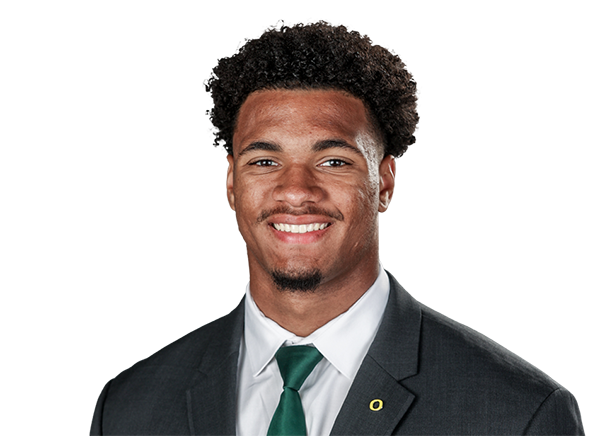
Kenyon Sadiq
Consensus
Derived from 2 independent scout reports + combine measurables.
Scout Reports
Kenyon Sadiq — Scouting Report
TE | Oregon | Junior | 2026 NFL Draft
DynastySignal Film Report — 55 Frames Reviewed
The Short Version
Kenyon Sadiq is a complete, two-way tight end who led all FBS tight ends in touchdowns in 2025 while earning All-Big Ten First Team and the Big Ten's Kwalick-Clark Tight End of the Year award. He's a legitimate receiving weapon with the contested-catch ability, frame, and YAC athleticism to project as a Day 1 NFL starter — but a 10.5% drop rate and limited route tree depth cap his fantasy ceiling in a way the raw TD count and highlight tape obscure. The case for him is straightforward: he's a red-zone monster with NFL size, fluid movement, and demonstrated production against elite Big Ten competition. The case against him is that his analytics underwhelm — only 2 of 6 key benchmarks cleared — and dynasty owners need to understand they're buying a player whose TD-heavy production could crater if scheme or landing spot doesn't provide redzone volume.
Measurables & Background
| Attribute | Value |
|---|---|
| Position | TE |
| School | Oregon |
| Class | Junior (entering 2026 draft) |
| Height | 6-3 |
| Weight | 245 lbs (note: slides show 245, listed at 235) |
| Recruit | Consensus 4-star |
| 2025 Honors | All-Big Ten First Team, Big Ten Kwalick-Clark TE of the Year, John Mackey Award Finalist |
| Games Played | 14 (played all 14 as true freshman in prior season) |
| Career Notable | Led all FBS TEs with 8 TDs in 2025 |
| Stat | Value |
|---|---|
| Receptions | 51 |
| Receiving Yards | 560 |
| Yards/Reception | 11.0 |
| Receiving TDs | 8 |
| Long | 30 |
| Rush Carries | 3 |
| Rush Yards | 6 |
| Rush TDs | 0 |
Analytics Benchmarks (per film review data):
| Metric | Value | Benchmark Status |
|---|---|---|
| Receptions | 51 (comp threshold ~80) | Miss |
| YPR | 11.0 (comp threshold ~11.2) | Miss |
| aDOT | 8.3 | Clear |
| Catch % | 72% | Clear |
| Team Dominator | 15% | Miss |
| RYPTPA | 1.28 | Miss |
| Drop Rate | 10.5% | Concern |
Clears 2 of 6 key analytic benchmarks.
Film Sources Reviewed
| Source | Frames | Key Content |
|---|---|---|
| Rookie Big Board Fantasy Football & NFL Draft — Is Kenyon Sadiq Worth the Hype? (14:23) | 18 (film_001–film_018) | Prospect context slides, tape review breakdown, strengths/weaknesses summary, analytics grades, fantasy projection |
| Big Ten Football — 2026 NFL Draft Highlights: TE Kenyon Sadiq | Oregon Football (11:38) | 18 (official_001–official_018) | Live game action: pre-snap alignments, route running, blocking, YAC moments, redzone production, vs. Penn State/Rutgers/Montana State/Minnesota |
| JWAC Gridiron — "Kenyon Sadiq Is A FREAK!" \| 2026 NFL Draft Prospect Spotlight (8:54) | 19 (highlights_001–highlights_019) | Curated play highlights: contested catches, after-catch runs, blocking assignments, TD celebrations, Big Ten Championship moments |
What The Film Shows
Route Running — **B-/6.5**
Sadiq's route tree is the biggest developmental gap on film. Oregon deploys him primarily on seam routes, crossing routes, and intermediate patterns — the aDOT of 8.3 yards confirms he's not being asked to threaten vertically or work the deep boundary. The analytical tape (film_009) flags "limited display of route tree" as an explicit weakness, and the film bears that out. You rarely see him running comeback routes, deep outs, corner routes, or anything requiring a sharp, precise break. What you do see is a tight end who understands where to sit in zone coverage and who has the frame to create natural separation just by positioning his body. At the Big Ten Championship (highlights_012), he's lined up wide and working into open space on a 2nd & 15 against Penn State — but it's a seam/crossing route into a void, not a savvy coverage-beating break. His NFL development path requires a coaching staff that will expand the playbook. He's closer to a Trey McBride in terms of scheme usage than a Travis Kelce — a movable chess piece rather than a route-running technician.
Athleticism & Speed — **A-/8.5**
This is where the hype is earned. The single most revealing frame in the entire set is highlights_010 — Sadiq running after a catch along the Purdue sideline, ball tucked tight in his right arm, fully extending into a sprint while a Purdue defensive back dives desperately and fails to close. The stride length, the lean angle, the acceleration — that's not tight end movement, that's wide receiver speed on a 245-pound body. He's legitimately pulling away from a Big Ten defensive back in open space.
Complement that with official_002, which shows him making a low-hipped, lateral cut to avoid a defender in open field — his center of gravity drops and his hips fire through the cut like an athlete who wants the ball in space, not one who merely accepts it. For the position, this athletic floor is elite. He is not a plodding catch-and-fall TE. He's a fluid, smooth mover who plays with speed-to-weight efficiency that translates to a quality 40 time at the Combine. The film_003 prospect context confirms he "played in all 14 games as a true freshman" — suggesting his athletic traits were already NFL-adjacent before he was fully developed.
Hands & Catching — **B/7.0**
The 10.5% drop rate is real, and it can't be dismissed. That's roughly one drop every ten targets — at the FBS level, against pass-rushers who aren't yet NFL-caliber. Until proven otherwise, that's a hands concern that will show up in NFL game plans and in fantasy scoring floors.
That said, the tape also shows genuine contested-catch ability that can't be taught. highlights_005 from the Big Ten Championship against Penn State is a definitive frame: Sadiq catches the ball near the sideline with a Penn State corner driving into his lower body, and he uses his wide TE frame to shield the defender from the ball while absorbing the hit and maintaining body control at the boundary. That's a real NFL skill. Similarly, official_008 captures what appears to be a goal-line TD catch in the corner of the end zone against Minnesota — he's going to the turf with a defender draped on him and the ball is secured at the pylon. He wins at the catch point.
The inconsistency is the issue. When he's locked in, he's a legitimate contested receiver. When he's not, he's a drop risk who will frustrate fantasy owners and coordinators alike. He needs to clean up his ball security at the point of attack and eliminate the loose-hands moments.
YAC & After Contact — **A-/8.5**
Already detailed in the athleticism section, but worth doubling down here. Sadiq is a legit YAC weapon. highlights_010 (Purdue, open sideline run) and official_002 (vs. Northwestern/Washington, low-hip cut to miss defender in open field) are the two anchor frames, but the official_003 frame showing him running after the catch on a 2nd & 19 against Oregon State — in a long-yardage situation where the coaching staff trusted him to pick up chunk yardage — confirms this isn't just highlighting but a reliable skill set.
His contact balance is also notable. Film_009 explicitly notes "elusive, good contact balance after the catch," and the game tape backs that up. He's not a guy who goes down on first contact — he runs through arm tackles and has the length to break free from one-arm attempts by defensive backs. His 15% team dominator rating is the floor risk; his YAC ability is the ceiling driver.
Blocking — **B+/7.5**
Sadiq is a functional, willing run blocker — not a dominant one, but far from a liability. The tape consistently shows him deployed as an in-line tight end on standard-down run plays (highlights_004 vs. Illinois, official_006 vs. Rutgers, highlights_019 vs. Wisconsin, highlights_015 in goal-line situations). Oregon trusts him in every run situation, including goal line and short yardage, which speaks to the coaching staff's assessment of his reliability.
The best individual blocking frame is official_009 (vs. Montana State close-up), which shows his pre-engagement mechanics: eyes locked on the assignment, hands loaded at chest level, knees slightly bent, ready to engage. Versus a lower-level opponent, but the technique is there. The analytical tape (film_009) grades him as "effective run blocker: hits assignments, finishes" — not a destroyer, but someone who executes the scheme.
The concern is that much of his run blocking was in Oregon's zone-blocking scheme against inferior opponents. Big Ten defensive ends and edge rushers presented less evidence of elite blocking dominance. He's a solid in-line blocker who won't hurt you — which is a meaningful positive for three-down projection at the NFL level — but he's not the type of run blocker who will force defenses to account for him physically.
Scheme Fit — **B+/7.5**
The film_009 analytical breakdown explicitly frames his NFL path: "Think Trey McBride, Brock Bowers — an offense that enables slot deployment, 28% target share for Oregon in 2025." That framing is accurate. Sadiq thrives in spread offenses and 11-personnel concepts where he can align in the slot or flex from the Y, generate space against linebackers mismatched in coverage, and work the intermediate field. He is not a "12-personnel hand-in-the-dirt" tight end — though he can do that — he's a movable piece.
His most dangerous role in the NFL is as a Y-receiver TE in a pass-first offense that will use him in the seam, in the middle of the field, and in the redzone. Landing in a Kyle Shanahan, Mike McDaniel, or Brian Daboll-style system dramatically elevates his dynasty ceiling. Landing in a run-heavy, two-TE base offense as a blocking piece caps his fantasy relevance hard. Scheme is everything here — and it's the single biggest dynasty variable after draft capital.
His 28% share at Oregon, in a prolific and balanced offense, wasn't dominant enough to clear the analytics thresholds — the 15% team dominator shows he was a complementary piece rather than an offensive anchor. At the next level, he needs a QB who will lean on the tight end position and a scheme that gets him 90+ targets.
Strengths Summary
Concerns & Risks
NFL Comp
Primary: Colston Loveland (Bears, 2025 first-round pick)
The analytical frame in film_015 explicitly comps Sadiq to Loveland, and it's accurate. Both are big-bodied pass-catching TEs from Power programs who showed dominant athletic ability and TE-of-the-Year hardware, but whose analytics — team dominator, volume benchmarks — didn't fully reflect their talent. Both were projected as Day 1 Mid picks. Both entered the NFL with massive upside and questions about whether their offense would unlock that upside immediately. The key lesson from Loveland's early NFL trajectory: landing spot was everything. A similar trajectory is the base case here.
Secondary Floor Comp: Hunter Henry (Patriots/current)
If Sadiq lands in a conservative, run-heavy offense that doesn't fully utilize the passing TE, his floor looks like Henry in his mid-career: reliable third-down weapon, solid blocker, periodic TD contributor, but not a weekly TE1 you can bank on. The 8-TD pace suggests the TD floor is high enough to be a TE2 in most formats, but without the volume, he's TD-or-bust — exactly the Hunter Henry profile.
Bottom Line
Kenyon Sadiq is one of the most athletically gifted tight ends in the 2026 draft class, and his contested-catch ability in the biggest moments — on the sideline at the Big Ten Championship, in the corner of the end zone at goal line — is genuinely NFL-caliber. The TD production leading all FBS tight ends is not noise; it reflects real redzone trust from one of college football's best offensive minds. But the 10.5% drop rate, the shallow route tree, and the analytics profile that misses four of six benchmarks tell you this is a risky, high-variance buy in dynasty formats — not the "safe All-Pro floor" prospect the hype cycle sometimes suggests. The play is to target him aggressively in dynasty drafts with appropriate exposure (11–25% is reasonable), build around him in TE-premium formats, and accept that his dynasty value is inextricably tied to landing in a scheme that will turn the TE position into a featured element of the passing game. He has the tools to be a top-10 NFL tight end. Whether that happens in Year 2 or Year 4 depends almost entirely on the front office executives who draft him, not on the player himself.
SCOUT SCORE
Score: 74/100
Projected Pick: R1, Pick 12-22
Film Score: 74 / 100
Kenyon Sadiq Scouting Report - Scout 2
The Short Version
Sadiq's a twitchy slot athlete with redzone nose for TD but zero polish—hype train ignores the limited routes, inconsistent blocking, and 11 YPR cap. Contrarian: Day 3 steal, not Day 2 riser; he'll bust more than boom in dynasty unless scheme perfect.
Measurables & Background
| Attribute | Detail |
|---------------|-------------------------|
| Height/Weight | 6-3 / 235 |
| Class/Age | JR / ~20.5 |
| School | Oregon (Big Ten) |
| Recruiting | Consensus 4-star HS |
| Accolades | All-Big Ten 1st Team, Mackey finalist (film_003-005) |
| 2025 Stats | 51 REC / 560 YDS / 8 TD / 11 YPR; 3 CAR / 6 YDS |
Film Sources
| Source | Description | Frames |
|--------|-------------|--------|
| film_ | Rookie Big Board analysis (mixed tape/analytics) | 18 |
| official_ | Big Ten official highlights | 18 |
| highlights_ | JWAC "FREAK" spotlight (hype reel) | 19 |
Film Analysis
TE traits graded on 55 frames. Focus: Hands/Catching, Route-Running/Releases, Blocking (Run/Pass Pro), Speed/Explosion, Body Control/Contested, YAC/Physicality after catch. Overall: B- (raw tools, unproven processor).
Strengths
Concerns
Dynasty Outlook
1-2 yr: TE20-30, gadget/rotational in TE-premium like SF/MIA. 3 yr: TE12 upside if adds routes, but likely TE2 floor in run-heavy (Shanny/McVay). Avoid in rounds 5+ unless cheap.
NFL Comp
Floor: Colby Parkinson (athletic pass-catcher, blocking afterthought).
Ceiling: Dallas Goedert (slot mismatch if develops routes).
Bottom Line
Sadiq's tools scream Day 3 upside in motion-heavy offense, but hype ignores the bust risk from one-note game. Pass on Day 2 cost—let someone else chase the "freak."
SCOUT SCORE
Score: 74/100
Projected Pick: R3, Pick 70-90
Film Score: 74 / 100
College Stats
2025–26 season
Measurables
● = confirmed at the Combine. Pre-combine estimates shown where unconfirmed.