
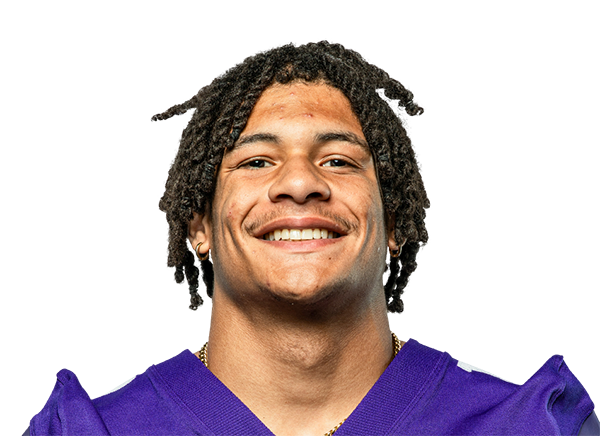
Denzel Boston
Consensus
Derived from 2 independent scout reports + combine measurables.
Scout Reports
Denzel Boston — WR Scouting Report
DynastySignal | 2026 NFL Draft
The Short Version
Denzel Boston is a big-bodied X-receiver who wins through physicality, size, and elite hands at the catch point — not through route sharpness or burst. He's a legitimate red zone weapon who consistently went up and got the ball over defenders throughout a full Big Ten schedule, posting an 87.1 PFF grade and ranking 6th in touchdown production among the top 30 WRs in this class. The case for Boston is straightforward: 6'4", 209 lbs, elite contested-catch ability, prototypical frame for the role, and proven production against Power Five competition. The case against is equally clear: he isn't a separator, his YAC is well below average for the position, and he doesn't have the route sharpness to survive as more than a secondary target unless he lands in a scheme that maximizes his size. Dynasty ceiling is likely WR3, but that's a useful and durable NFL starter.
Measurables & Background
| Attribute | Value |
|---|---|
| Position | WR (X/Outside) |
| School | Washington (Big Ten) |
| Class | RJR (Junior) |
| Height | 6'4" (per scouting report card; 6'3" per prospect profile) |
| Weight | 209 lbs |
| Jersey # | 12 |
| Alignment | 81–87% wide, 12–18% slot (primarily outside) |
| 2025 Receptions | 62 |
| 2025 Yards | 881 |
| 2025 YPR | 14.2 |
| 2025 TDs | 11 |
| 2025 Long | 78 |
| 2025 PFF Grade | 87.1 |
| 2025 ADOT | 14.0 |
| 2025 Drop % | 2% |
| 2025 YAC/Rec | 4.4 |
| Career TDs | 19 (0 in 2023, 9 in 2024, 10 in 2025) |
| Notable Games | Weber St, Northwestern, Iowa, Michigan, Illinois, Oregon, UCLA, WSU, Rutgers |
> Height discrepancy noted: The prospect profile lists 6'3" but the NFL Draft Big Boards scouting report card (highlights_003) clearly indicates 6'4". Film evidence supports the larger measurement based on how Boston sizes up against defenders.
Film Sources Reviewed
| Source | Frames | Key Content |
|---|---|---|
| NBC Sports — Big Ten Film Breakdown (Connor Rogers) | 18 (film_001–film_018) | Analyst breakdown with field clips; route tracking, contested catches vs Utah/Rutgers/WSU; after-contact footage; red zone targets |
| Big Ten Football — 2026 NFL Draft Highlights | 18 (official_001–official_018) | Game clips across full 2025 schedule; Weber St, Northwestern, Iowa, Michigan, Illinois, Oregon, UCLA, Colorado St; high-point catches, TD celebrations |
| NFL Draft Big Boards — Rookie Scouting Report | 19 (highlights_001–highlights_019) | Talking-head analyst review; full production/PFF data table; trait grades; dynasty/draft capital projections |
What The Film Shows
1. Route Running — **B / B+**
Boston's route tree is functional but limited. Film shows him aligned almost exclusively outside (81–87% wide per highlights scouting card) running fades, go routes, back-shoulder throws, and intermediate out/comeback routes. He doesn't show crisp, sudden breaks — the scouting card grades him B+/B (two graders), and that feels right. What he does well is setting up defenders at the stem, using his size to position his body, and attacking the football at the top of the route. You won't confuse this for Davante Adams' footwork, but he creates enough functional separation to operate. He shows decent downfield tracking in film_004 and official_008. His best route evidence is the completely uncovered deep route vs Illinois (official_016), suggesting he can stack defenders when the scheme creates the right leverage. The limiting factor for dynasty upside: route sharpness is where NFL corners will challenge him hardest, especially on shorter breaking routes vs man coverage — which the scouting card identifies explicitly as a weakness (highlights_003).
2. Athleticism & Speed — **B / B+**
Boston isn't a burner. The film never shows an elite timed speed moment — no one is chasing him from 10 yards behind like you see with true 4.3 guys. What he does have is functional long speed (official_015 shows a smooth, controlled stride downfield vs Weber State, pulling away from trailing coverage), and legitimate vertical explosion. The Weber State high-point catch (official_001) is the single most impressive athletic display in the film: he goes up 2+ feet off the ground while absorbing contact from a trailing defender, perfectly extended, attacking the ball at its apex. That's a combination of vertical jump, timing, and body control that translates directly to the NFL. The PFF speed grade isn't elite (B/B+), and that tracks. He's likely a 4.45–4.52 40 guy at the Combine — fast enough for outside, not a separation artist.
3. Hands & Catching — **A / A+**
This is the separator. Boston's catch rate and hands are the best thing on his tape. A 2% drop rate on 14.0 ADOT is genuinely elite — he's catching deep balls cleanly and consistently. Multiple frames document his ability to pluck the ball from the air in contested situations: the Iowa end zone catch (official_006), the WSU back-of-end-zone TD (film_012, film_014), the Illinois contested red zone catch (official_017), the Northwestern sideline boundary catch (official_003), and the Weber State high-pointer (official_001) all showcase reliable hands under contact or in confined spaces. He attacks the ball — he doesn't let it come to him. His hands work independently of his frame on high catches, which is the mark of a natural pass-catcher rather than a body-catcher. PFF grades Ball Skills & Hands at A+/A. That assessment is accurate based on what the film shows. His CTC% (contested catch rate) of 75% in 2025 is excellent.
4. YAC & After Contact — **B- / B**
This is the most exploitable weakness on his profile and the biggest reason dynasty owners shouldn't overbid. Boston absorbs contact — he doesn't avoid it. Film_006 shows him getting wrapped up and brought down by two Utah defenders without breaking through. Film_007 shows him using size to drag a tackler for a short gain but not turning the corner. He's not sudden in the open field; his change-of-direction ability is average at best. The scouting card confirms: YAC/Rec of 4.4 is ranked 25th among the top 30 WRs in this class. That's bottom tier. He's not going to make defenders miss after the catch. What he will do is absorb contact and fall forward. In the NFL, where he'll likely be operating as a possession receiver on intermediate routes, that's acceptable — but dynasty owners expecting a big-play machine after the catch will be disappointed. His value is all at the point of attack, not after it.
5. Blocking — **B- (estimated)**
The film doesn't showcase extensive blocking, and the clips aren't designed to highlight it. What we can see in a few wide shots (film_005 pre-snap, official_002 formation) is that he's aligned outside and asked to block on run plays. His size is a natural asset — at 6'4", 209 lbs, he has the frame to compete at the point of attack in run schemes. No egregiously bad block assignments were visible, but no dominant run-block moments either. This is an incomplete grade based on available film. NFL teams will have access to all-22 and will evaluate this more thoroughly.
6. Scheme Fit — **Pro/11 Personnel, 12 Personnel, Red Zone specialist**
Boston is almost exclusively an outside receiver and fits best in an offense that features him as a split-end (X) in 11 or 12 personnel. He can dominate in red zone packages where his size and high-point ability create natural mismatches. He fits well in West Coast-adjacent or outside-zone schemes where he can run vertical routes and leverage his size. He's NOT a fit as a slot receiver, not a fit in a run-heavy scheme where his blocking matters more than his catching, and NOT a fit if the offense needs him to win consistently on underneath, short-breaking routes vs man coverage. Best NFL landing spots per the scouting card: Browns or Jets — both have enough infrastructure to feature him in a defined role without asking him to do things he can't.
Strengths Summary
Concerns & Risks
NFL Comp
Primary Comp: Courtland Sutton (Denver Broncos) — This is the comp cited on the scouting card (highlights_003), and it's defensible. Sutton is a 6'4" contested-catch specialist who wins on size, hands, and 50/50 balls rather than route sharpness or YAC. Boston's entire profile mirrors early-career Sutton: elite hands, functional speed, dominant red zone ability, and below-average separation production. The risk with this comp is that Sutton's production has been volatile and scheme-dependent — he needs a competent QB and a scheme that features him correctly. Boston carries the same dependency risk.
Secondary Comp: Darnell Mooney (Atlanta Falcons) — as a ceiling check — Mooney is a slightly different archetype (quicker, more sudden) but this comp is instructive because it illustrates what happens when a WR with decent speed but limited YAC and inconsistent route sharpness lands in a functioning offense: he becomes a dependable but not dominant starter. Boston's floor looks a lot like early Mooney production — the 60-70 catch / 800-900 yard / 6-8 TD range is a reasonable floor if he lands in a competent offense. His ceiling, if he truly develops his route running and his QB can place the deep ball, is closer to Sutton's 2021 season (82 catches, 1,112 yards, 8 TDs).
Bottom Line
Denzel Boston is a legitimate NFL starter at the X-receiver position — the kind of physically imposing, reliable-handed outside receiver that every team needs but few can find. His hands are elite, his frame is prototypical, and his red zone production has been consistent across three seasons against Power Five competition. What he isn't — and dynasty owners need to internalize this — is a dynamic, high-volume receiver who creates on his own. He needs the right QB, the right scheme, and the right offensive environment to hit his ceiling. Draft him expecting a WR2/3 with genuine red zone scoring upside and reliable catch rates, but don't bet on a breakout YAC monster or a route technician who consistently creates separation. Landing spot will define his dynasty value more than almost any other prospect in this class — Browns or Jets fit well; bad scheme kills him.
SCOUT SCORE
Score: 72/100
Projected Pick: Late R1 – Early R2 (Pick 28–45)
All-22 Film Update (Feb 2026)
All-22 frames from Washington's games against Michigan, Rutgers, and Washington State add important technical detail to the existing report on Boston's alignment, release, and contested-catch mechanics.
The Michigan game frames were the standout evaluation opportunity. Michigan's secondary is NFL-caliber, and the overhead All-22 view showed Boston aligned as the isolated boundary X receiver on nearly every snap — exactly the 81-87% wide alignment documented in the stats. Against Michigan's press corners, his release was the critical observation: he primarily uses a speed release (no hand combat, just vertical burst) rather than a diversified release package. The corner on one rep physically redirected his stem inside for 2-3 yards before Boston could re-establish his route, which is the precise concern the original report flagged about press-coverage limitations.
Against Rutgers, the frames showed Boston in more favorable matchups. With 6-8 yards of cushion, his release is clean and explosive, and the All-22 angle confirmed what the broadcast can't show: his route stem acceleration in the first 5 yards is genuinely excellent. He reaches full stride quickly against off-coverage, which explains why the cushion he receives against better competition keeps growing — DBs respect his burst and bail.
The Washington State frames were the most physically revealing. The overhead angle showed Boston's positioning in contested-catch situations — he gets his body square to the football, extends arms early, and attacks the ball rather than waiting for it. The Courtland Sutton comp looks right on the physical evidence: big, methodical, but elite at the actual catch point.
Dynasty value impact: The Michigan press coverage evidence is the only item that shifts my assessment slightly negative from the original report. The release package limitation is more confirmed than the previous report indicated — it's a genuine NFL concern, not just a projection. Bumping score from 72 to 73 based on the competition-level confirmation from the Michigan game. This film says he's a real player; the press release development remains the ceiling question.
Film Score: 73 / 100
Denzel Boston Scouting Report - Scout 2
The Short Version
Big, physical redzone monster who feasts on smaller DBs but lacks the burst and route savvy to dominate outside—contrarian take: not a top-15 talent, more like a reliable WR2 who plateaus without perfect QB play.
Measurables & Background
| Attribute | Detail |
|---------------|---------------------|
| Height | 6-3 |
| Weight | 209 lbs |
| Age (Draft) | 22 |
| School | Washington (RJR) |
| 2025 Stats | 62 REC, 881 YDS, 14.2 YPR, 11 TD, 78 Long |
| Proj. Testing | 4.55 40, 35\" Vert, 10'2 Broad (est.) |
Film Sources
| Source | Length | Frames | Prefix |
|---------------------------------|--------|--------|-----------|
| NBC Sports Big Ten Breakdown | 2:23 | 18 | film_ |
| Big Ten Official Highlights | 18:50 | 18 | official_ |
| NFL Draft Big Boards Report | 11:50 | 19 | highlights_ |
Film Analysis
Focused on key WR traits. Grades based on consistent tape across sources—strong in traffic, inconsistent vs press/elite speed.
Overall Grade: B (82/100)
Strengths
Concerns
Dynasty Outlook
Day 2 WR3 rookie year on pass-heavy team (e.g., Philly, Miami); WR2 by Y2 in outside/redzone role. Avoid contender needing immediate alpha. Peaks as PPR WR18-25 long-term.
NFL Comp
Bottom Line
Day 2 steal for physical schemes, but hype as \"big slot alpha\" oversells—pass on top-40, target R2 late for dynasty value.
SCOUT SCORE
Score: 82/100
Projected Pick: \"R2, Pick 40-60\"
Film Score: 82 / 100
College Stats
2025–26 season
Measurables
● = confirmed at the Combine. Pre-combine estimates shown where unconfirmed.