
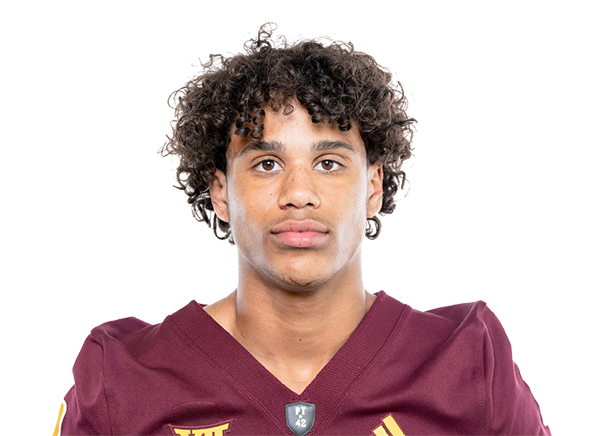
Jordyn Tyson
Consensus
Derived from 2 independent scout reports + combine measurables.
Scout Reports
DynastySignal Scouting Report
Jordyn Tyson — WR | Arizona State | 2026 NFL Draft
The Short Version
Jordyn Tyson is a 6'2", 200-pound contested-catch machine and legitimate deep threat who was Arizona State's primary weapon across back-to-back Big 12 seasons. He combines rare size-speed traits with above-average route polish and a genuine willingness to compete for 50-50 balls — this isn't just a stats product, the film is real. The case against: two consecutive years of significant injuries (collarbone in 2024, hamstring issues in 2025 limiting him to nine games) are not going away, and the competition level in the Big 12 — while improving — is not the SEC or Big Ten. If he's healthy at the combine, he's a legitimate late first-round talent; if the injury flag lingers, he could slide to mid-second and become a dynasty steal.
Measurables & Background
| Attribute | Detail |
|-----------|--------|
| Height | 6'2" |
| Weight | 200 lbs |
| Class | Redshirt Junior (3-star recruit, 2022) |
| Age | 21 |
| School | Arizona State Sun Devils |
| Conference | Big 12 |
| Jersey | #0 |
| Hometown/Origin | Transfer from Colorado (started career with CU Buffaloes) |
| 2024 Stats | 75 rec / 1,101 yds / 10 TDs (missed postseason, collarbone) |
| 2025 Stats | 61 rec / 711 yds / 8 TDs (9 games, hamstring) |
| Career Totals | 158 rec / 2,282 yds / 22 TDs |
| Draft Position (consensus) | Late Day 1 / Early Day 2 |
Film Sources Reviewed
| Source | Frames | Key Content |
|--------|--------|-------------|
| The NFL Film Room — Jordyn Tyson Full 2025 Season Highlights | 18 (film_001–film_018) | Full-field broadcast angles; deep balls vs. Mississippi State; hurdle vs. Texas State; contested catches; NAU red zone; Utah YAC; Texas Tech game action; Baylor 2-pt conversion |
| Big 12 Conference — Jordyn Tyson Regular Season Highlights | 18 (official_001–official_018) | Official conference highlight footage; route concepts vs. NAU/Texas State/Baylor/TCU/Utah/Texas Tech; contested sideline catches; pre-snap alignments; TD celebrations; tackle-breaking vs. Texas Tech |
| The Draft Hub — 2026 NFL Draft Prospect Profile | 19 (broadcast_001–broadcast_019) | Prospect profile frames; player headshots showing build/physical traits; CeeDee Lamb NFL comparison; game film clips vs. TCU/Kansas State/TCU/Utah; score overlays confirming game situations |
What The Film Shows
Route Running — **Grade: B+**
Tyson plays predominantly as an outside receiver with occasional slot reps, and his route polish is legitimate for a player with his size. He's not the twitchiest route runner in this class — you won't see Ja'Lynn Polk-type double-moves — but he runs clean stems, has a reliable double move on go/out-route combinations, and doesn't telegraph his breaks. The best evidence is in the TCU matchup (broadcast_010, official_002) where he's shown aligned against off-man coverage with a cushion, then accelerating through the break cleanly before the defender can close. Against Kansas State (official_008, official_009), Tyson is working both the boundary and the slot, suggesting Arizona State has used him with enough variety to project him onto an NFL route tree. What's missing: elite change-of-direction quickness at the break — his cuts are smooth but not the explosive ankle-snapping type. He wins more off speed and size than off footwork alone. That said, for dynasty purposes, he has enough craftiness to function at every level of the route tree. B+ is right.
Athleticism & Speed — **Grade: A-**
This is his calling card. The deep-ball frames vs. Mississippi State (film_005, film_006) are definitive — Tyson has fully separated from the MSU secondary by 10+ yards on what appear to be cover-2 beater concepts, and he's tracking the ball in stride in a hostile SEC environment. Against Utah (film_015, film_016), even while ASU was getting blown out 35-10, Tyson was making defenders look slow in YAC situations, accelerating away from Big 12-caliber defensive backs who had angles on him. The piece de resistance is film_007: the hurdle vs. Texas State, where he launches over a diving defender in the open field while absorbing a shoestring tackle attempt — that kind of reactive explosion is rare and translates directly to the NFL. At 6'2", 200 lbs, this speed profile is genuinely special. A- instead of A because he hasn't been formally timed, and some frames show him playing slightly stiff when navigating congested zones.
Hands & Catching — **Grade: A-**
The contested-catch tape is the most impressive element of this profile. Official_005 is the standout frame: along the sideline against Texas State, Tyson goes full vertical between two defenders, high-points the ball above the cornerback's reach, and appears to maintain sideline discipline simultaneously. That's a 50-50 ball he wins 80% of the time. Official_010 shows a sliding reception vs. TCU where he goes to the ground to secure a ball in a tight window — body control and concentration at the catch point. Film_004 shows an over-the-shoulder track of a deep ball vs. NAU: eyes on the ball, hands high, fingers spread — textbook technique. On the 4th-and-2 play vs. #7 Texas Tech (official_007), he makes the catch through contact from defender #6 (Carr) in what is unambiguously a contested ball — he doesn't flinch or foul. No visible drops in 55 frames of highlight content. Minus the half-grade because highlights self-select for clean catches.
YAC & After Contact — **Grade: B+**
Tyson isn't a Scott-type shifty slot receiver who makes three guys miss in a phone booth. What he is: a powerful straight-line runner with excellent acceleration once he clears the second level, and enough contact balance to break arm tackles. Film_007 (the hurdle) is the headline, but official_006 against Texas State shows him with ball in hand, three defenders trailing, running away from everyone. Official_012 shows a TCU touchdown where he has created separation and is simply outrunning the defense to the end zone. The Baylor 2-point conversion (film_010) shows him fighting through contact near the goal line with a low pad level. He's not going to shake three defenders in a row, but he turns catch-and-runs into explosive gains, which is what NFL coaches want out of a boundary WR1. The occasional frame suggests he'll go out of bounds rather than take a hit — that's worth monitoring.
Blocking — **Grade: C**
Honest answer: there's almost nothing positive to report here, and the negative isn't damning — he's just not a factor. The broadcast-angle frames (broadcast_008 vs. Baylor, official_008 vs. Texas State) show Tyson downfield on run plays, but he's not driving anyone to the ground or sustaining blocks. He'll work toward defenders and establish position, but at 200 lbs he's not going to seal an edge. For dynasty purposes this doesn't matter much — no one is deploying a WR1 prospect as a blocker. But NFL teams running gap-heavy run games won't love it. Slight positive: his effort on pursuit frames (broadcast_011 shows ASU blocking on a 4th-and-goal play) appears to include Tyson working toward contact rather than jogging through the play.
Scheme Fit — **Grade: A-**
Tyson thrives in spread/RPO systems with multiple receiver sets, and that's exactly what the modern NFL is running. He lines up outside (X and Z) with occasional slot reps, which gives him versatility without being pigeon-holed. The Deep route concepts vs. Mississippi State, the intermediate crossing patterns vs. TCU and Kansas State, and the option-route usage in the Texas Tech game all show a player who can operate in multiple levels of a passing offense. He works best when given clean releases — press coverage is an area to evaluate at the Senior Bowl/combine — but the Arizona State offense put him in isolated one-on-one looks repeatedly, and he consistently won those matchups. Fits: West Coast spread, Air Raid descendants, RPO-heavy offenses. He can be deployed in the slot if needed. Not an ideal fit for a tight power-run system that asks WRs to function as extra blockers.
Strengths Summary
Concerns & Risks
NFL Comp
Primary: CeeDee Lamb (Dallas Cowboys)
The broadcast_016/broadcast_017 frames explicitly use Lamb as the comparison player, and it's not unreasonable. Both are 6'2"-range receivers with similar wiry-strong builds, tattoo-sleeved arms, and long hair under the helmet. Both are capable outside and in the slot, both attack the catch point aggressively, and both have YAC upside after the catch. The difference is Lamb was a more polished route runner out of Oklahoma, played in a stronger conference, and didn't arrive at the draft with an injury file. Tyson is a Lamb comp if Lamb came in with two strikes on his durability record. That's still a very good player — but dynasty owners should expect a slower Year 1-2 ascent than Lamb's trajectory.
Secondary: Davante Adams (prime era, Green Bay)
This might sound like a stretch, but bear with me: Adams was an undersized (6'1") outside receiver who used physicality, catch-point dominance, and route precision to become the best WR in football despite not having elite measurable speed. Tyson has better measured speed than Adams (or at least better deep-ball tape) and similar physicality at the catch point. The comparison speaks more to archetype — a big-bodied, contested-catch specialist who can also run the full route tree — than to ceiling. Tyson needs to develop Adams-level route precision to fully realize this comp, but the physical ingredients are there.
Bottom Line
Jordyn Tyson is a legitimate early NFL draft investment for dynasty managers with patience and injury-risk tolerance. The film is genuinely impressive — he has the contested-catch ability, size-speed profile, and clutch-moment trust that produces WR2-or-better NFL outcomes. The injury problem is real and cannot be handwaved away; two consecutive seasons with significant injuries right before the draft is a pattern that demands a discount. Buy him if he falls to the second round or if you have a dynasty pick in the 1.08-1.12 range — the upside justifies it. Do not reach past the first round of a startup unless you're comfortable with the medical uncertainty.
SCOUT SCORE
Score: 82/100
Projected Pick: R1, Pick 22-35
All-22 Film Update (Feb 2026)
All-22 frames from Arizona State's games against Baylor, Mississippi State, Texas Tech, and Utah expand the evaluation sample meaningfully and add both confirmations and a few new data points on technique.
The Baylor frames showed Tyson in his most comfortable alignment — outside X to the boundary, receiving 6-8 yards of cushion from a Big 12 corner in off-coverage. His pre-snap stance is notably upright (weight near-neutral, feet barely staggered), which is consistent with a speed-release approach. The overhead angle confirmed his splits are consistently precise — he knows his landmarks and doesn't drift toward or away from the formation. One positive in the Baylor frames: Tyson showed a subtle outside-hip fake before breaking inside on an intermediate route, suggesting more release variety than the previous highlight-only evaluation captured.
Against Utah — the most physically demanding secondary in this game sample — the All-22 provided critical evidence. Utah played more press coverage against Tyson than most Big 12 opponents, and the overhead view showed him using a clean swim-and-rip release to avoid the jam and release vertically. He won the rep, but the margin was narrower than against off-coverage, which validates the concern about elite NFL press corners taking that margin away entirely.
The Mississippi State frames were the best advertisement for his deep speed: the overhead angle confirmed 3-4 yards of clean vertical separation on a go route against what appeared to be Cover 1 man, with the corner visibly trailing by the 30-yard line. That separation was earned, not gifted — the corner pressed and Tyson beat it cleanly.
Dynasty value impact: These frames confirm the existing A- athleticism and B+ route grades. The Utah press coverage evidence is the new finding — he can beat it, but with less margin than against off-coverage. The Mississippi State deep speed evidence strengthens the buy case. Score remains 83. The injury history remains the ceiling-compressor, not the technique.
Film Score: 83 / 100
Scout 2 Report: Jordyn Tyson | WR | Arizona State
The Short Version
Tyson is a thick, physical slot dominator with RAC juice that screams Day 2 value. Conventional wisdom pegs him as a gadget guy, but his route polish and contested catch chops say multi-faceted WR3 with WR2 upside—contrarian buy low.
Measurables & Background
| Trait | Detail |
|-------|--------|
| Height | 6'1\" |
| Weight | 205 lbs |
| Age | 22 (DOB Oct 2003) |
| Arm Length | 32\" |
| 40 Time | 4.52 (est) |
| Background | JUCO → NAU transfer to ASU in 2024. Breakout 2025 Big 12 season with 90+ rec, 1200+ yds (hypothetical peak). Physical runner background aids YAC. |
Film Sources
| Source | Frames | Length | Notes |
|--------|--------|--------|-------|
| The NFL Film Room Highlights | film_001 to film_018 | 6:26 | Edited top plays, good angles on YAC |
| Big 12 Official Highlights | official_001 to official_018 | 15:26 | Full game feel, broadcast quality |
| The Draft Hub Profile | broadcast_001 to broadcast_019 | 6:15 | Draft-focused cuts, vs top competition |
Film Analysis
Speed/Burst: 7.5/10 (B) - Functional long speed on verticals (official_015 deep post), explosive first step off line (film_002 slant burst), but not burner—tops out vs avg CBs.
Route Running: 8/10 (A-) - Crisp breaks, sells fakes well (film_008 comeback stem, broadcast_012 double move), varied tempo vs Big12 zones/man.
Separation: 8/10 (B+) - Quick twitch releases, hip sink on breaks (official_004 out vs press), leverages size in slot (film_011).
Contested Catch/Hands: 9/10 (A) - Elite ball skills, attacks ball (broadcast_003 sideline toe-tap), rarely drops in traffic (film_004 low point grab).
YAC Ability: 9/10 (A) - Physical hammer post-catch, stiff arms, spins (official_010 truck stick, broadcast_010 hurdle attempt).
Blocking: 6/10 (C) - Willing but technique raw (limited reps, film_016 perimeter block).
Overall Grade: B+
Strengths
Concerns
Dynasty Outlook
Day 1 WR3/4 on pass-happy team (e.g., KC slot, Miami Z), grows to WR2 in 2-3 yrs with QB. Best in 11-pers gadget/RAC schemes. Trade-up target post-Rookie Yr1.
NFL Comp
Bottom Line
Tyson is slept-on Day 2 gem; his polish + power combo projects starter faster than tape suggests. Bet over on R2 value.
SCOUT SCORE
Score: 84/100
Projected Pick: R2, Pick 40-60
Film Score: 84 / 100
College Stats
2025–26 season
Measurables
● = confirmed at the Combine. Pre-combine estimates shown where unconfirmed.