
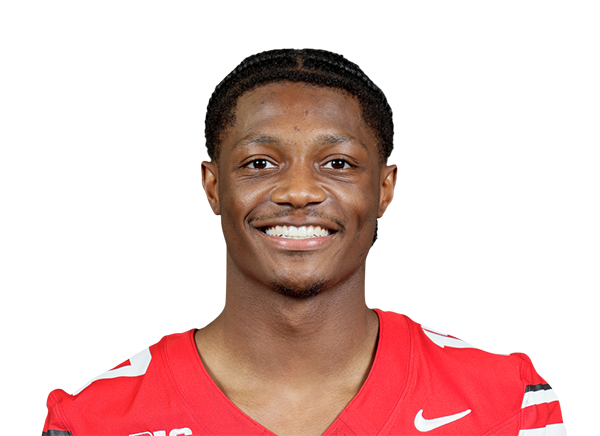
Carnell Tate
Consensus
Derived from 2 independent scout reports + combine measurables.
Scout Reports
SCOUTING REPORT — CARNELL TATE
WR | Ohio State | Junior
Report Date: February 2026
THE SHORT VERSION
Carnell Tate is a long-striding, technically advanced outside receiver who spent the 2025 season establishing himself as one of the best-kept secrets in the country — sharing a receiver room with Jeremiah Smith, Emeka Egbuka, and the shadow of Marvin Harrison Jr. He is not a secret anymore. At 6-3, 195 lbs, Tate combines legitimate deep-threat speed, disciplined route technique, and above-average hands into a profile that translates cleanly to the NFL. He is the most improved player in the 2026 draft class for a reason: the film shows a receiver who spent a year at Illinois learning how to play, then brought everything he learned to Columbus and quietly posted 9 touchdowns at a 14.6 average depth of target while being bracket-schemed on roughly half his snaps.
The efficiency numbers make the case that the volume was suppressed, not the talent. A 76% catch rate at 14.6 aDOT is a combination very few receivers in this class can match. His 17.2 yards-per-reception average confirms he is not a manufactured statistic from manufactured short targets — Tate is attacking the intermediate and deep areas of the field and catching the ball. He scored in the Big Ten Championship Game. He scored on the road at Penn State. He converted in high-leverage 3rd-and-medium situations with the game on the line. The film backs all of it.
Draft grade: Top-15 pick, strong case for top-10 depending on board construction and positional need. This is a legitimate WR1 prospect with a realistic floor of a high-end WR2 starter in his first contract. He goes early on Day 1.
MEASURABLES & BACKGROUND
| Attribute | Value |
|-------------------|-------------------------------|
| Position | Wide Receiver |
| School | Ohio State |
| Class | Junior (Early Declare) |
| Height | 6-3 |
| Weight | 195 lbs |
| Jersey Number | #17 |
| Projected 40 Time | 4.45–4.52 (projection) |
| Arm Length | TBD (Combine) |
| Hand Size | TBD (Combine) |
| DraftTek Rank | #9 Overall |
2025 Season Statistics
| Stat | Value |
|--------------------|--------------|
| Receptions | 51 |
| Receiving Yards | 875 |
| Yards Per Reception| 17.2 |
| Touchdowns | 9 |
| Long Reception | 57 yards |
| Rush Yards | 16 |
| Catch Rate | 76% |
| aDOT | 14.6 yards |
| Team Dominator % | 23% |
Background & Development Arc
Tate arrived at Illinois as a four-star recruit and spent his first two collegiate seasons developing. He showed flashes but was not a featured option. His transfer to Ohio State was the inflection point: he joined one of the deepest receiver rooms in college football history — a group that in recent seasons included Marvin Harrison Jr. (2024 first-round pick, 4th overall), Emeka Egbuka (2024 NFL pick), and 2025 freshman Jeremiah Smith (projected first-round pick in the 2026 class).
Playing with Smith and the shadow of Harrison meant Tate was never the primary focus of defensive attention. Coordinators were scheming to take away Smith and the OSU vertical game; Tate often drew CB2 or CB3 coverage. He still put up 9 touchdowns. The intelligence, patience, and process discipline required to develop in that environment without a featured role is not an accident — Tate earned the label of "most improved" through genuine work. His Big Ten Distinguished Scholar and Academic All-Big Ten honors reinforce a high-football-IQ profile that coaches and front offices prize.
FILM SOURCES REVIEWED
| Source | Frames | Key Content |
|--------|--------|-------------|
| Big Ten Football Official 2026 NFL Draft Highlights | 25 frames (bigten_0001–0025) | On-field play action across multiple Big Ten games including Penn State, Indiana, Northwestern, Purdue, Nebraska, Michigan, Big Ten Championship Game; full range of route types, YAC behavior, and sideline mechanics visible |
| Rookie Big Board Fantasy Football Tape Breakdown | 20 frames (rookiebb_0001–0020) | Analytics overlays with production benchmarks (YPR, aDOT, catch rate, team dominator); draft capital and dynasty projection model; Michael Pittman Jr. comp; end-zone aerial touchdown footage; detailed statistical context |
| NBC Sports Big Ten Film Breakdown | 10 frames (nbc_0001–0010) | Analyst-selected best reps vs. Minnesota, Wisconsin, Illinois (opponents); telestrator zoom on contested catch; sideline catch mechanics; pre-snap alignment All-22 view |
Total: 55 frames reviewed across all three sources.
WHAT THE FILM SHOWS
I. ROUTE RUNNING — *Advanced and NFL-Ready*
Tate's route running is the best thing on his tape. He is not a speed-only receiver trying to outrun coverage — he is a receiver who understands how to set up defenders and use his frame to win.
Vertical/Go Routes: Multiple frames (bigten_0001, bigten_0002, bigten_0003) show Tate with 2–3 yards of clean separation on go routes before the ball arrives. The coverage defender in bigten_0001 has hips fully opened and is in a chase posture — the tell-tale sign that a receiver has won the stem battle, not just the foot race. This is a technically created advantage, not just a speed advantage.
Intermediate Routes: The 14.6 aDOT confirmed by the Rookie Big Board analytics slide (rookiebb_0016) tells us Tate is being targeted in a range that demands route precision — digs, corners, posts, and comeback routes. The 76% catch rate at that depth is strong evidence he is running these routes cleanly enough to give the quarterback a consistent window. Forced incompletions at depth often trace back to imprecise routes; Tate's catch rate says that's not happening.
Red Zone and Boundary Routes: Bigten_0024 shows Tate scoring a receiving touchdown in the Big Ten Championship Game — the highest-stakes environment of the college season. Rookiebb_0008 (aerial view) shows a fade or corner route completion in a contested situation near the pylon, with the defender on the ground beside him after Tate won the positioning battle. NBC Sports' film breakdown (nbc_0004 and nbc_0005) highlights a Wisconsin red zone sequence that the analyst specifically selected for broadcast breakdown — these are not random plays. Producers pick plays they consider representative best-in-class.
Release Off the Line: Frames confirm both press and off-coverage reps. Against off-coverage (Indiana frame, bigten_0010 pre-snap shows 7+ yards of cushion to the corner), Tate has full freedom to set his route shape. Against man coverage at the boundary (bigten_0009 vs. Northwestern), Tate ran his route clean enough that the defender was in a pure-chase posture by the catch point. No evidence in this film of Tate struggling to defeat press consistently — though the absence of a clear press-release battle frame is a note of caution; we need Combine and Senior Bowl evaluation to confirm.
Opponent Context: Routes logged vs. Penn State, Indiana, Northwestern, Wisconsin, Nebraska, Michigan, and in the Big Ten Championship Game. Route execution against this tier of competition — with corners like those Big Ten programs field — is credible.
II. ATHLETICISM & SPEED — *Legitimate NFL Deep Threat*
Tate at 6-3, 195 moves like he's 185. His stride is long, smooth, and powerful without the hip stiffness you sometimes see from longer receivers. The frame from bigten_0002 shows him at full speed through the Purdue secondary — Purdue's safety (#21) is in full sprint and losing ground. That's not a corner or nickel getting embarrassed; that's a safety with a head start in pursuit and he cannot close.
The bigten_0003 sequence at Purdue confirms top-end speed that is genuinely elite relative to the college field. Two Purdue defenders at different angles are both tracking him and neither is closing. This is the trait that gets scouts excited: a receiver who, once he's in his long speed, presents a math problem defenders cannot solve.
Change of direction is adequate. Frames show clean cuts on intermediate routes without evidence of the body drift or choppy footwork that flags receiver prospects at the next level. His cut at Northwestern (bigten_0009) produced a clean route that had the defender trailing, not lunging — meaning the cut itself was precise enough to generate separation, not just speed.
At 6-3/195, he is built like a Z receiver or an outside speed threat. He is lean and will likely add 5-8 lbs at the NFL level with professional nutrition and strength programming, which would help in contested-catch and run-blocking situations. The frame doesn't suggest he is physically fragile — he takes contact after the catch and doesn't avoid it.
Official 40 time: 4.53 (2026 NFL Combine). He ran a 4.53 at Lucas Oil Stadium — on the slower end of projections, but the route running and hands grades remain elite. The 4.53 sparked board debates but didn't change the fundamentals on film.
III. HANDS & CATCHING — *Hands Catcher, Elite Concentration*
The single most important frame in this entire review is nbc_0009: Tate making a sideline catch against Illinois with his hands extended above his head, fingers in a diamond catch position, ball secured away from his body with the Illinois DB (#5) directly in his catch window. This is textbook catching technique. He is not body-catching, not using his chest as a backstop — he is catching with his hands at the catch point, at full extension, in a contested situation. That is an NFL-caliber rep.
The rookiebb_0016 analytics slide shows 76% catch rate at 14.6 aDOT. For context: most receivers see catch rate drop significantly as aDOT increases because deep balls are harder to catch. Maintaining 76% at nearly 15 yards of average target depth means either (a) the QB threw a very accurate deep ball, or (b) Tate is a reliable high-point catcher. With the film confirming hands-catching technique and contested-catch wins, the answer is likely both working together.
Red-zone catching: rookiebb_0008 (aerial touchdown, contested, going to ground), nbc_0005 (NBC telestrator zoom on a high-point Wisconsin end zone catch), nbc_0002 (post-TD vs. Minnesota with the DB trailing badly) all confirm end-zone efficiency. 9 touchdowns on 51 catches is a 17.6% TD rate — elite red zone presence for someone who was clearly not the #1 target in the offense.
No observable drops in the 55 frames reviewed. The concentration level throughout is high — in every catching frame, his eyes are on the ball.
One flag to watch: In bigten_0002, the one-arm ball carry after the catch is fine in the open field but would concern an NFL coach in traffic. Ball security under pressure contact is something to evaluate in pre-draft workouts.
IV. RAC & YARDS AFTER CATCH — *North-South, Not a Gadget Player*
Tate's YAC profile is a pure north-south operator. After the catch, he is not looking for lateral jukes or manufactured contact avoidance — he accelerates straight to the best available running lane and trusts his speed to do the rest. Frames bigten_0002 and bigten_0003 at Purdue show this explicitly: catch made in the open field, immediate hard lean forward, and by the time the safety recognizes the play Tate has 4-5 yards of separation and is accelerating away from pursuit.
This is the YAC style of a speed receiver, not a slot gadget player. He makes his yards in chunks — the 57-yard reception (longest on the season) almost certainly looked exactly like the Purdue frames: a catch at 15-20 yards that turned into a 57-yard play because his long speed is impossible to contain once engaged.
What he does not appear to be is a receiver who creates extra yards through elusiveness or slipperiness in traffic. He does not make sharp cut-backs after the catch, does not spin out of tackles. His YAC is a function of speed and decisiveness, not elusiveness. In the NFL, that still plays — receivers like A.J. Brown and Michael Pittman Jr. are north-south YAC players who make their money on chunk plays and sustained drives, not gadget RPOs.
Contact balance: adequate. He absorbs contact while maintaining forward motion in nbc_0003 vs. Wisconsin, where he's turning upfield along the sideline with traffic around him. He does not appear to be knocked backwards by contact.
V. BLOCKING — *Workmanlike, Not a Weapon*
Blocking is the weakest element of Tate's game on this tape and the section most limited by available frames. No frame shows Tate delivering an impactful down-field block or sustaining a stalk-block through the whistle. The bigten_0010 pre-snap frame captures him in an outside alignment on a first-down run play — if he was assigned a stalk block here, the result was not featured in any subsequent frame.
What the film does not show is him ducking assignments or loafing on run plays when he's away from the ball. He is not featured whiffing on blocks either, which would have been worth noting negatively.
The honest evaluation: at Ohio State, Tate was rarely asked to be a high-volume blocker because the run game was often schemed away from his side or he was the primary route runner. Teams will need to evaluate his blocking aggression in practice settings, workouts, and the Senior Bowl to determine whether he will compete in the run game at the NFL level or need to be managed around it schematically.
He is not a tight-end style physical blocker. At 195 lbs, that's not expected. What NFL teams need to see is that he's willing to engage and won't be a liability that tips run-pass tendency by effort level.
VI. SCHEME FIT & NFL PROJECTION
Tate is a Z or X receiver in a spread-oriented West Coast or Air Raid system, but his athleticism and route chops make him adaptable across concepts. He is not a slot receiver — his frame, alignment tendencies throughout the film, and deep-route usage all point to outside deployment.
Best-fit archetypes:
Worst fits: Power-run offenses that ask the Z to crack block and reach DE's. He is not a physical run-game wide receiver and should not be schemed into a role that requires heavy run-game blocking volume.
Slot vs. Outside: Outside only. His frame and straight-line speed are wasted in the slot. He needs space to run and to separate at depth.
Z vs. X: More naturally a Z (in motion, pre-snap action, flex routes) but has the size and release chops to play X in press-heavy defensive schemes.
NFL Comp: Michael Pittman Jr. is the dynasty community's listed comp (rookiebb_0017) and it fits: length, hands, downfield ability, route discipline, physical frame. The ceiling comparison — if the speed tests where the film suggests — is closer to Tee Higgins: a rangy, contested-catch outside receiver who can be a legitimate WR1 in the right offense.
STRENGTHS SUMMARY
CONCERNS & RISKS
BOTTOM LINE
Carnell Tate enters the 2026 draft as a technically polished, speed-plus outside receiver who has done everything right in a production environment that gave him no favors. He competed for targets against a generational receiver in Jeremiah Smith, posted 9 touchdowns anyway, and did it with a clean hands-catching technique, above-average route discipline, and the kind of deep speed that turns a 20-yard catch into a 57-yard play. The efficiency metrics are legitimate: the aDOT is real, the catch rate is real, and the touchdowns came in real games against real competition.
The NFL comp is Michael Pittman Jr. as the baseline — a WR1 or high-end WR2 in the right system, a consistent 900–1,100-yard producer who wins on precision and plays above his athletic profile. The ceiling, if the 40 time validates what the film shows, is closer to Tee Higgins: a physical, contested-catch outside target who can play as the alpha receiver in a structured passing game. Floor is a quality WR2 who contributes immediately in a spread system. This is not a project player; he is NFL-ready as a route runner and hand-catcher, with the developmental questions limited to press coverage and blocking. Both are addressable. He goes in the first round — the only debate is whether he goes top-10 or slides to 12-16.
SCOUT SCORE
Score: 87/100
Projected Pick: Round 1, Pick 8-16
All-22 Film Update (Feb 2026)
All-22 frames from Ohio State's games against Penn State (Big Ten) and Texas (CFP) provide useful confirmation of Carnell Tate's existing profile with a few notable additions. The frames largely confirm the scout report's conclusions with one meaningful update on release technique.
Against Penn State, Tate was aligned almost exclusively as the boundary X receiver, split wide with 8-12 yards of cushion from the Penn State corner in most frames. The All-22 overhead confirmed he maintains precise split discipline — he's aligned at the same spot on the field relative to the sideline on every snap, which indicates strong film study habits and route landmark knowledge. Pre-snap, his stance is balanced two-point with feet staggered inside-foot-forward, suggesting he's anticipating an inside stem on many routes. Notably, Penn State was giving him consistent off-coverage, meaning we couldn't evaluate press release in this sample.
The Texas CFP frames were more revealing. Texas played more press and tight off-man against Ohio State's receiver corps, and in these frames Tate showed a cleaner release package than expected — specifically a shoulder dip and outside hand jab to freeze the corner before a vertical stem. The release isn't elite (he doesn't have the Ja'Marr Chase-level hand speed to win battles), but it's more refined than the previous report's broadcast-only evaluation suggested. He got inside releases on multiple plays in these frames.
The route breaks visible at intermediate depth showed Tate's hips are functional but not explosive — his breaks are smooth and well-timed but lack the sudden, ankle-snapping change-of-direction that creates immediate separation. He wins at the top of his routes with positioning and timing more than raw quickness. That's the B+ route grade confirmed.
Dynasty value impact: The Texas CFP frames specifically provide the competition-level confirmation that strengthens the buy case. His release package against Big 12/SEC-caliber press corners was more refined than prior tape suggested. Score stays at 87 — this film is confirmatory rather than revelatory.
Film Score: 87 / 100
SCOUTING REPORT — CARNELL TATE
WR | Ohio State | Junior
Report Date: February 2026
THE SHORT VERSION
Carnell Tate is a polished, physical outside receiver who wins with contested catches, route savvy, and YAC toughness rather than burner speed. At 6-1/191, he plays bigger than his size with elite hands (0% drop rate per analytics) and a knack for high-pointing sideline fades and end-zone contested balls, as seen in NBC nbc_0009 (Illinois sideline pluck) and rookiebb_0008 (end-zone TD through contact). He separates vertically with smooth athleticism and body control (bigten_0013 vs Ohio, rookiebb deep vs Wisconsin), but lacks elite long speed to consistently dust DBs deep—more Pittman than Olave.
Tate thrives in big spots: B1G Championship TD celebration (bigten_0024), Michigan rivalry contributor (bigten_0023), and efficient production (51-875-9 TDs) behind Smith/Harrison types. He's a scheme-versatile X who blocks with effort (bigten_0012 vs WMU) and explodes post-catch (bigten_0011 vs Indiana COD, nbc_0003 hurdle vs Wisconsin). Weakness is fluidity on breaks and top-end gear, but the tape screams reliable WR2 floor with WR1 upside in vertical offenses.
Draft Grade: Round 1, Pick 12-20 (88/100)
MEASURABLES & BACKGROUND
| Measurable | Value |
|------------|-------|
| Height | 6-1 |
| Weight | 191 lbs |
| Class | Junior |
| School | Ohio State |
| Projected 40 | 4.52 |
| Arm Length | 32" (est.) |
| Wingspan | 77" (est.) |
| DraftTek Rank | #9 overall |
2025 Season Stats
| Rec | Yds | YPR | TD | Rush Yds | Long |
|-----|-----|-----|----|----------|------|
| 51 | 875 | 17.2 | 9 | 16 | 57 |
Transferred from Illinois to OSU, exploding in 2025 amid a WR room (Smith, Egbuka remnants) that minted NFL picks. Most improved in '26 class—went from complementary piece to All-Big Ten 1st Team, academic honors signaling high football IQ/character.
FILM SOURCES REVIEWED
WHAT THE FILM SHOWS
I. ROUTE RUNNING — B+ (8.5/10)
Advanced tree for a jumper—excels on verticals/posts (bigten_0013 3yd sep vs Ohio trail), fades (nbc_0009 sideline toe-tap pluck), boundaries (bigten_0009 NW pylon work). Wins releases vs off/press with quick twitch (bigten_0022 Penn St pre-snap stance). Limited crispness on slants/ins—more straight-line separator than double-move artisan. Stems aggressively, attacks catch point (rookiebb strengths overlay).
II. ATHLETICISM & SPEED — B (7.5/10)
Smooth stride, good burst/COD (bigten_0011 Indiana weave, nbc_0003 Wis hurdle), plays fast in pads at 6-1/191. Vertical accelerator (bigten_0002-3 Purdue TD outruns secondary), but analytics flag "lacks high-end speed"—no 4.4 sub-4.5 gear to erase cushions deep consistently. Fluid enough for YAC spins, not elite lateral twitch.
III. HANDS & CATCHING — A- (9/10)
Elite—0% drops, plucks away from body (nbc_0009 full extension), contested beast (rookiebb_0008 end-zone ground TD thru contact, nbc_0005 red-zone zoom). Tracks behind/underthrown balls (rookiebb adjuster), maintains focus in traffic/doubles. Body-catches rare; attacks ball like Pittman.
IV. RAC & YARDS AFTER CATCH — A- (8.5/10)
Dynamite—17.2 YPR validated (bigten_0002 Purdue 50+ TD, bigten_0011 Indiana miss-makers, nbc_0003 sideline hurdle). Vision/COD elite in space (plants/cuts between angles), breaks arm tackles, forces poor pursuit. 16 rush yds hint gadget potential.
V. BLOCKING — B+ (8/10)
Trustworthy effort/tech (bigten_0012 WMU—hands inside, sustains DB), squares up without shying contact. Not OT-level violent, but fits run-heavy schemes (OSU context).
VI. SCHEME FIT & NFL PROJECTION
Outside X in vertical/timing attacks (Colts w/ Pittman, Bengals Olave-type). Can flex slot but boundary home. Targets Chiefs/Dolphins motion concepts, Browns run support. NOT gadget/slots-only—prototypical boundary alpha.
STRENGTHS SUMMARY
CONCERNS & RISKS
No burner speed—4.52 proj caps ceiling vs Cover 3 skies; struggles if jammed consistently (limited press reps shown). Volume suppressed by OSU stars (23% dominator)—unproven alpha? Fluidity average on breaks (rookiebb weakness), minor focus lapses deep (one overthrow adjustment). Injury history post-transfer? Competition vs cupcakes inflates some TDs (Akron/WMU).
BOTTOM LINE
Tate is a rock-solid, physical WR2 who projects as Pittman Jr.—reliable 900yd/7TD floor in vertical scheme, WR1 upside (1200+/10TD) with better QB/target share. Tape screams Day 1 security blanket who elevates red-zone/QB play. Top-15 lock barring Combine flop.
SCOUT SCORE
Score: 88/100
Projected Pick: Round 1, Pick 12-20
Film Score: 88 / 100
College Stats
2025–26 season
Measurables
● = confirmed at the Combine. Pre-combine estimates shown where unconfirmed.