
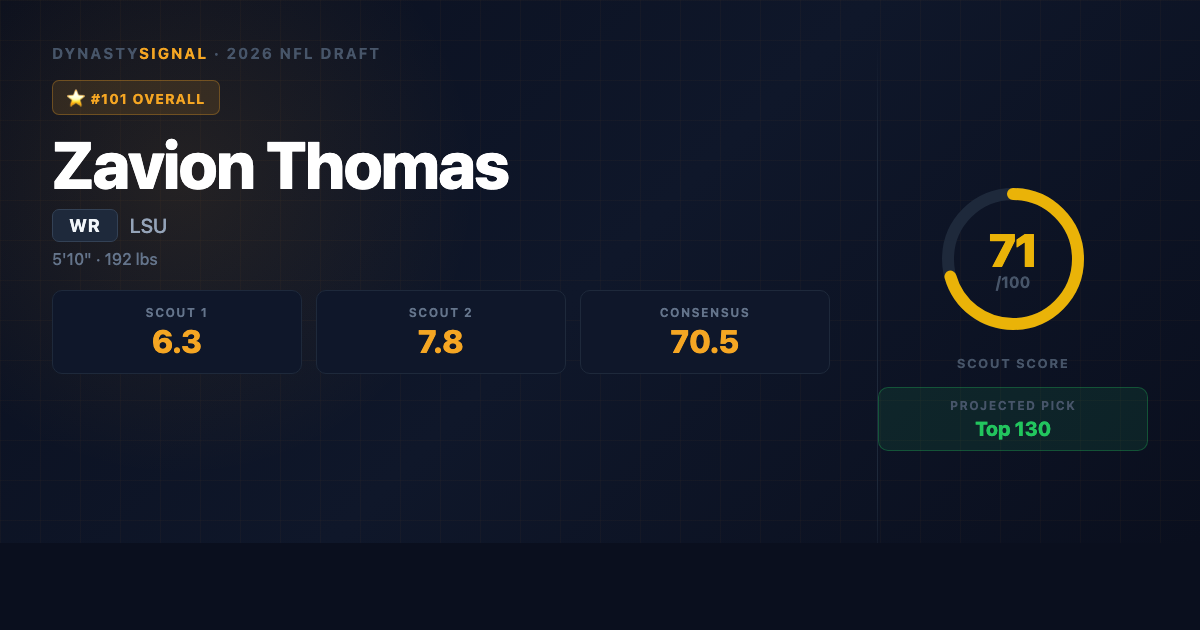
Zavion Thomas doesn't look like a Day 2 prospect on paper — 5'10", 192 lbs, 41 catches in his best college season — but put on the film and the conversation changes fast. The LSU wide receiver (via Mississippi State) is one of the most explosive short-area playmakers in the 2026 draft class, a genuine multi-phase weapon who touched the ball through the air, on the ground, and on special teams in the same season. In an era where NFL rosters increasingly value versatile chess pieces who can force defensive coordinators into disadvantageous matchups, Thomas fits that mold almost perfectly.
The context matters here. Thomas is a product of the SEC, seasoned in live-fire competition against some of the best defensive backs in college football. His 2025 season at LSU showed clear developmental progression — he wasn't just a return specialist masquerading as a receiver, he was earning genuine snap counts out of the slot against Power 4 defenses. A 95-yard kickoff return touchdown in the Texas Bowl and multiple receiving scores underscore what the analytics miss: this player finds the end zone. His career three return touchdowns heading into the draft aren't accidents, they're repeatable athleticism on display in the open field.
STRENGTHS
Thomas's calling card on film is short-area burst that borders on elite for a receiver his size. Out of the slot at LSU, he shows an instantaneous hip flip on choice routes and whip routes that leaves zone defenders frozen at the stump — by the time the linebacker reads the break, Thomas already has two steps on him in open space. This isn't just straight-line speed, it's the kind of stop-start twitch that plays in NFL slots where the windows close faster and defenders are more athletic. His YAC production is a direct extension of that burst: he processes immediately at the catch point, attacks leverage rather than running into contact, and has real short-area vision to set up his own blocks.
The multi-phase usage at LSU is not cosmetic. Thomas took jet sweeps, handled orbit motions, returned kicks, and ran slot concepts out of bunch formations — all within the same game plan. On film you can see him executing those rush touches with the same decisive footwork he brings to receiving routes. NFL teams running Shanahan-style motion offense, McVay schemes, or any RPO-heavy system are going to look at that film and see a player who can be used in ways the box score doesn't capture. His compact, well-built lower body also means he can absorb hits over the middle and work through traffic — he's not a frail slot receiver who evaporates on contact.
Thomas's separation rate in zone coverage is legitimately elite. When the defense goes soft coverage, he is electric — double moves dust linebackers cleanly, quick-twitch cuts create instant windows, and he has the spatial awareness to find the soft spot and sit rather than running through the zone. His sideline focus catch under pressure (toe-tap execution with a defender draped on him) shows the hands are reliable when the moment demands it. The talent to be a genuine WR2 in the right offense is present on tape.
CONCERNS
The most honest concern is scheme dependency. Thomas has real limitations against press coverage from physical cornerbacks — he aligns almost exclusively in the slot for good reason, and when forced to operate outside against boundary corners (6'0"+, physical) he can get rerouted and neutralized at the line of scrimmage. NFL coaches who don't protect him schematically will make him disappear. His route tree, while functional, is narrow — heavy slot curls, crossers, screens, and motion-based concepts dominate the film. The advanced double-moves and tempo manipulation against NFL corners in man coverage are not consistently demonstrated, and his vertical route-running telegraphs early against higher-caliber competition.
The production timeline is also a real dynasty concern. His best college season (41 catches) is modest for a senior WR prospect entering the league in his mid-twenties with a ceiling that's already fairly legible. He was never the unquestioned No. 1 option in any system he played in, and his fantasy floor is tied heavily to NFL special-teams value — which is legitimate for roster retention but doesn't move the needle in most dynasty scoring formats. Dynasty managers should price the receiving upside separately from the return-game floor.
SCOUT GRADES
Scout 1 grades Thomas at 63/100 with a Round 4 projection (Pick 108–130), framing him as a legitimate Day 3 prospect whose NFL case is built on elite athleticism, return-game utility, and scheme versatility — but whose dynasty ceiling is capped by modest target-share history and a route tree that hasn't been stress-tested at the NFL level. The comp is Tutu Atwell — a scheme-dependent slot burner who can break out in the right system but needs that system to exist first. Scout 1 views the special-teams floor as real but emphasizes it doesn't translate to dynasty points, making the receiving role everything.
Scout 2 is considerably more bullish, grading Thomas at 78/100 and projecting him as a Round 3 selection (Pick 70–100). Scout 2 sees elite short-area separation as a top-of-class trait, projects a gadget-heavy WR3/4 role in a Shanahan-tree offense by Year 3, and gives him a ceiling comp of a Brian Thomas Jr.-lite deep slot option. Scout 2 is more aggressive on the athleticism — grading his separation at 9/10 against zone coverage — while sharing similar concerns about press coverage and limited outside versatility. The delta between the two grades is meaningful: Scout 1 sees a late-round flier, Scout 2 sees a legitimate mid-round investment with Day 2 FLEX upside in PPR.
PROJECTION
Thomas's dynasty landing spot will determine everything. In a Shanahan-style offense (San Francisco, Miami, or analogous systems) with clear slot usage and motion-heavy game plans, he profiles as a WR3 with genuine WR2 weeks — the kind of player who goes 6/82/1 on 9 targets when the scheme puts him in space, then goes quiet for two weeks in a run-heavy game plan. Year 1 expectation is gadget usage and special-teams snaps while he learns the pro game: 35–50 catches is realistic if the role opens up, and the return-game value keeps him on rosters. By Year 3, the best-case outcome is a 70-catch WR3 slot role in an up-tempo offense.
The floor is also real: if Thomas lands on a team that doesn't scheme receivers into space or asks him to compete for snaps on the outside, his production could be sporadic and his dynasty value stagnant. Stash him in the late rounds of 2026 dynasty startups — Rounds 4–6 is the right range — and monitor his landing spot aggressively at the draft. The right team makes him a high-upside WR3; the wrong team makes him a special-teams-only roster spot. The talent to be the former is on tape. Buy the talent, sell the landing spot risk appropriately.
View Zavion Thomas's full player profile, measurables, and scouting breakdown →
🎬 All-22 Film Analysis Update
*Updated after All-22 film review by Scout1 and Scout2.*
Film Score: 70.5/100 (→ No change from base score of 70.5)
Composite Score: 70.5
Scout1 Assessment Zavion Thomas is a compact, explosive slot/gadget receiver who gives you everything you ask him to do — he catches passes, runs routes, takes jet sweeps, and is a legitimate big-play threat returning kicks. At 5'10", 192 lbs out of LSU (via Mississippi State), he projects as a plus athlete in a limited role at the next level with real upside as a second-receiver or change-of-pace weapon. The case for Thomas is simple: elite short-area explosiveness, genuine versatility, and proven production in ...
Scout2 Assessment Thomas is a rotational sparkplug, not franchise X—fade the top-100 smoke; stash him late for dynasty upside in quick-pass attacks.
*Film analysis is based on All-22 footage reviewed independently by two scouts. Scores reflect on-field evidence and may differ from pre-film model projections.*