
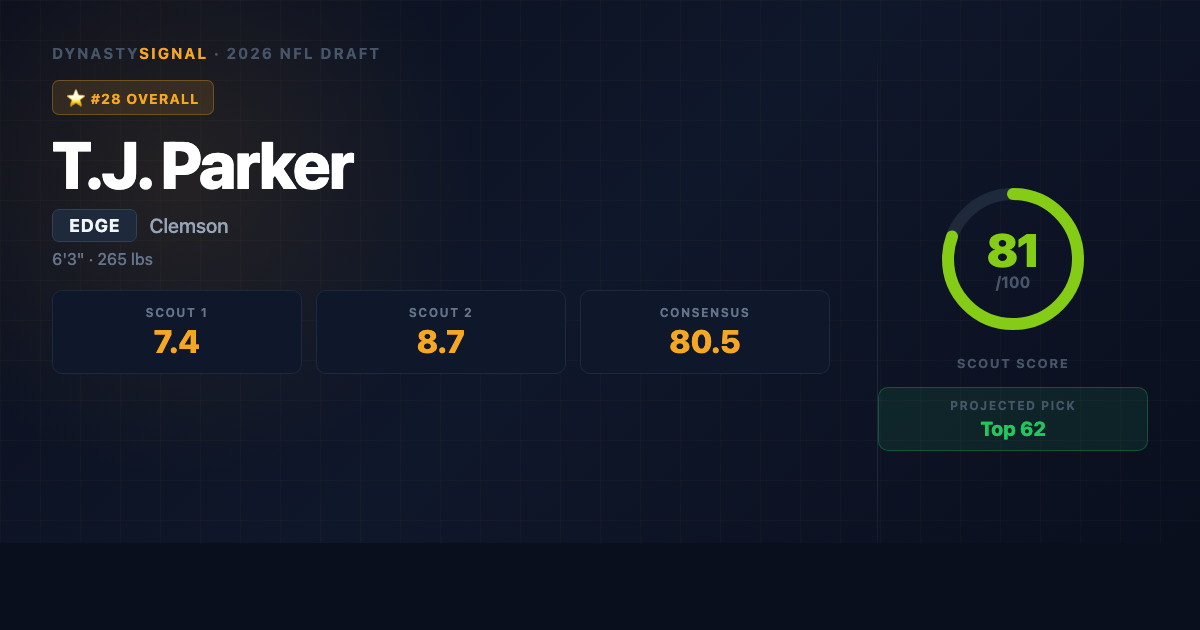
T.J. Parker came into the 2023 recruiting cycle as a top-50 overall prospect, and three years later the film confirms the projection was on target — if not yet fully realized. At 6'3"-6'4" and 260 pounds, he brings elite arm length, a relentless motor, and legitimate two-way ability as a Clemson edge rusher who generated 9.5 tackles for loss and 5.0 sacks in 2025 against a schedule that included LSU, Georgia, and multiple ACC contenders. His get-off is a genuine NFL weapon, his run defense is above-average for the position, and his effort level is visible whether the game is a blowout or a fourth-quarter battle.
The debate on Parker isn't about his floor — it's about his ceiling. The physical tools are there for a premium edge rusher. The pass-rush move set isn't yet polished enough to justify a first-round grade with confidence, and the sack production, while respectable, hasn't yet hit the 8-10 number that would make him a consensus top-20 pick. What you're buying is a high-floor, legitimate-starter EDGE with meaningful upside if his pass-rush counters develop under NFL coaching.
STRENGTHS
Parker's motor is the first thing scouts will note and the last thing they'll forget. He plays hard in blowouts. He plays hard in tight fourth quarters. He pursues plays 20 yards downfield on broken coverage. Multiple film sequences show him still flying around at full speed with the game in hand — that's character, not athleticism, and it translates directly to NFL snap count and long-term roster value.
His arm length is the physical foundation of everything else he does. Whether he's setting the edge in run defense or initiating a pass-rush rep, those long arms let him control the point of attack without giving blockers access to his pads. In run defense, he stacks blockers and sheds cleanly, keeping his outside shoulder free to funnel ball carriers back inside. In pass rush, he converts speed to power using his length to drive tackles back toward the pocket. Against South Carolina, Parker showed up on the strip-sack frame with his long arms bat-swiping at the ball — a natural finishing instinct that complements his rush ability.
His versatility is a genuine value-add. Parker has aligned in a three-point stance as a traditional 4-3 defensive end and in a two-point stance as a stand-up edge rusher, executing both comfortably without looking forced. That schematic flexibility matters in today's NFL, where teams run multiple fronts and need edge players who can stay on the field across personnel groupings.
CONCERNS
Parker's sack production — 5.0 in 2025 — is solid but not elite for a top-50 recruit with his physical profile. NFL scouts will note the gap between his tools and his finish rate. The primary technical explanation is his rush arc: he takes a wide loop around tackles that allows blockers to ride him past the pocket. Against Georgia's elite offensive line, the film showed him engaged but not winning cleanly — that is the data point evaluators will show him in pre-draft workouts.
His counter-move diversity is a real limitation at this stage. The speed rush and speed-to-power conversion are functional. A reliable inside counter — a refined swim, a rip-through, a push-pull — that keeps tackles honest on the outside threat is still developing. At the NFL level, every tackle he faces will have been coached specifically on how to absorb the wide speed rush and cut off his arc. The counter has to exist before the speed rush can be elite.
SCOUT GRADES
The two scouts diverge sharply on Parker's ceiling. Scout 1 graded him at 74/100 with a projected pick of Round 2, selections 45-62, emphasizing the sack production gap relative to his physical tools and flagging the wide rush arc and limited counter repertoire as real obstacles to elite pass-rush production. Scout 1 sees a high-floor starter rather than an alpha rusher.
Scout 2 is significantly more optimistic, grading him at 87/100 and projecting a first-round pick in the 15-25 range. Scout 2 characterizes him as a dominant power rusher whose bull strength overwhelms ACC and SEC competition, with the raw athletic foundation to develop into a double-digit sack threat with NFL pass-rush coaching. The 13-point grade spread makes Parker one of the most contested evaluations in this class — dynasty managers should treat him as a first-round talent with Day 2 risk rather than a sure thing at either end.
PROJECTION
Parker projects as a starting-caliber 4-3 defensive end in his first or second NFL season. His motor, length, and two-way ability mean he will not be a situational pass rusher who exits on early downs — he will play all three downs for whatever team drafts him, contributing to run defense while developing his pass-rush repertoire under professional coaching. The 6-9 sacks per year in Years 2-3 is a reasonable floor; if the inside counter develops, the ceiling climbs toward double digits.
For dynasty IDP managers, Parker is the textbook "buy the tools, wait for the production" profile. He will not be a Year 1 fantasy force, but the physical foundation for sustained starter value is already evident on film. Target him in the 2026 rookie draft at a price that reflects the current sack-production questions and hold through Year 2 when the pass-rush picture becomes clearer.
View T.J. Parker's full player profile, measurables, and scouting breakdown →