
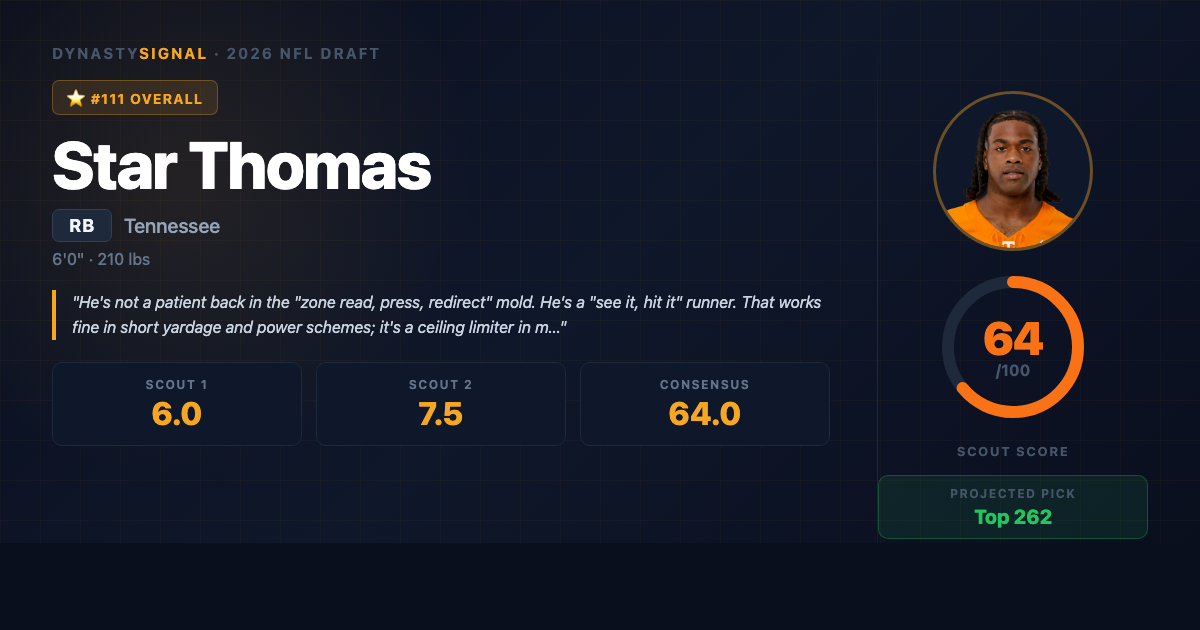
Star Thomas is not the kind of prospect that turns heads at a combine podium. He didn't light up the SEC as a featured back, he didn't win any major individual awards, and his path to Tennessee wound through Coffeyville Community College, New Mexico State, and Duke before he put on an orange jersey. But the 6'0", 210-pound power back has done something quietly remarkable: he's accumulated 528 FBS carries at a 4.9 yards-per-carry clip across three programs, and his 2025 finish at Tennessee — 95 carries, 529 yards, 5.6 YPC, seven touchdowns in a committee role — came against one of the toughest schedules in college football. That résumé doesn't scream "NFL starter." It whispers "guy who actually works."
What makes Thomas worth evaluating is precisely what makes him easy to dismiss: he's a specialist. In the age of the receiving back and the jet-sweep offense, Thomas is a throwback — a downhill, fall-forward, short-yardage hammer who doesn't need scheme complexity to do his job. Tennessee turned to him in the fourth quarter of a tied Georgia game. He was on the field on 4th & 2 in a tied Mississippi State game. He got the 1st-and-Goal call against Kentucky. Coaches trusted him with the ball when the margin for error was zero. That's not coincidence — that's a skill set that NFL special teams coordinators and short-yardage coaches know how to value.
STRENGTHS
Thomas's defining trait on film is contact balance, and it's genuinely elite for a prospect at this level. The film shows him absorbing multiple tacklers in pile situations against Syracuse and Mississippi State and refusing to stop moving his legs. On a 3rd & 1 against a stacked UAB front, he powered through at goal-line with low pad level and churning leg drive — the kind of rep that goes in a coach's mental file under "trust." His thick neck, broad shoulders, and barrel-chested torso are built for dirty work, and the tape confirms he seeks that contact rather than avoiding it. Scout 2 graded his power and contact balance at 9/10 each — the highest grades on the entire evaluation sheet.
Thomas is also a decisively north-south runner with solid play-side vision. He doesn't dance behind the line, and he doesn't need to — he identifies his gap, sets his feet, and attacks. In a tied game's fourth quarter against Georgia, he showed something more: legitimate open-field burst in space against one of the country's elite defenses, creating visible separation in stride at midfield. It was one play, but it was against one of the best defenses in the country in a pressure moment. His career volume at 4.9 YPC across multiple programs and competition levels adds context — this is a consistent football player, not a stat-padding product of one scheme.
His receiving profile at New Mexico State (34 receptions, 351 yards, 5 receiving TDs across two seasons) provides evidence that he can serve as a check-down option in the passing game when deployed correctly. His Tennessee role limited that side of his game, but the historical baseline exists. Combine that with the coaching staff's willingness to use him in shotgun sets and on second-and-long, and there's at least a functional receiving back somewhere in his profile — enough to keep an NFL defense honest.
CONCERNS
Age is the loudest concern and it doesn't go away. Thomas enters the 2026 draft as a 6th-year senior at roughly 24–25 years old, with 500-plus FBS carries already on his odometer. NFL teams are increasingly reluctant to invest real draft capital in older running backs with narrow skill sets, and Thomas's ceiling as a power/goal-line specialist makes the math even harder. He is not a three-down back. He will not be your lead runner. That's not a projection — that's the film. In space, he's functional but not threatening: the ankle tackle on a 4th & 2 against Mississippi State shows exactly what you get when a defender gets a hand on him — he falls forward for the yards he needs, but he doesn't make anyone miss.
His recent receiving numbers (8 catches for 36 yards at Duke in 2024, 10 for 98 at Tennessee in 2025) don't match the NM State data, raising the question of whether his pass-catching ability has atrophied or whether it was always more context-dependent than his stats implied. Pass protection grades are similarly hard to nail down — there simply aren't enough reps on film to evaluate him confidently as a blitz pickup back. His best statistical seasons came at lower competition levels; the Tennessee sample, while encouraging in YPC, was limited in volume and heavily filtered through a committee role with better offensive line support than he'll see in the NFL.
SCOUT GRADES
Scout 1 graded Thomas at 53/100, projecting him as a UDFA or late seventh-round pick (picks 240–262). The evaluation emphasized his contact balance (7.5/10) as his lone elite-adjacent trait, while flagging vision/patience and explosiveness both at 6–6.5/10 and pass protection at just 5/10. Scout 1's bottom line was unambiguous: Thomas belongs in an NFL training camp for his short-yardage utility, but age makes him impossible to justify with real draft capital, and dynasty managers should avoid investment at any cost.
Scout 2 was notably more bullish, grading Thomas at 75/100 with a Day 3, Round 6–7 projection. The same power and contact balance metrics drew 9/10 scores, and Scout 2 flagged vision and burst both at 7/10 — meaningfully higher than Scout 1's read. Scout 2's contrarian thesis: the transfer tag artificially depresses Thomas's draft stock, and his SEC-tested short-yardage ability makes him more valuable than his draft position will suggest. The comps diverge too — Scout 1 lands on Latavius Murray (long-term fringe piece), Scout 2 stretches to David Montgomery's ceiling (tough committee hammer with burst) while setting Zach Moss as the floor.
PROJECTION
In dynasty formats, Star Thomas is a monitoring-only name — not a buy. If he lands on a run-heavy roster (Pittsburgh, Cleveland, Buffalo are the archetypes), he can carve out a real NFL role as an early-down and goal-line back in a committee, potentially delivering RB3-level production in the right week-to-week matchup. Year 1 looks like 4–6 carries per game and red-zone reps with a ceiling of 400–500 rushing yards and 5–7 touchdowns. Year 2 could push 600–800 yards and 6–8 touchdowns if he earns expanded trust — Scout 2's optimistic ceiling, and a reasonable one if the landing spot is right.
The dynasty problem is the same as the NFL problem: at 24–25 years old entering the league, even a best-case Year 2 breakout happens at 26. That's the back-end of the fantasy window for most running backs, not the opening act. Thomas is worth a free agent add if he sticks on a power-run roster and earns a featured red-zone role, but he shouldn't cost you anything in startup drafts or rookie picks. Watch his landing spot in April — that's the only real variable that changes the calculus.
View Star Thomas's full player profile, measurables, and scouting breakdown →
🎬 All-22 Film Analysis Update
*Updated after All-22 film review by Scout1 and Scout2.*
Film Score: 64.0/100 (→ No change from base score of 64.0)
Composite Score: 63.5
Scout1 Assessment Star Thomas is a compact, physical power back out of Tennessee who took a winding road through JUCO and three FBS stops before landing at a major SEC program. The case *for* him: legitimate size and build (6'0", 210), willingness to run through contact, proven short-yardage effectiveness, and a 4.9 career YPC across 528 FBS carries. The case *against* him: he's a 6th-year senior entering the 2026 draft at roughly 24-25 years old, his Tennessee production was decidedly limited in a committee role...
Scout2 Assessment Thomas is a plug-and-play power back overlooked due to transfer tag—grab him Day 3 before he bullies for a grinder squad. Worth the dart over flashier small-school kids.
*Film analysis is based on All-22 footage reviewed independently by two scouts. Scores reflect on-field evidence and may differ from pre-film model projections.*