
When evaluators talk about small-school receivers, the first instinct is to discount the production. But Skyler Bell's 2025 season at UConn demands a second look. The Bronx native — a transfer from Wisconsin who found his footing in Storrs — finished the year with 101 catches, 1,278 yards, and 13 touchdowns, earning consensus All-American honors and a Combine invite. Those aren't numbers you manufacture against soft competition alone; they're the signature of a receiver who has figured out how to play football at a high level.
Bell is 23, a redshirt senior, and a speed-first slot/Z-receiver who ran an estimated 4.43 in pre-Combine workouts. At 5'11" and 187 lbs, he's not a boundary bully — but he was never supposed to be. His game is built on a sudden release, zone awareness, and the ability to turn a five-yard hitch into a fifteen-yard play before the defense can reset. His biggest test comes in Indianapolis, where the Combine will tell evaluators whether his traits hold up against the best in his class.
STRENGTHS
Bell's speed is the lead trait, and the film backs every word of the pre-Combine buzz. In multiple open-field reps — against FAU, Air Force, and Duke — defenders stop closing the gap entirely. He doesn't juke; he makes the pursuit-angle math impossible. Once into his stride, he is pulling away, not managing contact. That reported 4.43 fits perfectly with what the eye test shows: long, fluid mechanics, natural forward lean, and the kind of top-end gear that forces safeties into desperation angles. His YAC game is the direct extension of that speed. He attacks downhill after the catch — low pad level, hip drive through arm tackles — squeezing an extra three to five yards per touch that compounds massively across a full season. For dynasty purposes, this is his most valuable trait.
What separates Bell from typical small-school speedsters is a route tree that punches well above UConn's paygrade. The most revealing rep is a double-move concept from the Daft on Draft film session: Bell sells a hard out-breaking cut at 10-12 yards, then snaps back vertical, leaving the defender frozen at the false break point while Bell is already accelerating past. That kind of two-phase route execution — timed hip flexibility, deceptive change-of-pace, confident upfield commitment — is NFL-caliber construction. You don't see it often from players on independent schedules. His pre-snap alignment versatility compounds this: UConn used him outside, in the slot, in motion, and in condensed splits. The scheme diversity translates to expanded deployment at the next level.
Bell's contested-catch willingness is the underrated piece of the scouting file. The most important single frame is a Syracuse end-zone catch with four Orange defenders converging simultaneously — Bell has the ball secured, pad level dropped, absorbing all of it without flinching. That rep answers the physicality question directly. He backed it up in the fourth quarter against Duke, securing a contested boundary catch with a defender's full body weight on top of him in a one-score game with under two minutes left. Clutch, tough, and reliable in traffic — that combination is what gets a Day 3 receiver onto a 53-man roster.
CONCERNS
The competition discount is real and cannot be dismissed. Bell's 1,278 yards were built largely against FAU, FIU, UAB, Air Force, Ball State, and CCSU. The Duke and Boston College reps are encouraging context, but the sample of snaps against Power Four cornerbacks is thin. NFL scouts will be watching Combine one-on-ones closely to see whether his release quickness and route sharpness hold up against longer, more physical corners — because the press-coverage frames from his college film show a slight hesitation at the line that an elite corner will exploit if it isn't cleaned up.
Age is a legitimate dynasty-specific concern. Bell enters the NFL at 23 after a fifth-year senior season, which compresses his dynasty prime window relative to a 21-year-old coming out of the same draft slot. His body-catch tendencies on certain routes — catching into the body rather than hands away — will draw additional scrutiny from teams who project him against NFL timing and coverage. And the 2026 WR class is deep: Bell will need to beat out a crowded Day 3 field to earn early target volume, making landing spot everything for his Year 1 outlook.
SCOUT GRADES
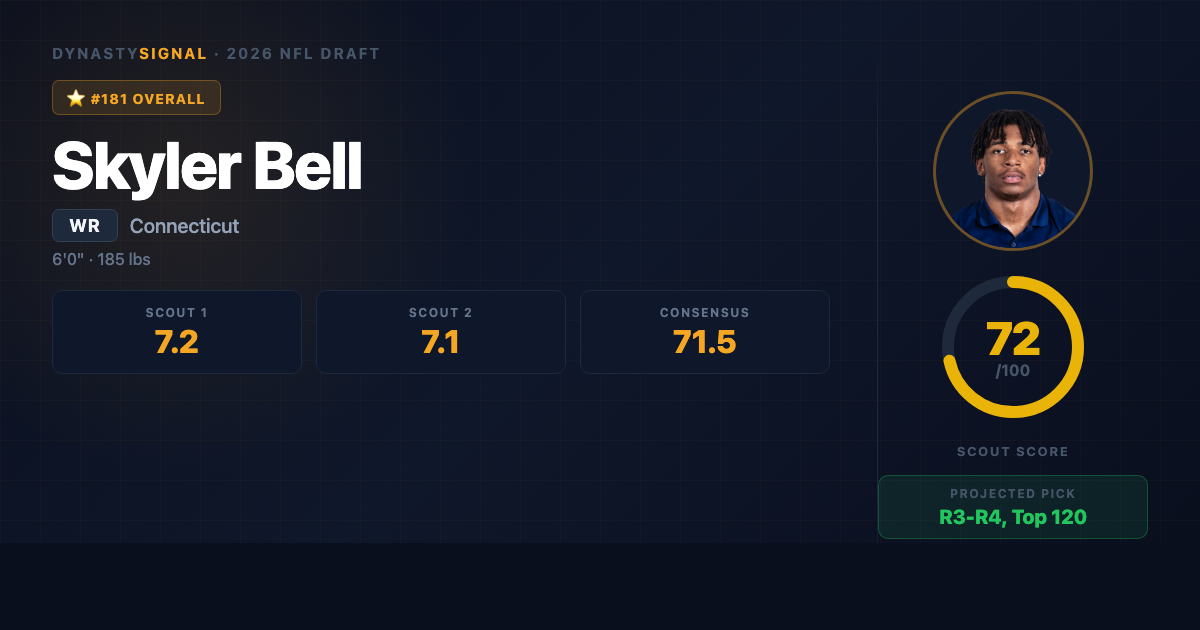
Scout 1 graded Bell at 72/100 with a projected pick range of Round 3-4, picks 75-120. The film score reflects genuine enthusiasm for Bell's speed (A-), YAC production (A-), and scheme versatility (A-), tempered by the competition-level discount on his route execution (B+) and hands (B+). Scout 1's projection frames Bell as a WR2/flex ceiling if he lands in an air-raid or motion-heavy offense, with a floor as a scheme-dependent WR4 who contributes on special teams. The Jayden Reed comp — a slot piece who earns usage through consistency and YAC rather than contested dominance — is the consensus landing point.
Scout 2 arrived at a nearly identical bottom line: 71/100, Round 3-4, picks 80-120, with an overall film grade of B-. Where the two scouts diverge is on athleticism: Scout 2 rated Bell's speed and YAC profile as adequate rather than elite, viewing his separation as route-and-IQ-driven rather than athleticism-driven. Scout 2's comp range spans Deven Thompkins (floor) to Kendrick Bourne (ceiling), which is a slightly more conservative dynasty framing. The consensus across both evaluations is a Day 3 prospect worth targeting in the late-rookie-pick range, with Year 2-3 as the breakout window in the right scheme.
PROJECTION
For dynasty purposes, buy Bell in the late first or early second round of rookie drafts — picks 1.10 through 2.04 in 12-team formats. His NFL trajectory is Year 1 as a rotational slot piece and special teams contributor, with the door cracking open for a WR3/flex role in Year 2 if he earns the trust of his offensive coordinator. The receivers with his profile — scheme-flexible slot with elite open-field speed and real YAC ability — tend to find their footing in Year 2 once they understand the pro game's timing and spacing demands. The ceiling is a legitimate WR2/flex who produces via volume in a West Coast or spread-based offense.
The key variables are landing spot and draft capital invested. A high-volume passing team — Green Bay, Detroit, San Francisco, Kansas City — turns Bell into a legitimate late-round keeper. A run-first team with a heavy press scheme buries him. If he runs sub-4.43 at the Combine, his draft stock rises and his dynasty value follows. Monitor his stock through the pre-draft process; a clean Combine showing could push him into Round 2 conversation and make him a top-20 rookie pick in dynasty formats.
View Skyler Bell's full player profile, measurables, and scouting breakdown →
🎬 All-22 Film Analysis Update
*Updated after All-22 film review by Scout1 and Scout2.*
Film Score: 71.5/100 (→ No change from base score of 71.5)
Composite Score: 71
Scout1 Assessment Skyler Bell is a consensus All-American who posted one of the most dominant single-season stat lines in UConn history — 101 catches, 1,278 yards, and 13 touchdowns in 2025 — at age 23 after a two-year stop at Wisconsin. He's a speed-first slot/Z-receiver who wins with a sudden release, legitimate track speed (4.43 range), and an innate feel for finding soft spots in zone coverage. The competition level at UConn's independent schedule will be the dividing line for evaluators, but he passed his bi...
Scout2 Assessment Bell is a smart, technically sound receiver who maximized his opportunities at UConn. The scheme fit and competition level questions are real, but there's a Day 3 prospect worth monitoring here.
*Film analysis is based on All-22 footage reviewed independently by two scouts. Scores reflect on-field evidence and may differ from pre-film model projections.*