
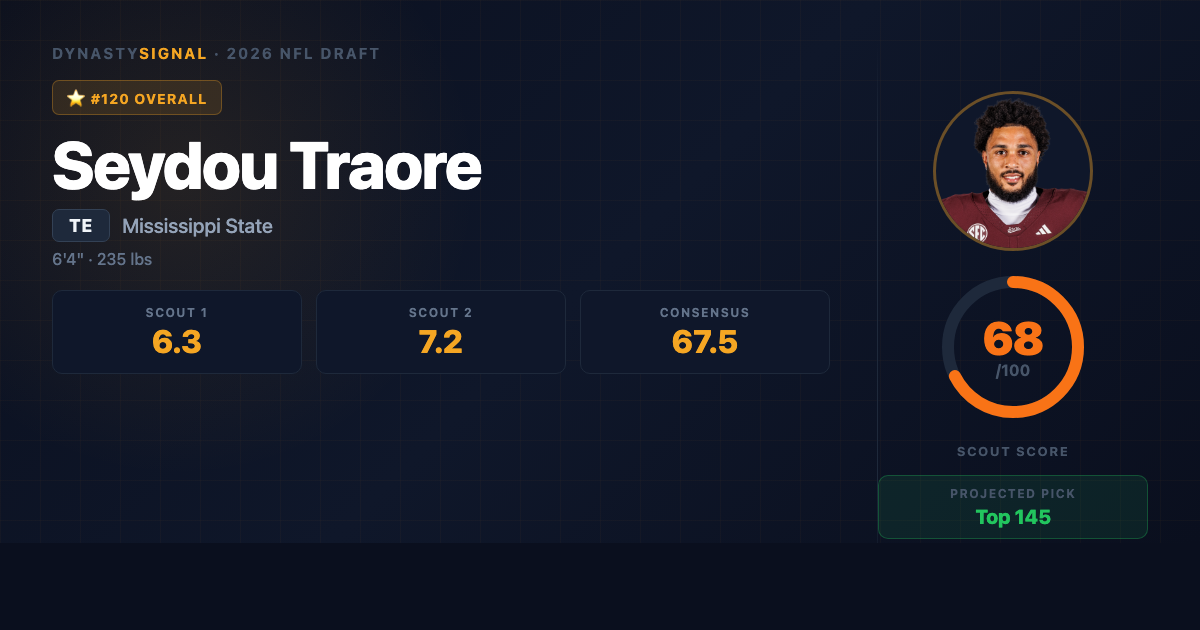
Mississippi State doesn't produce many tight end prospects worth circling on your 2026 draft board, but Seydou Traore is a legitimate exception. The 6'4", 230-lb senior is a French-born transfer who carved out a meaningful role in the SEC — not by dominating the stat sheet, but by flashing the kind of size-speed combination that NFL personnel departments covet in the modern passing game. Deployed almost exclusively in detached, wide-receiver-type alignments, Traore spent his 2024 season exposing mismatches against defensive backs who simply couldn't match his length. The result was modest: 34 catches, 361 yards, one touchdown — but the film shows a player whose real value is structural, not statistical.
What makes Traore interesting for dynasty managers isn't the 2024 production line — it's the archetype. The NFL has moved aggressively toward the chess-piece tight end, the movable Y who can flex into the slot, force a defensive declaration, and win against lighter coverage with sheer catch radius. At 6'4" with fluid, long-striding athleticism that suggests real combine upside, Traore profiles squarely into that mold. The questions are real — blocking is underdeveloped, 230 lbs is light for every-down usage, and thin SEC target volume leaves his hands evaluation incomplete — but the foundational tools are there for a legitimate NFL contributor in the right system.
STRENGTHS
Traore's film against Georgia's top-5 defense in 2024 is the most instructive data point available, and it's encouraging. Mississippi State consistently aligned him wide and in the slot — and against SEC competition at that level, he was consistently winning off the line. His release is clean and upright, his stride pattern long and efficient, and his route setup doesn't telegraph direction the way you sometimes see from developmental tight ends at this weight. On intermediate patterns, crossing routes, and sideline-oriented breaks, he creates enough separation to be a viable target. The athleticism reads off even from broadcast angles, which is usually a strong tell for combine performance. If he runs sub-4.55 with good explosion numbers in Indianapolis, his athletic grade climbs meaningfully.
The size-mismatch dimension of Traore's game is his most bankable trait. When he's split wide against a linebacker, the coverage matchup is untenable. When he's in the slot against a safety, he wins with catch radius. Scout 2's film review highlighted his frame dominating Liberty and Georgia linebackers in contested situations — extending over defensive backs for completions that smaller tight ends simply can't make. His toughness after the catch shows up too: even on limited reps, there are glimpses of a player who lowers his pad level, breaks arm tackles, and fights for extra yards rather than going down on first contact. That's a trait, not a scheme, and it matters for NFL projection.
His schematic fit in the modern NFL is a genuine strength. Mississippi State used him in multiple alignments — wide, slot, motion — which tells you the coaches saw enough versatility to deploy him as a movable piece rather than a static in-line target. The Kyle Shanahan tree, McVay-influenced offenses, and any team running heavy 11-personnel with a movable TE will know exactly what to do with Traore. His usage pattern in Starkville is almost a blueprint for how NFL offenses maximize players of his type.
CONCERNS
The blocking profile is the elephant in the room. In a full game's worth of film from a Mississippi State-Georgia matchup that included multiple short-yardage situations, Traore was never deployed as an in-line blocker against SEC defensive ends. Not once. That's either a schematic choice or a trust issue — and neither interpretation is reassuring for NFL teams that expect their tight ends to contribute in two-TE sets and the run game. Scout 2's review did identify some functional drive blocking against Liberty, but also flagged that Traore loses speed rushers when caught upright. At 230 pounds, he'll be a liability in traditional tight end alignments until he adds 10-15 pounds of functional strength. That weight addition, without sacrificing the quickness that makes him valuable, is not guaranteed.
The production question compounds the concern. Thirty-four receptions in a full SEC season is a thin résumé for a 2026 draft prospect who will turn 23 before the draft. Elite tight end prospects — even developmental ones — tend to find ways to accumulate 50+ targets against SEC competition. Some of that can be attributed to Mississippi State's poor offensive situation (they were 1-4 when the Georgia game film was shot, eventually losing 10-41), but scheme and QB quality can only explain so much. The low volume also leaves Traore's hands evaluation genuinely incomplete — there simply aren't enough catch reps in the available film to confidently assess his hands in contested situations or under pressure.
SCOUT GRADES
Scout 1 evaluated Traore as a receiver-first chess piece with a legitimate NFL archetype and came away encouraged by the athleticism and schematic fit. Individual tool grades landed at B+ (7.2) for athleticism, B (6.8) for route running, B- (6.5) for hands, and C (5.0) for blocking — reflecting both the genuine upside and the clear developmental gaps. The overall score landed at 63/100, with a projected pick in the fourth round, picks 120-145. The blocking void and thin production tempered an otherwise attractive physical profile, and the report flagged scheme fit as a critical variable: right offense, real contributor; wrong offense, roster bubble.
Scout 2 offered a more contrarian read, grading Traore at 72/100 with a Day 3 projection in the range of picks 100-130. Where Scout 1 emphasized the receiving archetype, Scout 2 saw a functional inline blocker who telegraphs his routes from space — a Day 3 special teamer who sticks as a TE2 blocker in run-heavy schemes rather than a fantasy-friendly move tight end. Scout 2 flagged the same stiffness in acceleration and the same low-volume production concerns, while crediting his size-length (9/10, A-) and his ability to sustain blocks at the point of attack. The two evaluations triangulate to a consistent fourth-round consensus with meaningfully different upside cases depending on deployment.
PROJECTION
For dynasty purposes, Traore's year-one role will almost certainly be special teams and rotational snaps — call it 20-30% of offensive opportunities as a TE2/TE3 in whatever system drafts him. The stat line in year one is a near-zero. The dynasty calculus is about year two and three: if he lands in a spread-friendly offense that values the movable TE role (think Kansas City, Detroit, San Francisco system alumni), he can develop into a legitimate flex-TE contributor with 35-50 catch upside by year three. The Cole Kmet comp is the bull case — a big-framed receiving tight end who needed time but eventually became a 65-catch starter. The Noah Gray comp is the realistic base case: a quality complementary TE who earns a consistent role without ever becoming a fantasy starter.
Avoid drafting Traore in dynasty drafts before the fourth round of rookie picks — his NFL draft slot, scheme landing spot, and combine numbers all need to clarify before he's worth real capital. In devy leagues, he's a speculative stash worth a late pick. The combine will be the pivotal moment: a sub-4.55 forty with strong explosion numbers would dramatically increase his upside and his dynasty draft cost. Watch the Senior Bowl for early blocking development evidence. The tools are real; the path to fantasy relevance is scheme-dependent and still unfolding.
View Seydou Traore's full player profile, measurables, and scouting breakdown →
🎬 All-22 Film Analysis Update
*Updated after All-22 film review by Scout1 and Scout2.*
Film Score: 67.5/100 (→ No change from base score of 67.5)
Composite Score: 67
Scout1 Assessment Seydou Traore is a long-strider with a legitimate receiving profile — a 6'4", 230-lb tight end who Mississippi State deployed almost exclusively in detached, wide receiver-type alignments, creating size-speed mismatches against defensive backs throughout the 2024 season. The case for him is straightforward: elite frame for a move TE, smooth athlete, and a coaching staff willing to get him into open space where his size advantage is maximized. The case against is just as clear: 230 pounds is ligh...
Scout2 Assessment Traore's a plug-and-play blocker for physical teams, but don't buy the "move" TE smoke—mid-round reach at best. Pass unless you need trenches depth.
*Film analysis is based on All-22 footage reviewed independently by two scouts. Scores reflect on-field evidence and may differ from pre-film model projections.*