
Robert Henry Jr. took the long road to the 2026 NFL Draft — Jones College, two NJCAA rushing titles, a Walter Jones Trophy, and three grinding years at UTSA — and he arrives with something most Day 3 backs can't claim: a verified elite trait. The 5'9", 205-pound senior ran away from an SEC defense on the road in Week 1 of 2025, posting 177 yards and two touchdowns against Texas A&M before most dynasty managers had even printed their rookie draft boards. That game alone doesn't make a career, but it's a data point that separates Henry from the noise.
His 2025 season ended with 1,045 rushing yards and nine touchdowns — First-Team All-AAC honors in a conference that no longer gets to hide its talent. Across three seasons at UTSA he has been remarkably consistent: 588 yards and 11 TDs in 2023, 706 yards and 7 TDs in 2024, and a cap-it-off senior breakout. Add his NJCAA-leading 1,302-yard, 18-TD season at Jones College in 2022 and you have one of the more complete resumes in this draft class from outside the Power Four footprint. The question for dynasty is whether the trail leads to a legitimate NFL role or a special-teams career waiting to happen.
STRENGTHS
Henry's most obvious trait — and the one that matters most — is legitimate long speed. Multiple film sequences show him separating from defensive backs in the open field the way only a handful of backs in any draft class can: cleanly, quickly, and without drama. The 177-yard eruption against Texas A&M in the 2025 season opener wasn't a stats-padding performance against soft competition — he was gashing an SEC defense on the road, and the acceleration he showed breaking into the second level was the real article. His high school track background (11.72 100m as a freshman) is not a fabrication; the film confirms it on every reel.
Beyond the headlining speed, Henry's contact balance is the secondary trait that elevates his profile. At 5'9"/205 he plays with a low center of gravity and thick lower half, fighting through arm tackles at the boundary, absorbing shots near the goal line, and churning for extra yards after initial contact. His vision in zone and gap concepts is also impressive — he reads pulling guards patiently and attacks creases with conviction without overrunning them. The coaching staff at UTSA used him in critical short-yardage situations, which signals genuine trust, and his hurdle ability in traffic shows a player who understands how to protect yardage when he can't power through.
The production resume backs the film. Three seasons of double-digit (or near double-digit) touchdown totals at UTSA, a breakout 220 all-purpose yard performance against Colorado State, and sustained excellence in the AAC. He isn't a one-game wonder or a product of soft scheduling — his counting stats against Group of 5 competition are legitimate, and the Texas A&M game provides meaningful Power Four evidence.
CONCERNS
The most honest concern is age. Henry will be 24 years old on draft day — older than virtually every running back in this class — and his dynasty window as a result shifts later and compresses. Instead of a 23-through-28 prime, you're projecting a 25-through-29 window at best, which matters considerably in a dynasty format where you're drafting futures. The JUCO route was the right call for his development, but it costs him in dynasty clock terms.
The rest of the concern list is less damning but real. His receiving and pass protection tape is essentially nonexistent — no clean pass-catching reps on film, no visible pass protection assignments — which in the modern NFL means early-career third-down exile. Dynasty managers need production on all three downs; a back who can only function in two-down packages will struggle to return value in the first two years of his career. His scheme fit is also specific: he's a zone and spread-system back who needs daylight to operate. Drop him behind an 18-personnel power offense and his impact is limited considerably. Landing spot will matter more for Henry than for most backs in this class.
SCOUT GRADES
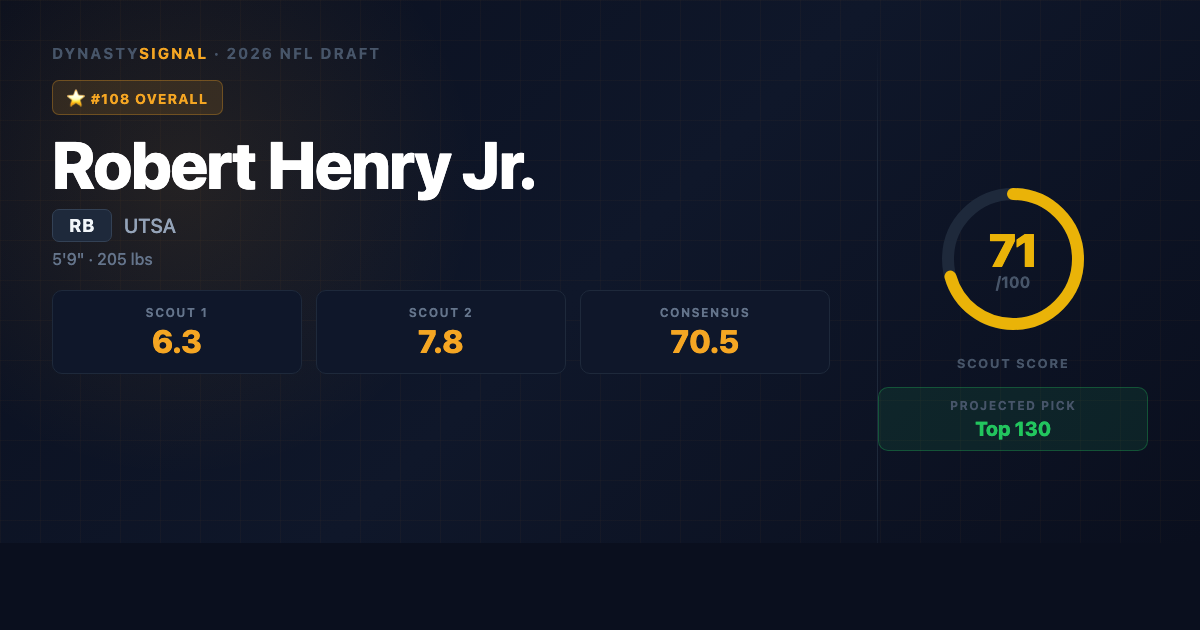
Scout 1 grades Henry as a speed-first back whose elite athleticism is his defining NFL trait — awarding an A for explosiveness and open-field threat, and a B for contact balance, while flagging vision and scheme fit as key developmental variables. The overall assessment lands at 63/100 with a projected draft slot of late Round 5 through Round 7 (picks 155–235). The primary concern driving that range is the combination of age, limited receiving tape, and zero visible pass protection reps — traits that make his path to a three-down role uncertain. Scout 1's NFL comp is Raheem Mostert: a compact, elite-speed back who requires the right scheme to unlock but becomes a genuine home-run threat when placed in it.
Scout 2 reads the same film and arrives at a meaningfully different conclusion, grading Henry as a power-first grinder rather than a speed back — emphasizing his A-level contact balance, elite vision in traffic, and workhorse production volume as the lead traits. Contact balance earns a 9/10, vision a 8/10, while long speed comes in at just 6/10, citing film sequences where Henry was run down rather than ran away. Scout 2's overall grade is 78/100 with a projected pick of Round 3, picks 70–90, arguing that Henry is a contrarian Day 2 value who will outperform his draft slot in a gap or power scheme. The NFL comp is David Montgomery — the underrated grinder who quietly became a 1,300-yard back once given a full-time role. The divergence between scouts — speed back vs. power back — is wide enough to be meaningful; the truth is likely somewhere in between, and both scouts agree on the production, the receiving question mark, and the scheme dependency.
PROJECTION
For dynasty purposes, Robert Henry Jr. fits the profile of a high-upside dart throw in the third round of rookie drafts. The cost of acquisition will likely be low given his age and Group of 5 background — NFL teams and dynasty managers alike will be skeptical enough to let him slide — but the combination of elite speed (or elite contact balance, depending on your read of the film) with three years of consistent production at a legitimate level is not something that grows on trees in the late rounds. If an NFL team with a zone-heavy system drafts him in Day 3, he could push for a change-of-pace role in Year 1 and develop toward 70–90 touches with home-run upside.
Year 1 is realistically a 40-to-70-touch season in a committee role, assuming he can demonstrate enough in pass protection to get on the field on third downs. Year 2 is the inflection point: if he earns trust in the passing game, the usage expands and the dynasty value spikes meaningfully. Year 3 has starter-level upside in the right scheme. The floor is a special-teams contributor who washes out before reaching his dynasty ceiling — that's the honest risk with every JUCO-to-G5 prospect at 24 years old. Buy Henry in rookie drafts at the end of the third round and hold through his first training camp. If he sticks and earns third-down reps, his value will outpace his acquisition cost quickly.
View Robert Henry Jr.'s full player profile, measurables, and scouting breakdown →
🎬 All-22 Film Analysis Update
*Updated after All-22 film review by Scout1 and Scout2.*
Film Score: 70.5/100 (→ No change from base score of 70.5)
Composite Score: 70
Scout1 Assessment Robert Henry Jr. is a legitimate big-play threat who has quietly posted three years of productive running back tape at UTSA, capping it with a 1,045-yard, 9-TD senior season that earned him First-Team All-AAC honors. The case for Henry is straightforward: elite long speed, genuine contact balance, and the ability to turn any carry into a touchdown — he's the rare back who can rip a 60-yard run on third-and-two and still convert a short-yardage run on fourth-and-one. The case against is equally c...
Scout2 Assessment **The Short Version** Henry Jr. is a no-nonsense, between-the-tackles bruiser who's criminally underrated because he's from UTSA—guys like this always get slept on until they hit NFL camps and truck linebackers. Hot take: He's not flashy, but in a gap/power scheme, he's a Day 2 steal who outproduces his draft slot by a mile.
*Film analysis is based on All-22 footage reviewed independently by two scouts. Scores reflect on-field evidence and may differ from pre-film model projections.*