
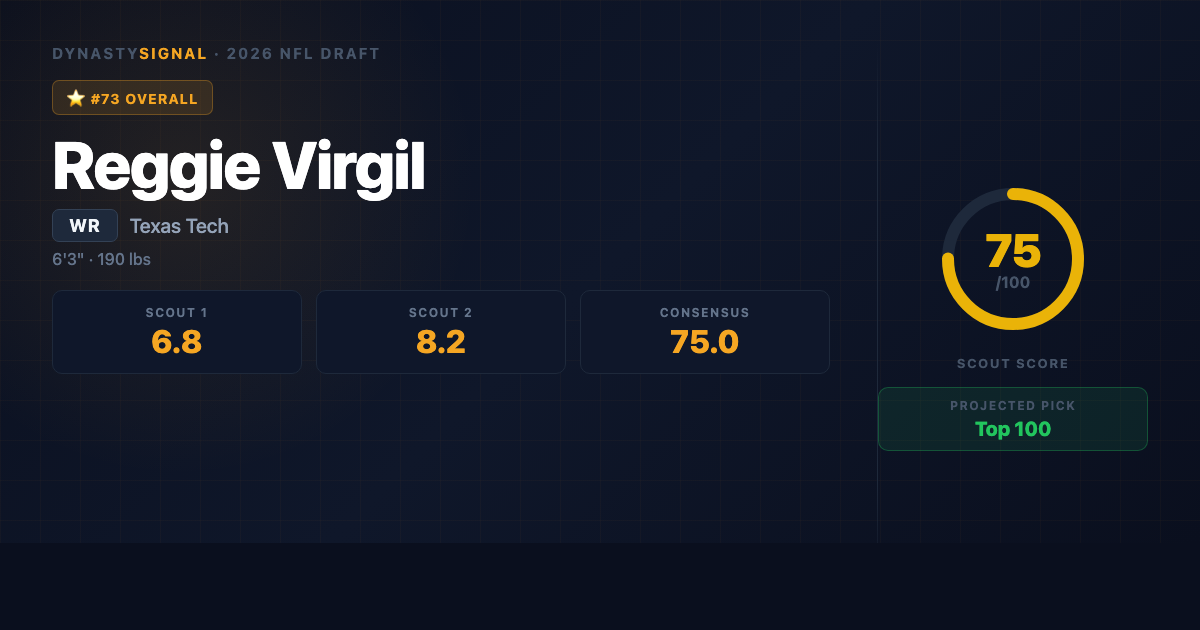
Texas Tech doesn't produce a lot of first-round buzz, but every now and then a receiver comes out of Lubbock with a skill set that quietly demands attention. Reggie Virgil is that guy for the 2026 class. A 6-3, 190-pound outside receiver with freakish hand instincts and a catch radius that stretches well outside his frame, Virgil put together a legitimate Big 12 season — 57 catches, 705 yards, and 6 touchdowns against a conference schedule that included BYU, Utah, K-State, and Arizona State. Texas Tech went 11-1 in the regular season and made the Big 12 Championship Game. These aren't padded numbers against bottom-feeders.
What makes Virgil worth your dynasty capital is the combination of contested-catch ability and red-zone upside that's genuinely rare in a receiver his age. He doesn't win with burner speed or juke-heavy route running — he wins at the catch point, extends over defenders, and secures the ball through contact. In a dynasty world increasingly obsessed with slot speed and YAC metrics, Virgil represents a different kind of value: a true outside X receiver who can be deployed as a red-zone weapon from Day 1 regardless of the depth chart around him.
STRENGTHS
The film evidence on Virgil's hands is overwhelming. Both scouts flagged his catch-radius as among the best in this class — he routinely extends both arms over his helmet on fade routes, plucks back-shoulder tosses with his fingertips, and secures the ball through contact without alligator-arming it. The pylon fade against Oregon State (28-0 in the third quarter) and the diving full-extension sideline catch are the two marquee plays of his 2025 film package — both show a receiver who understands how to use his frame as a weapon and trust his hands under duress. His body torque mid-leap is an especially rare trait: he can twist in the air on 50/50 balls and still get both feet down.
His red-zone production isn't a scheme artifact — it's a skill. At 6-3, he physically leans on defensive backs for position, boxes out smaller corners on the back-shoulder, and high-points the ball naturally. Multiple end-zone catches in this package came against draped coverage that would have grounded most receivers at this level. Scout 2 specifically identified his fade-bullying on contested end zone looks as a legitimate mismatch weapon at the next level. That trait doesn't disappear in the NFL — if anything, it becomes more valuable as red zones tighten.
Virgil also moves better than his frame would suggest. He's not a burner, but his long-speed is functional — in open-field sequences against BYU and Kansas he pulled away from closing defenders and tracked the ball cleanly at full stride. His route stems on verticals and slants are smooth, his footwork at the break point is clean against zone, and his stutter-step release against soft coverage is quick enough to generate early separation. He's a system-friendly receiver who fits naturally in any spread, pro-spread, or West Coast offense asking outside receivers to work verticals, digs, and option reads.
CONCERNS
The weight is the story. At 190 pounds, Virgil is starter-kit thin for an outside receiver in the NFL, and the film makes that abundantly clear. He was jammed off his release and pushed off his route on several occasions — not consistently, but enough that both scouts flagged it as a genuine red flag rather than a minor concern. NFL corners are bigger and more physical than anyone he faced in the Big 12, and a 17-game season full of jam attempts will test his body in ways the Air Raid never did. He needs to add meaningful mass before training camp or he risks becoming a chess piece rather than a starter.
His route tree is thin, and that's a real NFL problem. Virgil's work at Texas Tech was concentrated heavily on fades, crossers, over routes, and option reads underneath — there's limited evidence of double-moves, nuanced out cuts against press, or advanced option route adjustments. The Air Raid system handed him clean releases and favorable alignments; what happens when he has to earn his release against a physical press corner is still an open question. His short-area quickness is functional but not exceptional, and his breaks lack the crispness that would allow him to win separation on intermediate routes without help from scheme.
SCOUT GRADES
Scout 1 gave Virgil a 68/100 overall score with a projected pick range of Round 3, picks 75–100. The individual grades are illuminating: Hands/Catching earned an A- (8.0) — the clear standout — with Scheme Fit at B+ (7.5) reflecting his natural fit in spread systems, and Route Running and YAC both grading B. Athleticism came in at B- (6.4) and Blocking at C+ (5.5), reflecting the weight and press-coverage concerns that dominate the risk side of his profile. The comp landed on Josh Reynolds as a realistic ceiling — a dependable red-zone option who contributes in the right system but doesn't ascend to true WR1 territory.
Scout 2 was more bullish on the overall grade, landing at B (82/100) with a similar pick projection of Round 3, picks 80–100. The alignment between scouts is notable: Body Control/Ball Tracking at A- (8/10), Hands at A- (8/10), and Contested Catch at B+ (7/10) all confirm the same calling card. Scout 2's ceiling comp is Gabe Davis — a big-play red-zone X receiver who can be a legitimate fantasy asset in the right volume scheme. The floor comp of Jalen Nailor reflects the concern that without added mass and improved press-coverage technique, Virgil becomes a serviceable chain-mover rather than a fantasy difference-maker.
PROJECTION
For dynasty purposes, Virgil is a Round 3 rookie draft target with legitimate WR2 upside in the right landing spot. His NFL rookie year will likely look like a WR4/5 role — he won't be handed a starting job, and the weight and press-coverage questions will require an adjustment period. But his hands and red-zone skill set are the kind of traits that get a young receiver early target share, even on a loaded depth chart. If he adds 10–15 pounds before training camp and the combine confirms functional athleticism, his profile accelerates quickly.
Years 2 and 3 are where Virgil's dynasty value peaks. A receiver with his catch-radius in a high-volume air attack — think a Mahomes-era Chiefs, a Dolphins-type offense, or any team running 35-plus pass attempts per game — can reach 600–800 yards and 6–8 touchdowns with ease once he carves out a defined role. His ceiling is a genuine WR2 in dynasty scoring, particularly in PPR formats that reward his intermediate and red-zone targets. The landing spot matters enormously — a run-first or tight-end-centric offense would bury him — but with the right scheme, Reggie Virgil is exactly the kind of mid-round dart throw that wins dynasty championships three years down the road.
View Reggie Virgil's full player profile, measurables, and scouting breakdown →
🎬 All-22 Film Analysis Update
*Updated after All-22 film review by Scout1 and Scout2.*
Film Score: 75.0/100 (→ No change from base score of 75.0)
Composite Score: 75
Scout1 Assessment Reggie Virgil is a long-bodied, contested-catch specialist who punched well above his weight in Texas Tech's run to the Big 12 Championship game, posting 57 catches for 705 yards and 6 touchdowns against a legitimately tough conference schedule. At 6-3 with a wing span that allows him to outreach defenders at the catch point, Virgil is a natural red-zone weapon who wins on fades, back-shoulder tosses, and extended hands catches — not someone who creates with his feet. The case against him is his...
Scout2 Assessment **The Short Version** Virgil's a rangy red-zone threat with plus hands and body control, but he's no burner—contrarian take: scouts overhype his size/speed combo; he's a tweener who'll struggle vs NFL press without adding 15 lbs fast. Day 2 upside as WR3, not the steal everyone's buzzing.
*Film analysis is based on All-22 footage reviewed independently by two scouts. Scores reflect on-field evidence and may differ from pre-film model projections.*