
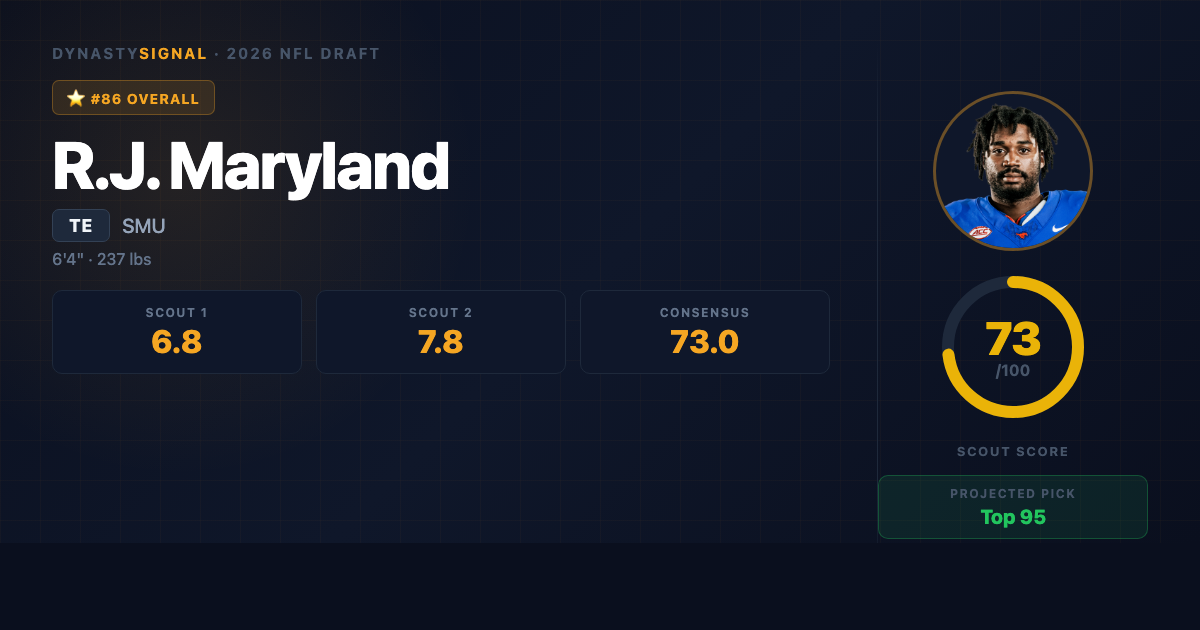
R.J. Maryland carries a last name that echoes through NFL history — his father Russell Maryland was the No. 1 overall pick in 1991, a dominant Cowboys defensive tackle who won three Super Bowls. But R.J. isn't riding a legacy; he's building his own. A track-certified sprinter who clocked an 11.33 in the 100m as a high school junior, Maryland arrived at SMU as one of the most athletic tight end prospects in the country, and he backed it up. In his 2023 breakout, he posted 54 receptions, 518 yards, and 7 touchdowns to earn First-Team All-AAC honors. Then, in 2024, he went bigger — moving up to ACC competition and opening the season with an 8-catch, 162-yard, 1-TD explosion against Nevada that earned him ACC Receiver of the Week. He was on trajectory for a legitimate draft-stock-defining junior season before a torn ACL in Week 7 ended everything.
At 6'3", 224 lbs. with a track background and the bloodlines of a No. 1 pick, Maryland is exactly the kind of tight end that NFL teams pay premium draft capital to acquire. He's a legitimate seam-stretcher who can align in-line, in the slot, or split wide — the kind of flex weapon that modern passing offenses are purpose-built around. The ACL tear is real risk, and at 224 pounds he needs to add mass to hold up at the next level. But if he tests clean at the combine and comes back at full speed in 2025, you're looking at a Day 2 prospect with upside that extends well beyond his draft slot.
STRENGTHS
Maryland's most defining trait on film is his speed — and not just speed for a tight end. Speed, full stop. His track background (11.33 100m, 23.21 200m, 50.68 400m) is confirmed elite athleticism, and it shows up every time he's in open space. In the Nevada opener, he out-ran defensive backs on a catch-and-run that helped him reach 162 yards on 8 catches, averaging over 20 yards per reception. Against Stanford, he generated separation on a vertical route from an inline alignment and took it to the house — that's not a gadget play, that's a legitimate NFL seam threat executing from TE alignment against a Power Four secondary. When a tight end can threaten the back of a defense the way Maryland does, defensive coordinators have to account for it on every down. That's positional value.
His hands are equally impressive. Scout 2 graded him at 9/10 — sticky mitts that attack the ball rather than letting it come to him. The highlight that defines his catch-point ability is an end zone reception against Florida State: arms fully extended overhead, tracking a contested ball with a defender trailing from behind, high-pointing it with the concentration and spatial awareness of a polished receiver. He's not body-catching; he's winning at the catch radius, which translates directly to the NFL level. His ball security after the catch is clean, and he runs with a north-south lean that picks up yards after contact rather than dancing laterally into loss. Scout 2 also noted elite contested catch production, giving him B+ marks in both release/separation and YAC — the combination of a quick first step off the line of scrimmage and the ability to keep running after the catch makes him a volume threat at all three levels.
Maryland's alignment versatility is the dynasty trump card. SMU moved him into a WR/TE co-starter role during his 2025 return season, confirming that his coaching staff views him as a chess piece, not a formation fixture. On tape he shows up in-line, as a wing, in the slot, and split wide — and he's credible in all of them. In high-leverage ACC games (against ranked Louisville with the game tied in the third quarter, against FSU, against Stanford) he was the primary option. You don't earn that role as a receiving-only specialist; you earn it by being the most dangerous matchup on the field.
CONCERNS
The ACL tear is the unavoidable headline. A helmet-to-knee collision during SMU's win at Stanford in October 2024 ended his junior season, and he spent the better part of a year in recovery before returning for 2025. ACL injuries don't automatically derail careers — plenty of players come back at full speed — but they can permanently dull explosion, alter cutting mechanics, and introduce hesitation in traffic. A Fox Sports report noting he "isn't 100 percent for the opener" due to knee issues in fall camp 2025 is a yellow flag. The combine will be the first real data point, and if his 40 time or vertical jump reflects a meaningful drop from his pre-injury athletic profile, the entire upside case weakens.
The weight is the other real concern. At 224 pounds, Maryland is underweight for a traditional Y tight end in the NFL. Both scouts flag it: getting washed on drive blocks against edge speed (Nevada, Stanford) and losing leverage when power rushers attack his anchor. He can get away with technique and athleticism at the college level against ACC competition; he won't be able to lean on those same advantages against NFL-caliber edge rushers if he can't add mass. His blocking grade lands at C/C- from both evaluators — not a flat-out liability, but nowhere near a strength. If he adds the 10-15 pounds of functional mass that most player development staffs would target and maintains his speed, the floor rises. If the weight gain blunts his athleticism, the ceiling lowers. That's the trade-off.
SCOUT GRADES
Scout 1 gave Maryland a 68/100 with a Round 3 projection (picks 70-95). His evaluation leans into the elite athletic profile — A- for scheme fit (8/10), B+ for speed (7.5/10) and hands (7/10) — while applying appropriate caution to the ACL recovery and the blocking question. The 68 reflects real uncertainty: it's not a dismissal of the talent, it's an honest accounting of the injury risk and the body weight limitation. Scout 1's comp lands between Noah Fant (freakish athleticism, undersized frame, Day 1 talent) and Trey McBride (reliable volume producer from a non-power program who proved it mattered).
Scout 2 is more bullish, grading him at 78/100 with a similar Round 3 window (picks 70-90). His film-specific grades are striking at the top: 9/10 for hands (A), 8/10 each for contested catch, YAC, and release/separation (all B+). Scout 2's contrarian note is that bloodlines inflate expectations — his concern is that Maryland profiles more as a gadget/mismatch weapon than a complete tight end, and that his route tree is shallow enough to be exploitable against tight man coverage. The overall grade lands at B, and his dynasty comp ranges from a Goedert-lite floor (reliable TE2 receiving pop with blocking questions) to an Evan Engram ceiling (athletic mover, YAC demon, mismatch nightmare in space). Both scouts converge on Round 3, which is the right number given the risk-reward profile.
PROJECTION
In dynasty, Maryland's value is a bet on a specific outcome: clean combine testing, a full-speed 2025 return, and a landing spot in a pass-heavy offense that deploys moveable tight ends rather than traditional Y blockers. If all three break right, his receiving upside from 2023 (54/518/7 TDs) understates the ceiling — he was doing that in the AAC before the injury, and his 2024 ACC film showed he was ready to take the next step before the knee ended it. The ideal NFL home is something in the mold of Kansas City or San Francisco — a scheme that creates seam stress through formation flexibility and wants a tight end who can go from in-line on 1st and 10 to isolated in the slot on 3rd and 6 without a substitution.
Year 1 in the NFL is likely a developmental role — TE3/flex piece on a competitive roster, learning the blocking assignments and earning snaps through receiving production. Year 2 is where the volume starts if the health holds: a TE2 role with legitimate targets in a 12-personnel-friendly offense. Year 3 is the ceiling window — if the scheme is right and he's added the weight, he profiles as a starting TE1 who grades out as a fantasy asset at the position. The bust risk is real and lives entirely in the knee and the weight room. But the upside comp is Noah Fant meets Evan Engram — and those are names worth chasing in dynasty.
View R.J. Maryland's full player profile, measurables, and scouting breakdown →