
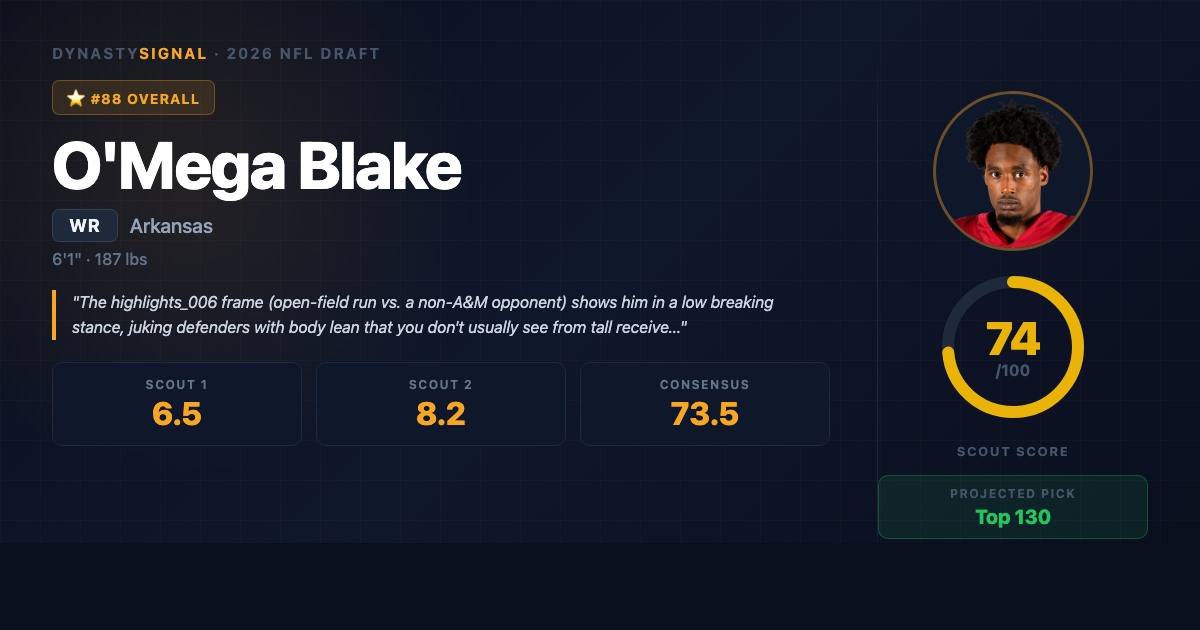
There are wide receiver prospects who make you work to find the upside, and then there are prospects like O'Mega Blake — where the upside finds you. At 6'3" and 220 pounds with legitimate top-end speed, Blake is the kind of size-speed combination that NFL front offices circle on their draft boards and never stop talking about. A winding path through South Carolina, Charlotte, and Arkansas has produced a player who is, at 23 years old, finally playing to his physical ceiling — and what that ceiling looks like on film is genuinely exciting.
Blake's breakout came in 2024 at Charlotte, where he turned in one of the more electric G5 seasons in recent memory: 32 catches for 795 yards and 9 touchdowns, a jaw-dropping 24.8 yards per reception that wasn't a fluke of scheme — it was a fluke of talent. He followed that up by transferring to the SEC and holding his own at Arkansas in 2025, proving the traits survive contact with real competition. When the combine clock starts in Indianapolis, and if it stops somewhere south of 4.45, O'Mega Blake's draft stock is going to move very fast.
STRENGTHS
The calling card is the speed, and the film doesn't disappoint. In Charlotte tape against ECU, Blake converts a deep ball and the cornerback isn't trailing close — he's left multiple yards behind as Blake crosses the goal line. He isn't catching up to the football; he's running *away* from a defender who was already at full speed trying to close. Against UAB in a 4th-quarter tight game, he catches a ball in space around midfield and simply accelerates past pursuit angles from multiple directions — that's track-level burst in a football context. For a receiver who carries 220 pounds on a 6'3" frame, it's a genuinely rare combination that creates structural mismatches the moment he lines up.
Blake's hands and red-zone ability are a legitimate secondary weapon. Against Ole Miss in the SEC, he high-pointed a fade in the back of the end zone — both hands above his frame, attacking the ball at its highest point, with a trailing defender unable to contest. That's not raw athleticism masquerading as technique; that's trained ball-tracking paired with spatial awareness. He shows the same hands in traffic against Texas A&M, catching through contact with a defender draped over him and maintaining ball security. Across the full body of film reviewed, concentration drops are conspicuously absent, and his contested-catch reliability near the goal line is the kind of thing that keeps NFL scouts coming back to the tape.
After-the-catch production is where the dynasty case accelerates into something special. Blake runs *through* tackles the way backs do, with a low pad level that lets him absorb hits and drive for extra yards rather than going down on first contact. Against Texas A&M defenders, he broke through a diving tackle while absorbing a secondary hit from another defender and kept churning. The Charlotte-to-Arkansas arc shows a player who was always this physically equipped — he just needed quality competition to expose how much of the game comes naturally. His hip quickness and field acceleration in space are attributes that translators love when projecting to NFL YAC-friendly systems.
CONCERNS
The primary reservation on Blake is route refinement, and it's real. On intermediate routes — digs, crossers, double-moves — he tends to round off his cuts rather than snap them, which bleeds separation against tighter coverage. The Arkansas coaching staff deployed him frequently in schemed quick-game concepts and motion packages against Alabama A&M rather than isolating him on contested coverage routes, which tells you something about where their trust level sat early in the season. Both scouts flagged his route tree as a work in progress: his breaks are predictable against man coverage, he can telegraph route stems, and press coverage at the line of scrimmage remains an unresolved question mark heading into the NFL. How much of his college separation was architecture, and how much was execution, is the central debate.
The surrounding context also demands honesty. His monster Charlotte season came in part against FAU (2-8), UAB, Rice, and other AAC/CUSA-caliber defenses. The competition-level concern isn't fatal — plenty of productive NFL receivers came from G5 programs — but it does require the combine and pre-draft process to validate what the tape suggests. His transfer history (three programs across five seasons) raises developmental questions, and at 23 years old entering the 2026 draft he carries a slightly tighter development ceiling than younger prospects at a comparable talent tier.
SCOUT GRADES
Scout 1 projects Blake as a late Day 3 value, assigning a 65/100 overall grade and a Round 4 projection (picks 110–130). The assessment centers on Blake as a functional football player with a genuine plus tool in his speed-for-size, but real limitations in route nuance and press-coverage projection. The DJ Chark comp — a 6'4" speed demon from LSU who ran a 4.34 at the combine and became a legitimate NFL contributor before injuries — captures both the ceiling and the fragility of the profile. Scout 1's view: buy the athleticism, accept the developmental ceiling, let the combine be the catalyst.
Scout 2 arrives at a considerably more optimistic conclusion — 82/100 with a Round 2 projection (picks 40–60). The alternate measurable profile (6'1"/200) aligns with a slot-leaning deployment, and Scout 2 sees a Zay Flowers–type ceiling: a twitchy, explosive weapon who can separate via athleticism and create havoc in motion-heavy, RPO-friendly systems. The YAC violence and ball-tracking ability earn grades of 8/10 in both categories, and Scout 2 grades his release package at 7/10 — functional enough to survive NFL press if deployed smartly. The split in projections (Round 2 vs. Round 4) reflects genuine uncertainty about how much his competition discounts the tape; the traits themselves are not in dispute.
PROJECTION
For dynasty managers, the ideal entry point is the mid-to-late third round of rookie drafts — after the consensus WR1/WR2 options come off the board but before the combine potentially sends Blake's consensus ADP surging. His dynasty floor is a functional WR4/flex weapon in his rookie season, used in the slot and motion packages the way teams deploy gadget-speed receivers to create schemed looks. The landing spot will matter enormously: in a Shanahan-style system, an RPO-heavy offense, or alongside a mobile quarterback who stresses defenses pre-snap, Blake's athleticism gets weaponized in ways that could fast-track his role.
The Year 2–3 projection is where it gets interesting. If he develops even modest route-running nuance to complement his speed — tighter releases against press, cleaner intermediate breaks — the WR2 ceiling is real and the production trajectory could mirror a Marvin Jones Jr. developmental arc: a physically gifted receiver who takes two or three years to fully translate his tools into a consistent NFL role. He won't be a WR1 for your dynasty roster, but a 6'3"/220-pound receiver running sub-4.45 who can win vertically, attack the red zone, and pile up YAC in the right system is a legitimate WR2 asset by his third NFL season. The combine will set the market — get in before it does.
View O'Mega Blake's full player profile, measurables, and scouting breakdown →