
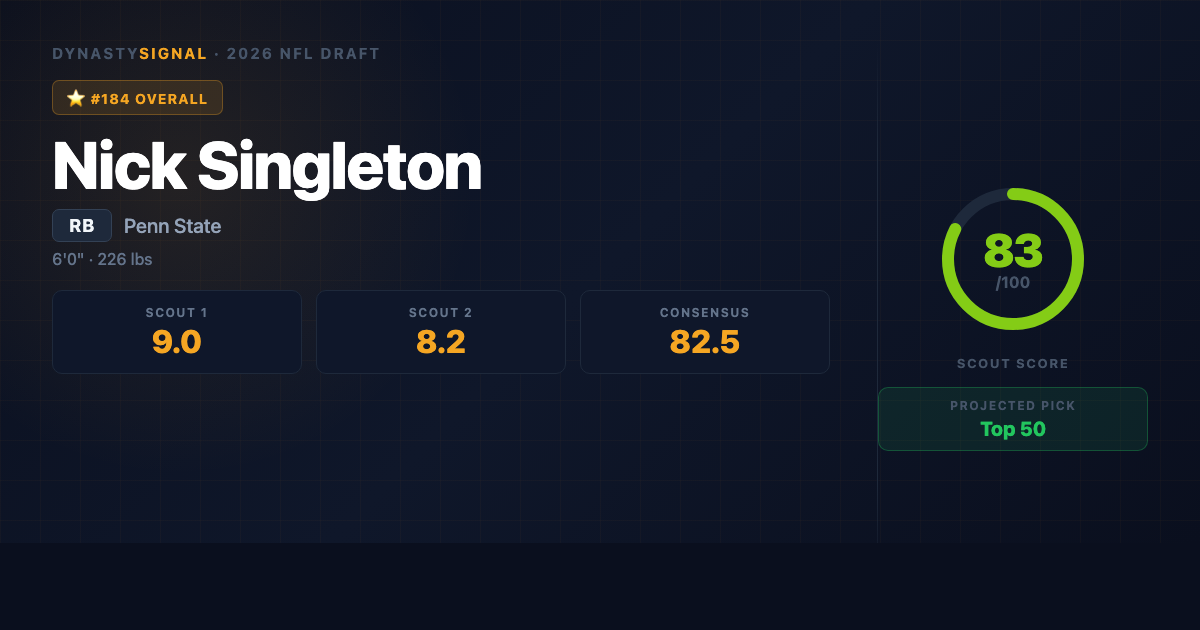
Nick Singleton arrived at Penn State in 2022 as the crown jewel of that recruiting class — a 5-star, top-6 national prospect who looked the part from the jump. Four years later, he's leaving State College as arguably the most *efficient* running back in the entire 2026 NFL Draft class. His EPA/Play (0.22), EPA/Rush (0.22), and Success Rate (55.4%) all led his peer group, which includes names like Ashton Jeanty and TreVeyon Henderson. And his 8.9% Stuff Rate — the lowest of any major draft prospect — means he almost never wastes a down by running into a wall. That's not luck; that's football IQ translated into production.
What makes Singleton interesting for dynasty is the package he represents: a legitimate home-run threat with elite pre-contact efficiency *and* a passing game profile that goes well beyond dump-off duty. His 0.25 EPA/Target led the class, and a 77.1% catch rate on 8.7 yards per reception shows a back who can be deployed as a genuine passing-game weapon. In a dynasty landscape where dual-threat running backs command premium capital, Singleton checks nearly every box that matters — with one or two legitimate asterisks that will shape where he lands on your board.
STRENGTHS
Singleton's calling card is vision and decisiveness, and the film proves it repeatedly. His 2.0 YBCt/Att (yards before contact per attempt) was the best in his class — a metric that captures exactly what scouts love: a back who maximizes available yards before a defender ever touches him. Against Minnesota, the all-22 shows him identifying a stunting defensive tackle, pausing for a half-count, then exploding through the adjacent gap once the block develops. Against BYU, he threads a crease so tight that only a back with elite spatial awareness would have even identified it. He doesn't freelance or dance; he reads, commits, and accelerates — a refinable, sustainable NFL skill set.
The explosiveness on top of that vision is what elevates his ceiling. Multiple tape examples against ranked opponents in high-leverage games — the Rose Bowl against Utah, the Fiesta Bowl against Boise State, road games at Maryland — show him separating from entire secondaries with what projects as sub-4.4 speed. In the Fiesta Bowl clip, Singleton's blocker is effectively serving as a parade escort while a pursuit defender trails by five-plus yards. That's not scheme-created speed; that's legitimate game-breaking ability against Power 5 competition on the biggest stages. Add in his underrated receiving ability — where he dramatically outperformed backfield mate Kaytron Allen (0.25 EPA/Target vs. Allen's -0.15) — and you have a back whose multi-faceted value proposition deserves more than a simple "speed back" label.
His big-game track record is worth underscoring for dynasty purposes. Penn State trusted Singleton on 4th & 1 against Maryland, 3rd & Goal against Illinois, and goal-line carries in multiple bowl games across a four-year career. Coaching trust in high-leverage moments doesn't get handed out arbitrarily — it's a signal of character, reliability, and football intelligence that tends to translate.
CONCERNS
The legitimate knock on Singleton is his broken tackle rate, and it's not a small one. At 29.9%, his Broken Tackle % was the lowest among major class peers — Jeanty broke tackles at 49.7%, Jeremiyah Love at 42.5%, Henderson at 36.8%. At the NFL level, where angles are tighter and defenses faster, a back who can't regularly turn a 5-yard gain into 9 by breaking arm tackles becomes scheme-dependent in a way that limits his ceiling if he lands in the wrong system. He can handle contact and maintain forward lean — the film shows that — but he won't routinely manufacture extra yards the way the class's most physical finishers do. His YACt/Att sits in the middle of the class, confirming it.
The other genuine concern is pass protection, where the film simply provides no clear evidence. Penn State used him in a shared backfield with Allen, and how they divided protection assignments is unclear from available tape. Teams will need to see pro-day blitz pickup work before they can confidently project him as a three-down back. If protection is a weakness, his early NFL role could be capped at a rotation back with defined snap counts — which would suppress dynasty value in the near term, particularly in the first year.
SCOUT GRADES
Scout 1 grades Singleton at 83/100 with a projected draft range of late Round 1 (picks 20–32) to early Round 2 (picks 33–48). The evaluation leans into his elite efficiency metrics and home-run speed as the primary value drivers, while flagging the broken tackle rate and pass protection uncertainty as the two legitimate drags on his grade. The comp of choice is Tony Pollard — a similarly dynamic, efficiency-first back who needed time and the right system to develop into a lead back, but whose floor as a high-efficiency, pass-game-capable RB2 was always clear.
Scout 2 lands at 82/100, projecting him squarely in Round 2 (picks 35–50), and takes a slightly more skeptical view on his power and contact finish. The film note on marginal performance against loaded fronts — getting absorbed by 8-man boxes when Penn State's offensive line couldn't create clean lanes — is a real concern that the advanced stats partially obscure. Scout 2's ceiling comp of Jahmyr Gibbs (if he adds functional strength to his elite athleticism) and floor comp of Zach Charbonnet (speed-and-vision complementary piece without the physical dominance) frames the range of outcomes well. Both scouts are aligned on scheme fit: zone-based operations unlock his ceiling; gap-heavy or power-heavy teams should step back.
PROJECTION
For dynasty, Singleton is a high-upside RB2 in Year 1 of his NFL career who you're betting on becoming an RB1 by Years 2–3 if the landing spot is right. A zone-heavy operation — think San Francisco, Dallas, Houston, or a Miami-style spread system — gives him the clearest path to a featured role. In Year 1, project him as a committee back who flashes, contributes as a third-down option, and builds his case for more. In Year 2, if an offensive line clicks and the scheme fits, he has genuine 900–1,100 yard upside with receiving production as a meaningful add-on. The Tony Pollard development arc is the right frame: it took time for the role to materialize, but the talent was never in question.
Avoid workhorse contexts (Pittsburgh, traditionally power-oriented offenses) and temper expectations if he lands without a clear path to carries. The broken tackle and pass protection questions are real enough that a committee role is the realistic floor — which is fine if you drafted him at his proper value in the second or third round of dynasty rookie drafts. His efficiency profile and receiving ability give him a safe floor as a flex contributor even in a timeshare. The ceiling, with the right landing spot, is a Top-12 RB by Season 3.
View Nick Singleton's full player profile, measurables, and scouting breakdown →
🎬 All-22 Film Analysis Update
*Updated after All-22 film review by Scout1 and Scout2.*
Film Score: 82.5/100 (→ No change from base score of 82.5)
Composite Score: 82.5
Scout1 Assessment Nick Singleton is an elite-efficiency, zone-scheme running back whose calling card is vision, decisiveness, and home-run speed — not power or broken tackles. The case for him is straightforward: he led the entire 2026 RB draft class in EPA/Play (0.22), EPA/Rush (0.22), and Success Rate (55.4%), while also posting the lowest Stuff % (8.9%) — numbers that paint a picture of a back who rarely makes a wrong decision, consistently moves the chains, and creates explosives when the defense over-commits...
Scout2 Assessment Singleton's twitch makes him draftable, but he's no three-down hammer—contrarian fade on top-15 buzz; smart R2 value for speed-score addicts.
*Film analysis is based on All-22 footage reviewed independently by two scouts. Scores reflect on-field evidence and may differ from pre-film model projections.*