
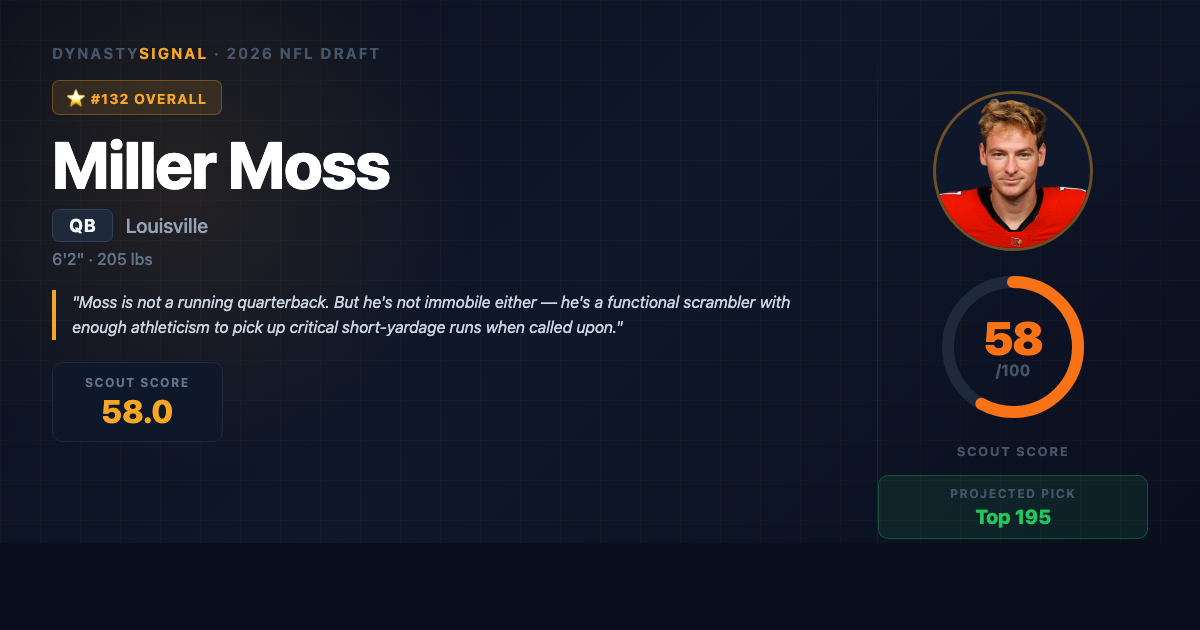
Miller Moss arrived at Louisville with something to prove. After inheriting the USC starting job when Caleb Williams left for the NFL, Moss put together a serviceable but scrutinized season for the Trojans before transferring to Louisville — where he promptly silenced doubters with one of the most quietly impressive 2025 ACC campaigns of any quarterback in the draft class. He finished the regular season with a 64% completion rate, 2,526 yards, and 23 touchdowns for a ranked Cardinals squad, orchestrating multiple fourth-quarter comebacks and delivering the signature win of the college football year: a road upset of the #2 team in the country.
What makes Moss interesting for dynasty isn't a single elite trait — it's the accumulation of evidence that he competes at a level above his measurables suggest. At roughly 6'1" and 210–215 lbs with average arm velocity, he's easy to dismiss on a pre-draft checklist. But the film tells a different story. Down 0–17 on the road at Pitt? He won. Facing #2 Miami away from home? He controlled the clock and won 23–13. Down in the fourth quarter against Virginia, his own 6-yard line, needing a miracle? He converted a 3rd-and-24 with two minutes left. Quarterbacks who do that consistently don't do it by accident.
STRENGTHS
Moss's defining trait is his ball placement, and it shows up repeatedly on film. Rather than relying on arm velocity to force throws through coverage, he consistently wins by putting the ball where only his receiver can make a play — back-shoulder fades on the boundary, back-corner fades in the end zone, touch-drops over linebackers on crossing routes. The 23-touchdown season on 2,526 yards translates to a touchdown roughly every 110 yards of offense, and the film confirms he earns those in a variety of ways: designed TD throws to Bell Jr. in the corner of the end zone against Miami, a 3rd-and-1 play-action strike against Pitt with the game on the line, and a red-zone fade against EKU that was placed perfectly against tight man coverage.
His pocket poise under duress is the other standout quality. Moss was backed up at his own six-yard line against a ranked Virginia defense and still drove the field to cut the deficit. He converted a near-impossible third-and-24 in the final two minutes on the road. Against #2 Miami — the loudest, most hostile environment Louisville faced all year — he scored early on a QB sneak and never let the Hurricanes back into the game. These aren't garbage-time numbers. These are fourth-quarter moments in power-conference stadiums, and Moss delivered in virtually all of them. The body language the film captures between plays — upright posture, no visible panic — is a meaningful signal about how he'll handle a sideline when things go sideways in the NFL.
Scheme versatility rounds out the strengths profile. Louisville's 2025 offense was a genuine hybrid: under-center power concepts, shotgun spread, RPO elements, two-minute hurry-up. Moss handled all of it. He worked from heavy goal-line packages and empty formations alike, and ran short-yardage QB sneaks when needed without flinching from contact. That formation flexibility matters for NFL teams deciding whether a developmental QB can execute multiple systems over a long roster tenure.
CONCERNS
The arm talent ceiling is the real limiting factor. Nothing on film suggests elite velocity or the ability to stress defenses vertically on a consistent basis. The one deep ball captured in the highlight set showed adequate but unremarkable trajectory — the kind of throw that works when the receiver wins his route, but not the kind that creates separation on its own. In the NFL, where windows close faster and corners are longer and faster, a below-average arm can become a structural liability on outside breaking routes, deep crossers, and any throw requiring the QB to win versus press coverage on the perimeter. Combined with a frame that doesn't project significant added mass at 6'1", there's a real ceiling here.
There are also schedule and sample-size concerns worth noting. The early portion of the highlight film is dominated by FCS opponent EKU and mid-major James Madison — competition that inflates efficiency numbers and can make an average offense look elite. Moss's resume does include meaningful Power-4 wins, but he also failed to close the comeback against #24 Virginia in what appeared to be a 24–21 final. More importantly, this evaluation is based on a curated highlight package: incompletions, sacks taken, bad decisions under collapsing pockets, and turnovers are not visible. The 36% incompletion rate underlying the 64% completion number is essentially unaccounted for.
SCOUT GRADES
Our scout graded Moss at 58/100 overall, projecting him as a 5th-to-6th round selection (picks 148–195). The individual film grades tell a cohesive story: Accuracy & Touch led the card at 63/80, driven by the 64% completion rate and multiple well-placed throws in tight windows on the road. Pocket Presence and Toughness graded at 67/80 — his strongest attribute and the most transferable trait to the NFL level. Processing and Decision-Making came in at 61/80, supported by the multi-game evidence of functional progression reads and successful two-minute drill execution. Arm Talent graded at 55/80, reflecting sufficient but unspectacular velocity. Mobility graded at 50/80 — functional scrambler, not a running threat. The consensus NFL comp is Cooper Rush: an accurate, tough, system-fit quarterback who doesn't profile as a franchise centerpiece but has repeatedly proven capable of winning games when given the opportunity.
PROJECTION
For dynasty purposes, Moss is a late-round flier in superflex leagues — the kind of dart throw you take in the final rounds of a startup when you're already covered at QB1 and QB2. His NFL path is realistic but narrow: a late Day 3 pick who makes a roster as QB3, develops into a credible QB2 by year two, and by year three is either a career backup earning –8M annually or earns a spot start if a starter goes down and performs well enough to hold the job for three to four weeks. The Colt McCoy career trajectory — a long-tenured backup who occasionally wins games in relief — is the honest floor. A Cooper Rush-type breakout season is the ceiling.
The reason to roster him at all in dynasty is that the NFL is increasingly short on QBs who can win games in a pinch and operate efficiently in West Coast or RPO-heavy systems. Moss fits exactly that profile. If he lands with a team that protects his arm limitations — a run-first team that asks him to make five to twelve reads per game rather than sixty — he has the competitiveness and accuracy to outperform his draft slot. Don't reach for him. But if he's there at the end of a startup draft and your QB depth is already sorted, there's real signal buried under the modest measurables.
View Miller Moss's full player profile, measurables, and scouting breakdown →
🎬 All-22 Film Analysis Update
*Updated after All-22 film review by Scout1 and Scout2.*
Film Score: 65.0/100 (↑ +7.0 from base score of 58.0)
Composite Score: 61
Scout1 Assessment Miller Moss is a transfer-heavy, production-validated pocket quarterback who beat the #2 team in the country, orchestrated multiple comebacks against Power-4 defenses, and posted a 64% completion rate with 23 touchdowns for a ranked Louisville squad in the ACC. The case for him is straightforward: he's been battle-tested in big moments, shows functional mobility, and operates efficiently in a pro-style spread hybrid that translates well. The case against is equally plain: his arm strength doesn'...
Scout2 Assessment Excellent anticipation/touch | Smooth mechanics/arm talent | Limited mobility but poised [confidence: high]
*Film analysis is based on All-22 footage reviewed independently by two scouts. Scores reflect on-field evidence and may differ from pre-film model projections.*