
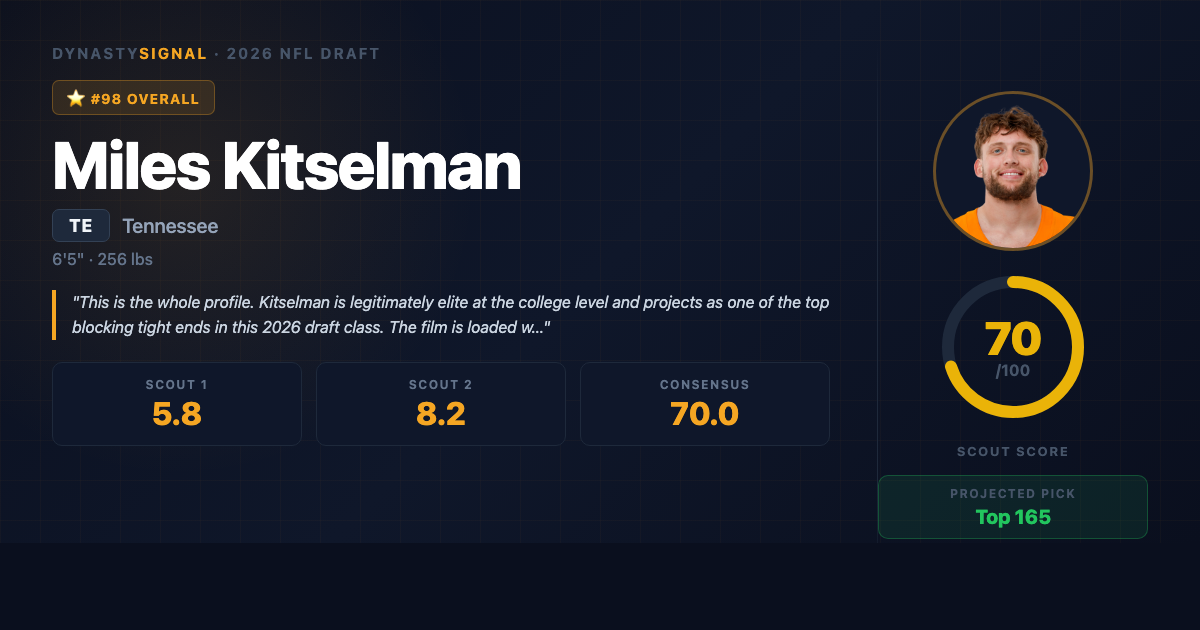
Miles Kitselman doesn't show up on the dynasty community's radar yet — but the 6'5", 256-pound tight end out of Tennessee is the kind of player who quietly earns a 53-man roster spot and stays there for five years. A fifth-year senior who cut his teeth at Hutchinson Community College before spending two years as a reserve at Alabama and then transferring to Tennessee, Kitselman is the definition of a prove-it prospect: every stop on his journey demanded more of him than the last, and at each one he delivered. The Volunteers leaned on him as a key catalyst of one of the SEC's most productive ground attacks in 2024–2025, and the film shows why.
The receiving numbers are modest — 48 receptions, 551 yards, and 6 touchdown catches across two seasons in Knoxville — but context is everything here. Tennessee's run-first attack deliberately limited his route tree, and even within that constraint he racked up six red-zone scores and showed a career near-zero drop rate. His size (long arms, wide catch radius) and blocking dominance make him a legitimate two-phase weapon rather than a pure Y-blocker collecting a paycheck. Toss in a journeyman's toughness — he was on Josh Heupel's leadership council as a fifth-year veteran and competed through a pectoral procedure in spring 2024 and a left leg injury in November 2025 — and you have the makings of a player coaches fall in love with long before fantasy managers figure it out.
STRENGTHS
Blocking is where Kitselman's career will be made, and the film is unambiguous about it. Against Georgia — arguably the toughest defensive front in the SEC — he delivered what appears to be a pancake block in a second-and-five run situation, firing off the line with violent hands, proper leverage, and the kind of sustain through the whistle that defensive line coaches get paid to develop. He's seen holding his assignment against NC State in a ranked matchup, anchoring in-line against Kentucky's pass rush, and pulling wide as an outside blocker in perimeter run schemes. Tennessee's ground game didn't run through Miles Kitselman by accident; opposing coordinators knew he was the enforcer and game-planned accordingly. At 8.5-to-9 out of 10 on the blocking scale per both scout evaluations, he projects as one of the top blocking tight ends in this entire draft class — a player who could be an NFL starter in 12-personnel on Day One.
His hands are a legitimate secondary skill rather than an afterthought. Kitselman's career drop rate was essentially zero until battling through injuries in 2025, and the clutch-moment evidence on film is compelling: a third-and-five catch across the middle against Vanderbilt in a tie game with two defenders converging, a back-corner end-zone touchdown against Syracuse that required outstanding body control and spatial awareness, and a sideline grab near the boundary with a defender closing. Long arms and strong hands create a wide catch radius — he plucks balls away from his body and secures contested catches in traffic. Both scouts awarded him an 8/10 on hands, which is elite for a blocking-first tight end.
The vertical threat is real and underappreciated. An open-field sequence against Arkansas in the fourth quarter showed genuine burst from a 256-pound man — long striding gait generating deceptive speed that made pursuing defenders look slow. On a seam release against Oklahoma, he won the release cleanly and got a step behind the defender. Kitselman probably runs closer to a 4.75 than a 4.90, which creates real problems for linebackers assigned to carry him vertically. Defensive coordinators who sleep on his speed get burned; that's the kind of player who sticks in an NFL offense even with a narrow route tree.
CONCERNS
Separation at the break is the biggest limiting factor in Kitselman's receiving profile, and it's a real one. He creates space through size and physicality — not footwork, not burst out of cuts. Against an SEC reserve that's manageable; against NFL linebackers who are faster, and nickel corners who are bigger, his window of separation will compress on the horizontal route tree. Curls, digs, and out-breaking routes will be stressed. The third-and-13 frame against ETSU also reveals a YAC ceiling: once defenders get their hands on him, he falls forward rather than breaking free. He is a catch-and-fall-forward target, not a broken-tackle generator — and in dynasty formats, that distinction matters enormously because it caps the big-play upside that drives premium target-share value.
Medical scrutiny will follow him to the combine. Two significant injuries in his final season — a spring 2024 pectoral procedure that limited fall camp and a November 2025 left leg injury that cost him two regular-season games — create legitimate durability questions for a Day 3 investment. He returned for the bowl game against Illinois, which is a positive sign, and pre-injury 2025 film is clean and explosive. But NFL teams will pore over his medicals, and a prospect whose age (23 as a fifth-year senior) already compresses the development timeline cannot afford a question mark on his health record. Age combined with positional maturation curves means his dynasty window is narrower than a typical tight end prospect.
SCOUT GRADES
Scout 1 grades Kitselman at 58/100 and projects him as an early Day 3 selection — Round 5, picks 148–165. The evaluation is built around his blocking excellence (A-, 8.5/10) and reliable hands (B, 6.8/10) as genuine strengths, while flagging route-running (C+, 5.5/10) and YAC production (C, 5.0/10) as real NFL limitations. The projection is measured and floor-focused: a player who makes a 53-man roster through blocking value and situational receiving, with a dynasty ceiling in the TE18–24 range. Primary NFL comps are Ben Sims (Green Bay) and Jack Stoll (New York Giants) — both blocking-specialist tight ends who contribute in run-heavy two-TE systems without generating significant fantasy production.
Scout 2 is decidedly more bullish, grading Kitselman at 82/100 (B+) and projecting a Round 3 selection at picks 70–90 — a meaningfully earlier call that reflects a contrarian read on his Day 2 traits being masked by Tennessee's scheme and a late-season injury. Scout 2 awards elite marks on blocking (9/10), rates his hands equally at 8/10, and notably upgrades his athleticism (7/10) and YAC production (7/10) relative to Scout 1 — pointing to north-south stiff-arms and balance through contact that Scout 1 downgraded. The ceiling comp is Dallas Goedert-lite (less polish, more grit), with a floor of Jack Stoll. The two evaluations agree on Kitselman's blocking dominance and hand reliability; they diverge sharply on his receiving athleticism and, consequently, his pick projection by two full rounds.
PROJECTION
For dynasty purposes, landing spot will determine everything. If Kitselman falls to a power-gap, run-first offense — Detroit, Green Bay, San Francisco, or Kansas City in their two-TE sets — he has a realistic path to 300–450 receiving yards per season by Year 2 as the complementary tight end in 12-personnel. That's a TE2/flex asset in deeper formats and a solid late-round dynasty flier at his draft capital. He will contribute on special teams immediately, which accelerates his path to the active roster and meaningful snaps.
The honest dynasty ceiling is high-end TE2 in the right system — not a weekly locked-and-loaded starter, but a player worth rostering in 14-team leagues and streaming in 12-team formats during favorable matchups. His Year 1 value is primarily in the blocking game; Year 2 opens up as offensive coordinators figure out how to deploy his red-zone body in 12-personnel; Year 3 is where you see whether he develops enough route-running nuance to hold a meaningful role as the receiving TE ages or turns over. The window is short given his age, but the floor is durable: players who block this well and don't drop the football find NFL employment for a long time.
View Miles Kitselman's full player profile, measurables, and scouting breakdown →
🎬 All-22 Film Analysis Update
*Updated after All-22 film review by Scout1 and Scout2.*
Film Score: 70.0/100 (→ No change from base score of 70.0)
Composite Score: 69.5
Scout1 Assessment Miles Kitselman is the prototypical "glue guy" tight end — a 6'5", 256-pound fifth-year senior who was the backbone of one of the SEC's most prolific rushing offenses and showed just enough as a receiver to make teams take notice. The case for him is straightforward: elite in-line blocking credentials, reliable hands, legitimate red-zone value, and NFL-ready size with a journeyman's toughness built across stops at Hutchinson CC, Alabama, and Tennessee. The case against him is equally clear: he i...
Scout2 Assessment **The Short Version** Kitselman is a classic in-line mauler with Day 2 traits masked by a run-heavy scheme and late-season injury—contrarian take: he's no Day 3 afterthought; elite blocker with sneaky receiving upside screams TE2 starter potential in power-gap schemes. Fade the injury noise; this kid's a tone-setter.
*Film analysis is based on All-22 footage reviewed independently by two scouts. Scores reflect on-field evidence and may differ from pre-film model projections.*