
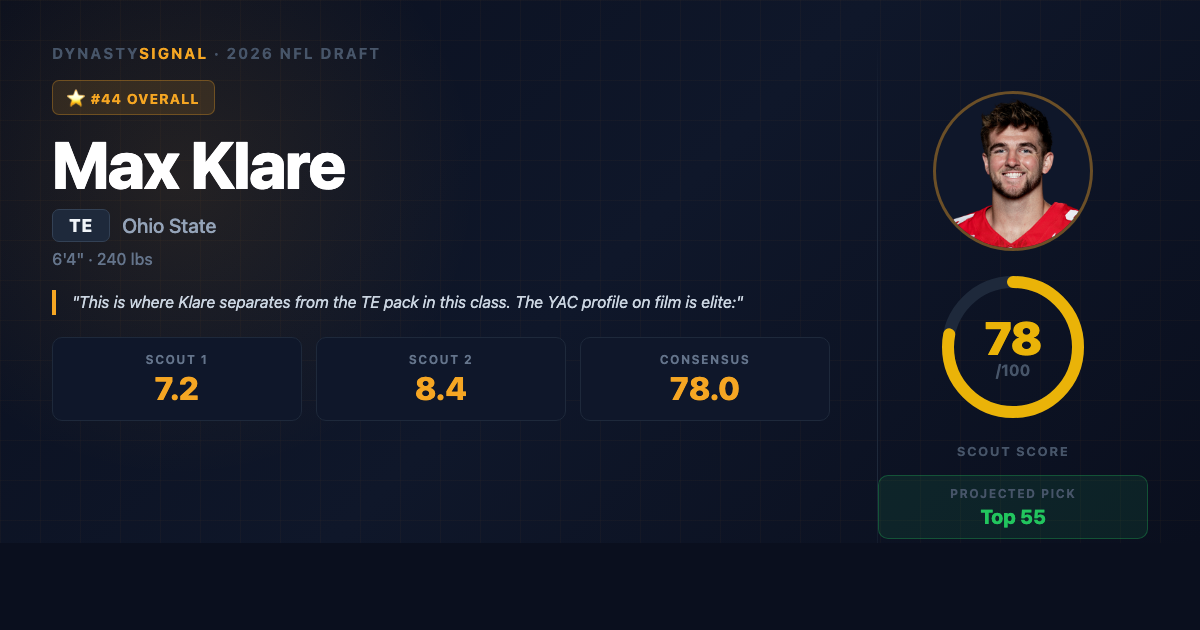
When Ohio State comes calling, you answer — and what Max Klare did next told NFL scouts everything they needed to know. After putting up one of the most efficient receiving seasons in the country at Purdue (85.6 PFF receiving grade, 4th nationally among tight ends), Klare didn't just survive the jump to Columbus — he earned snaps in Big Noon Kickoff games against ranked opponents, holding his own in an offense built around first-round skill players. That kind of quiet audition against elite competition is exactly what separates a résumé-padded prospect from a real one.
The numbers at Purdue were almost absurd given the context. Fifty-one receptions, 685 yards, 13.4 yards per catch, and a 2.22 YPRR that ranked 5th nationally — on a team that went 1-11. His quarterback posted 4-of-9, 16 yards, one interception in a game Klare still found ways to be productive. That kind of separation from team context is a legitimate green flag. At 6'4" and 236 lbs with wide receiver athleticism and a 6.6 YAC/reception average, Klare is the kind of tight end modern offenses are designed to deploy — and the kind of player dynasty managers should be targeting before the pre-draft hype fully crystallizes.
STRENGTHS
Klare's most obvious weapon on film is what happens after the catch. The Michigan State sideline sequence — four defensive backs in pursuit, Klare running free along the boundary — is the kind of clip that gets pulled for NFL draft rooms. His 6.6 YAC per reception ranked 15th nationally among tight ends, and that number undersells what the eye test confirms: he's not just escaping arm tackles in traffic, he's turning short completions into 20-yard gains with open-field burst that belongs in a wide receiver room. The Penn State tape shows him absorbing a diving tackle attempt along the boundary and staying on his feet with legitimate balance and contact power. That YAC profile in PPR formats is worth a full-round premium at a position where most players fall dead at first contact.
His route running punches above his weight for a player listed at tight end. He gets in and out of breaks cleanly, shows quick acceleration out of his stance, and understands how to weaponize his frame on seam routes and digs. The Illinois game film shows coaching staff drawing up deep crossers and seam concepts specifically designed around his ability to stress linebackers vertically — that's a tell. When a coordinator is building plays for you, not just slotting you into a generic role, it means the coaching staff sees a genuine mismatch threat. His 47%/48% slot-to-inline split confirms he's being used every way an offense can deploy a tight end, and he's executing in both alignments.
The athletic testing will be the final confirmation of what the film already shows. His change of direction is legitimate plus-athleticism — not "good for a tight end" — with quick-twitch releases off the line, smooth lateral cuts, and the kind of spring-game burst that most players his size simply cannot replicate. When Klare was targeted against Washington, Illinois, and Michigan State in live Big Ten game action, he delivered on contested catch situations with full arm extension, hands above the head, and clean ball security. The high-pointing ability is a legitimate NFL-caliber skill.
CONCERNS
The drop rate is the real conversation. At 8.9% (46th percentile), Klare drops balls at a rate that contradicts everything else about his receiving profile — he was 5th in YPRR but almost bottom-half in drop rate, meaning he's creating separation, getting open, and then occasionally letting the ball slip through. That doesn't come from nowhere. Whether it's a technique issue (body-catching on back-shoulder throws) or a concentration pattern that shows up in specific game situations is the question teams will spend combine reps trying to answer. In the NFL, a tight end with a drop problem loses targets to the running back, and a lost target compounds quickly in a week-to-week game plan.
The blocking limitations are a real ceiling cap, not a minor footnote. At 236 lbs, Klare cannot anchor against an NFL-caliber edge rusher or a strong-side linebacker in a power run scheme. He gets upright and loses leverage, and the film shows him getting washed out by speed rushers in situations where a complete tight end holds the point. Until he adds 10-15 pounds of functional strength and cleans up hand placement, he's a 60-65% snap player at best — and in dynasty, that kind of role limitation matters when you're counting on week-to-week floor. He'll need a coaching staff patient enough to develop his run-blocking before he can be trusted as a three-down starter.
SCOUT GRADES
Scout 1 grades Klare at 72/100 with a projected Day 2 selection in the range of picks 35-55. The core of this evaluation centers on the Evan Engram comparison — a big-framed, lightweight receiving tight end with elite athleticism, genuine drop history, and minimal blocking value who took five-plus seasons to fully realize his potential. Scout 1 sees the YPRR and YAC numbers as legitimately elite, flags the drop rate as the single biggest suppressor of his draft capital, and projects him as a moveable chess piece in spread-friendly systems. The blocking concern is noted as correctable but requiring real mass addition before any team trusts him in-line on early downs.
Scout 2 grades him higher at 84/100 with a projected Day 2 range of picks 35-50, and his assessment leans more bullish on the receiving toolkit while sharing the same blocking concern. His comps span Hunter Henry at the floor (reliable hands, target-hungry, but snap-limited by blocking deficiencies) to Sam LaPorta at the ceiling — a seam-and-YAC dynamo with starter traits if technique develops. Scout 2's specific caution is that the transfer shine from Purdue to Ohio State may be masking a limited snap count against truly elite competition, and that one Ohio State season isn't enough to project a full three-down role. Both scouts converge on Day 2, both see real receiving talent, and both agree the blocking development will ultimately determine whether Klare becomes a TE1 or a specialist.
PROJECTION
For dynasty managers, Klare's Year 1 profile is a depth stash with upside — a rotational seam weapon in a pass-heavy scheme who contributes in PPR as a YAC specialist while his blocking develops. The ideal landing spot is a Shanahan-tree or McVay-style offense (San Francisco, Los Angeles Rams, Kansas City) that deploys move tight ends in 11-personnel at a high rate and doesn't demand full inline blocking on every down. In those systems, Klare's athleticism and route fluidity can translate into 35-45 catches as a rookie while he earns trust on third down.
Year 2-3 is where the dynasty ceiling opens up. If the drops are corrected and the blocking improves to functional, Klare is a TE2 flex in the NFL who catches 55-70 balls in a pass-friendly system — and in dynasty PPR formats, that's a starting tight end. His Evan Engram comp is apt: Engram took time to become the 80-catch, 1,000-yard playmaker Jacksonville eventually got, but when he arrived, he arrived. Klare is the kind of prospect you buy in the mid-to-late rounds of rookie drafts while the market is pricing in the drop rate, and you hold through his development arc. The athleticism doesn't regress. The drops can be fixed.
View Max Klare's full player profile, measurables, and scouting breakdown →
🎬 All-22 Film Analysis Update
*Updated after All-22 film review by Scout1 and Scout2.*
Film Score: 78.0/100 (→ No change from base score of 78.0)
Composite Score: 79
Scout1 Assessment Max Klare is a premium receiving tight end archetype — long, fluid, and a genuine YAC threat after the catch. He built a legitimate PFF resume at Purdue (85.6 receiving grade, 4th among TEs nationally in 2024) on a team that won one game, then transferred to Ohio State and immediately held his own against top-10 competition. The case for him is clear: elite athleticism for the position, reliable hands on most routes, and the kind of open-field speed that makes coordinators design plays specifica...
*Film analysis is based on All-22 footage reviewed independently by two scouts. Scores reflect on-field evidence and may differ from pre-film model projections.*