
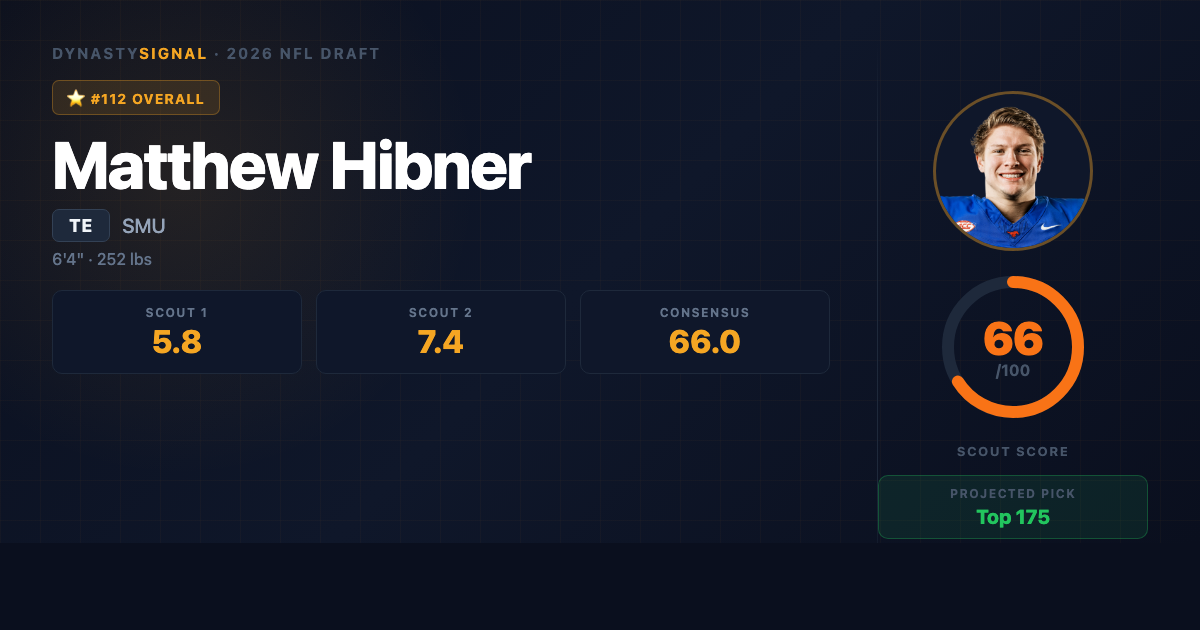
Matthew Hibner isn't the name lighting up draft Twitter right now, but he's the kind of player dynasty leagues are built on discovering early. The SMU tight end — a Michigan transfer — finally got real opportunity in 2024, and when the ACC gave him room to operate, he delivered: 24 catches for 368 yards (15.3 YPR) and 4 touchdowns in 14 games, playing meaningful snaps against Boston College, TCU, Pitt, Cal, and Clemson. That 15.3 yards per reception isn't a dump-off number. Hibner was being schemed into chunk plays, and he consistently converted them.
What makes him worth tracking is the combination of physical tools and scheme versatility in a position group that often separates dynasty rosters from pretenders. At 6-foot-4 and 252 pounds, he moves like a man 30 pounds lighter — an attribute that was on full display during a fourth-quarter sequence against Pitt where he turned a catch in the middle of the field into a massive gain, running away from the secondary with loose, long-striding athleticism. He's a fifth-year prospect with a thin production résumé, yes — but the tools are genuine, and the right landing spot could unlock a TE2 contributor with legitimate upside.
STRENGTHS
Hibner's most dangerous trait is what happens after the catch. His open-field burst for a 250-pound tight end is legitimately special. Against Pitt, he secured a catch near midfield and simply outraced the defensive pursuit — multiple defenders with angles — over 20-plus yards of open grass. He isn't a bruising, arm-tackle-breaking runner; he beats you with burst and field vision, accelerating out of his breaks and finding soft grass before defenders can reset. Against Syracuse and Cal, the same pattern repeated: catch, accelerate, gain. That Kelce-zone, linebacker-exploiting YAC profile is one of the most valuable commodities in the modern NFL, and Hibner has a legitimate claim to it.
His red-zone instincts stand out on film as a secondary calling card. Against TCU he worked through traffic near the end zone with two defenders in his vicinity, maintaining body control through contact to complete the catch — the kind of contested-catch toughness that translates directly to scoring in the NFL. Against Clemson he showed comfort working the corner of the end zone in limited real estate. Both scouts flagged his willingness to high-point seams fearlessly and absorb contact at the catch point, a prerequisite for viable NFL tight ends who aren't just perimeter options. Four touchdown catches in eight starts suggests the production was real, not manufactured.
Alignment versatility rounds out his appeal. SMU deployed Hibner as an inline tight end, H-back, and split-out receiver across their 2024 schedule, and he handled all three without obvious discomfort. That pre-snap flexibility creates legitimate defensive problems and adds roster utility at the next level. Scout 2 also graded his inline blocking higher than the eye test might suggest — flagging a violent latch-and-drive technique and a frame-leveraging physicality that stuns defenders at contact, with multiple instances of him sealing linebackers and even pancaking a defensive end (highlights_011). He's not just a receiving specialist masquerading as a tight end; there's functional blocking value embedded in his game.
CONCERNS
The production history is the elephant in the room. Hibner spent four seasons at Michigan accumulating minimal statistics before transferring — 24 catches at SMU in 2024 represent the bulk of his college résumé. Whether the Michigan quiet years reflect depth chart positioning, injury, or technique concerns is a question that needs answering at the Senior Bowl and Combine. At his age as a fifth-year prospect, the absence of a multi-year starter résumé is a legitimate risk flag, not a footnote. The highlight tape also skews toward favorable situations — including fourth-quarter garbage time against Pitt when the score was 41-11 — so the ceiling evidence is real but the sustained-dominance evidence is not.
His blocking profile, while better than initially advertised per Scout 2's film review, still carries NFL-level questions at 252 pounds. Scout 1 flagged inconsistent hand placement and an inability to displace anyone at the point of attack against bigger college defensive ends. That weight limits his inline viability in gap-scheme, run-first NFL systems, meaning his roster value is tightly scheme-dependent. Add in a narrow route tree — mostly crossing patterns and seam routes with no evidence of complex releases or deep over concepts — and you have a player whose ceiling is real but contingent on landing in exactly the right offense.
SCOUT GRADES
Scout 1 graded Hibner at 58/100 and projects him as a 5th-round pick (picks 145–175). The report emphasizes his legitimate athleticism and red-zone utility but docks him heavily for the thin production history, blocking limitations at his current weight, and the uncertainty surrounding his quiet years at Michigan. The primary NFL comp is Tyler Conklin in his NYJ/Minnesota era — a functional, productive second tight end who wins over the middle in pass-heavy systems without dominating any individual trait. The floor comp is Josiah Deguara, a versatile H-back/F-TE utility player whose dynasty ceiling tops out at streamer territory.
Scout 2 was considerably more bullish, grading Hibner at 74/100 with a 4th-round projection (picks 100–130). The divergence stems from Scout 2's higher evaluation of his blocking — grading his inline punch at 8/10 and his body control/physicality at 8/10, citing violent latch-and-drive technique and a motor that shows up chasing blocks downfield. Scout 2's ceiling comp is Dallas Goedert (if the scheme fits a move-TE role), while the floor is Tanner Hudson — a reliable blocker and gadget receiver. The meaningful gap between the two projections (one full round) reflects genuine evaluator disagreement on whether Hibner's blocking adds enough value to push him up boards, or whether his receiving limitations cap him as a late-round dart.
PROJECTION
In dynasty terms, Hibner is a late-round stash with legitimate TE2 upside — the kind of player you want to acquire at his floor price before an NFL landing spot elevates his profile. Year 1 looks like a rotational role in a system that can leverage his flexibility: TE3/TE4 in run-first offenses, or an immediate passing-game contributor in spread-heavy schemes like Kansas City, Philadelphia, or the Falcons. His dynasty clock doesn't start until he finds a home, but the traits that matter — athleticism, red-zone instincts, YAC burst — are real NFL commodities, not college-only skills.
Years 2–3 carry genuine starter upside if he adds mass (Scout 2 flagged 10 added pounds as the key threshold) and develops his route tree beyond crossing patterns and seams. The Goedert ceiling isn't a crazy projection for a player with Hibner's movement skills if he lands in a West Coast or RPO-heavy system that schemes him into space. Don't reach — his ADP should reflect the risk — but don't let him fall off your board in rookie drafts entirely. A 4th-round NFL pick with Kelce-zone athleticism and red-zone production is worth a late pick in most formats.
View Matthew Hibner's full player profile, measurables, and scouting breakdown →
🎬 All-22 Film Analysis Update
*Updated after All-22 film review by Scout1 and Scout2.*
Film Score: 66.0/100 (→ No change from base score of 66.0)
Composite Score: 65.5
Scout1 Assessment Matthew Hibner is a big-bodied, move-TE/seam-stretcher type who transferred from Michigan to SMU and had a breakout 2024 season in an ACC offense that gave him real opportunities to show what he can do. The case for him is legitimate: he's a fluid athlete for his size who can uncover over the middle, create big plays after the catch, and line up in multiple spots. The case against him is that this is a fifth-year player who only started eight games in his breakout year, his blocking film is func...
Scout2 Assessment Hibner gets overdrafted as "athletic mover"; bet against as every-down TE, but stash for blocking leagues—he derails Day 2 if can't protect edge.
*Film analysis is based on All-22 footage reviewed independently by two scouts. Scores reflect on-field evidence and may differ from pre-film model projections.*