
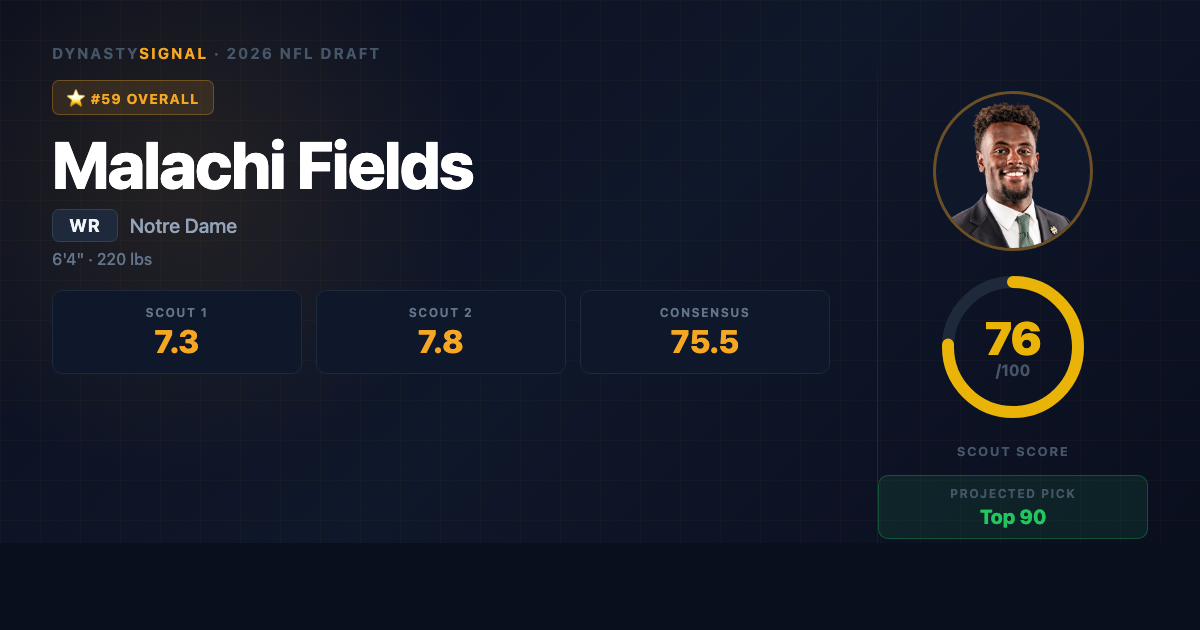
When Notre Dame needed a boundary weapon for their 2025 run, they turned to a grad transfer from Virginia who spent four quiet years building one of the most underrated careers in the ACC. Malachi Fields — 6'4", 218 lbs — arrived at South Bend not with fanfare but with purpose, and by the time the 2026 Senior Bowl rolled around, NFL.com's Lance Zierlein was calling him the most physically imposing wideout on the practice field. That's not a small statement in a receiver class stacked with high-profile names.
Fields finished his Notre Dame tenure with 36 catches, 630 yards, and five touchdowns — modest numbers in a run-heavy Irish offense — but the context matters. His 17.5 yards per reception led the team among qualifying receivers, and his 165-catch, 2,479-yard career at Virginia proved he can be a primary target when asked. The dynasty community has been slow to wake up on him, but the Senior Bowl turned heads. At a position where size and contested-catch ability are perennially undervalued in rookie drafts, Fields is worth a serious look.
STRENGTHS
Fields's calling card is his catch radius, and the film makes it obvious why scouts rave about it. At 6'4" with a long wingspan, he high-points the football in a way most defensive backs simply cannot contest. His ability to go up and snatch the ball at its peak — arms fully extended above his frame — gives him a catch window that renders conventional press coverage less effective. At the Senior Bowl, NFL evaluators specifically cited this trait as translating directly to the next level, particularly on red zone fades and back-shoulder throws. His 16 career touchdowns, spread across three seasons as a boundary target, tell the same story.
His route running is functional and improving. He ran a controlled stem against Wake Forest's corner in trail man coverage and consistently leveraged his frame to create separation on vertical routes rather than relying on burst. He's not a Stefon Diggs-level technician — his breaks can be rounded and telegraphed against zone — but at 6'4", he doesn't need to be. He manufactures catch windows through size that smaller receivers have to earn through footwork alone. His snap alignment data (89%+ outside throughout his career) confirms Notre Dame and Virginia both viewed him as a boundary WR first and always, and he's mastered the specific route tree that fits that role.
Perhaps the most underrated part of his game: he actually blocks. Notre Dame's pro-style system demands it, and Fields played all 12 starts for the Irish without being removed on run downs. Film shows him engaging in crack blocks and perimeter assignments with genuine effort — rare for a receiver his size and important for NFL teams running outside zone or RPO concepts. A 6'4" WR who adds value as a run-game tool has a longer NFL shelf life even if the receiving production develops slowly.
CONCERNS
The speed questions are real. Fields projects around a 4.50 in the 40 — functional but not threatening for a WR expected to win vertically at the NFL level. He can create the illusion of separation with his stride and length, but against disciplined NFL corners who are coached to jam and re-route, his press releases need work. Both scouts flagged struggles against physical coverage at the line of scrimmage. At the NFL level, a 6'4" receiver going 4.50 must win through technique and contested catching almost exclusively — there's no margin for sloppy releases or rounded breaks against elite corners.
His yards-after-catch profile is a real dynasty concern too. Despite his size, Fields is regularly brought down at or near the catch point. He's not a missed-tackle threat and doesn't accelerate through contact as a ball-carrier. In PPR formats, this caps his floor on underneath routes and makes him scheme-dependent — he needs to be in an offense that isolates him on verticals, fades, and deep crosses rather than using him as a short-area outlet. His Notre Dame target share (36 catches in 12 games) also leaves questions about how aggressively NFL teams will feature him, given the transfer context and modest college volume numbers.
SCOUT GRADES
Scout 1 came in with a 73/100 grade and a late Round 1 / early Round 2 projection (picks 26–40), driven primarily by the Senior Bowl performance and his contested-catch credentials. The evaluation leaned heavily on his A- hands grade, solid blocking (B), and above-average route running for his size (B+), offset by legitimate concerns about athleticism (C+) and YAC (C). The comp landed on Michael Pittman Jr. — a Round 2 pick who developed into a reliable 70/900/6 WR2 by Year 3. Scout 1 sees a similar trajectory for Fields in the right pro-style system.
Scout 2 was more skeptical on the technical side, grading Fields at B- overall with a Round 3 projection (picks 70–90). The size and physicality grade was elite (9/10, A-) and YAC surprisingly high (8/10, B+), but route running (6/10, C) and press release (5/10, C-) dragged the overall down significantly. Scout 2's floor comp is Tre Tucker — flash athlete, inconsistent producer — with a ceiling of Gabe Davis, the big-play X-receiver type. The divergence in projections (Round 1/2 vs. Round 3) reflects genuine disagreement about whether Fields's technique can develop fast enough to justify his draft capital, and dynasty managers should price him accordingly.
PROJECTION
For dynasty purposes, Fields profiles as a late 2nd-round rookie pick with legitimate WR2 upside by Year 3. His NFL value is almost entirely tied to landing spot — he needs a team running 12 or 21 personnel with a QB who trusts him on vertical routes and red zone targets. Fits include play-action heavy offenses like Buffalo, Pittsburgh, or Tennessee's build, where he can operate as a matchup problem against smaller corners. In those systems, a 70/900/6 season by Year 3 is a realistic ceiling, and his durability (12 starts, no injury history) supports the timeline.
In the short term, manage expectations. Year 1 will likely be a depth role with red zone opportunities — think WR4/5 on the initial depth chart while he develops his press releases and refines his route tree against NFL-caliber coverage. Year 2 should bring expanded usage if he proves reliable, and Year 3 is when the size advantage starts paying dividends in real production. Don't reach for him in the first round of rookie drafts — but if he slides to the mid-to-late 2nd in a 12-team format, he's one of the safer big-WR investments in this class.
View Malachi Fields's full player profile, measurables, and scouting breakdown →
🎬 All-22 Film Analysis Update
*Updated after All-22 film review by Scout1 and Scout2.*
Film Score: 75.5/100 (→ No change from base score of 75.5)
Composite Score: 75
Scout1 Assessment Malachi Fields is a throwback X-receiver — 6'4", 218 lbs — who wins the old-fashioned way: size, physicality, catch radius, and the willingness to fight for 50/50 balls that most receivers his size don't attempt. He spent four productive seasons at Virginia building a 165-catch, 2,479-yard career before transferring to Notre Dame for his final year and emerging as a Senior Bowl standout. The case for him is straightforward: there aren't many WRs at this size who can high-point the football, run ...
*Film analysis is based on All-22 footage reviewed independently by two scouts. Scores reflect on-field evidence and may differ from pre-film model projections.*