
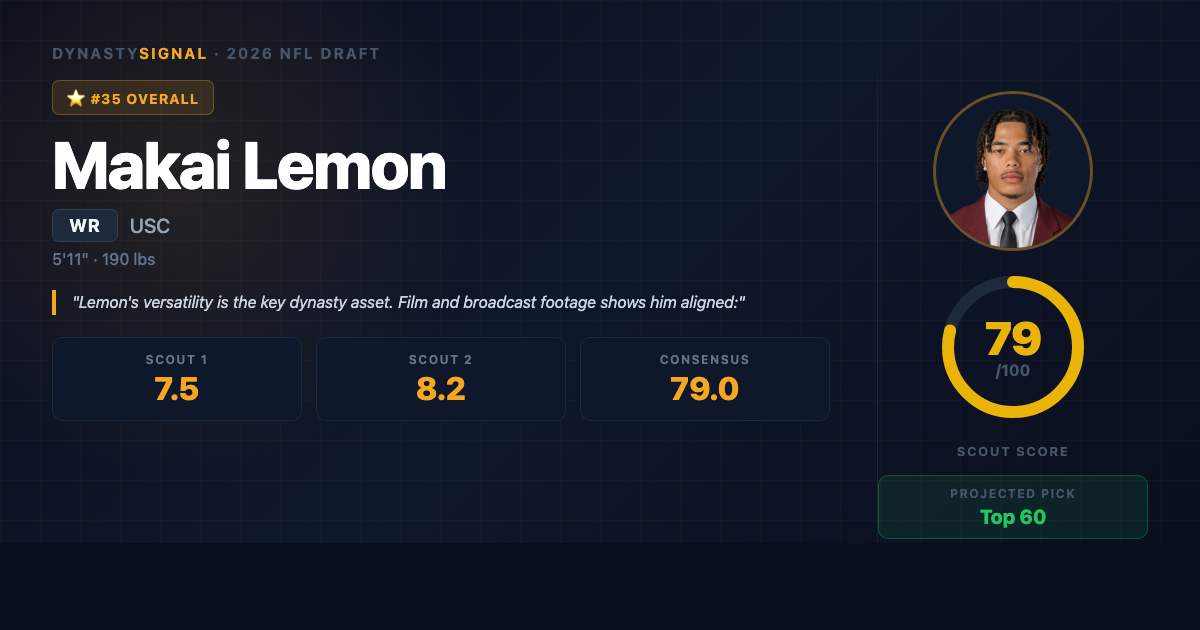
When USC moved to the Big Ten and immediately scheduled Michigan, Oregon, Notre Dame, and Penn State, the question wasn't whether Makai Lemon could handle the competition — it was whether anyone on the roster could. In 2025, Lemon answered emphatically: 79 receptions, 1,156 yards, 14.6 yards per reception, 11 touchdowns. He wasn't a gadget piece or a system stat-padder. He was the anchor of USC's passing game against a legitimate schedule, delivering in tight games against Michigan State, UCLA, and Notre Dame while posting the production line that puts him firmly inside the top tier of wide receiver prospects in this class.
The statistical narrative is supported by a film profile that scouts have increasingly appreciated as the evaluation process has progressed. Lemon is not a straight-line speed burner — he's a precise route-runner with excellent hands and the kind of alignment versatility across the formation that modern NFL offenses prize. Under USC's coaching staff, he evolved from a slot-only operator into a genuine outside receiver, lining up as the X or Z on a significant percentage of his snaps while also flexing inside when the formation called for it. That 360-degree positional flexibility — rare enough to note explicitly when evaluating sub-6-foot receivers — is the dynasty-relevant attribute that makes him more than a competition-dependent slot contributor.
His hands are the calling card. Fifteen total touchdowns in 2025 don't materialize from soft catches in open space — he wins contested catches in traffic, adjusts to off-target balls at the sideline, and shows elite body control on back-shoulder throws against physical coverage. Fernando Mendoza's USC offense trusted him on third downs, in the red zone, against Notre Dame in big games and against UCLA with the sideline contested. That quarterback trust across meaningful situations tells you something about his reliability at the catch point.
STRENGTHS
The sideline catch against UCLA is the single best representative rep in Lemon's entire film portfolio: a contested catch against tight man coverage with the corner draped on him at the catch point, zero apparent separation, and Lemon securing it with the combination of hand extension and body control that defines the elite boundary-catch archetype. That play — on a team that went up and down the Big Ten schedule in 2025 — happens against an NFL-caliber cornerback situation. His hands are not just "good for his size." They are a genuine NFL-grade trait.
His route running is equally impressive for a prospect who only recently made the positional transition to outside receiver. At the top of his routes, Lemon sinks his hips and redirects with minimal wasted motion — a technical detail that separates receivers who create separation from their footwork from those who rely on athleticism to manufacture it. His stems on intermediate routes push defensive backs vertically before the cut, forcing them to open their hips in the wrong direction. Against Iowa in press-heavy zone looks, against Oregon in a scheme that deployed premium athletes in the secondary, Lemon was consistently in his quarterback's sightline at the break — a reflection of route precision that doesn't get coached in a single off-season.
The production in high-leverage moments rounds out his profile. Touchdown catches against Michigan State, scoring plays against Michigan, contested receptions against Notre Dame when USC was trailing — these aren't garbage-time accumulations. They're evidence of a receiver who performs when the defense is calibrated and the season is on the line. His open-field acceleration post-catch produces genuine chunk plays, and his presence in bunch and condensed formation concepts confirms that USC trusted him as a pick-route executor and a read-progression anchor, not just a deep threat.
CONCERNS
The athleticism grade is the honest concern. Lemon is not going to blow up the combine with 4.3 speed — his separation at USC was primarily route-technique-based and scheme-generated, not driven by burst that creates windows independent of the coverage shell. Against elite NFL cornerbacks who can match his footwork athletically while pressing him, his ability to create on the outside without scheme help is the real unknown. The aerial view of his routes shows smooth movement rather than sudden acceleration, and his nine carries for four total yards in 2025 suggest USC didn't trust him as a run-game weapon in manufactured touches — which is at least a partial indicator that his pure burst is functional rather than exceptional.
His YAC profile is genuinely mixed. He turns short-to-intermediate catches into chunk plays with acceleration and smart footwork, but he goes to ground quickly after contact near the boundary and doesn't consistently break arm tackles. He's a separator-then-runner, not a contact-balance specialist who adds meaningful yards through tackles. The Rashod Bateman comparison that scouts float is instructive: the talent is real, the hands are real, but production consistency and the ability to unlock that talent in varying scheme contexts is the question that defined Bateman's career and will define Lemon's.
SCOUT GRADES
Scout 1 grades Lemon at 76/100, projecting round 2, pick 40–60, and sees his hands and route versatility as the anchors of a WR2/flex ceiling with a legitimate JSN-style arc in the right system. Scout 2 grades him at 82/100 with the same pick range and pushes back on the speed concerns — noting the elite hands (A-grade), solid route running (B+), and explosive YAC ability (A-) as the traits that make him more than the sum of his athleticism questions. The JSN comparison that floats through the evaluation community is meaningful: like Jaxon Smith-Njigba coming out of Ohio State, Lemon is a precise route-runner at an undersized frame who relies on separation quality over raw athleticism, with proven slot/outside flex ability and productivity in system contexts. Both scouts agree his scheme fit skews toward spread and RPO systems; both identify press-heavy defenses and physical NFL corners as the primary risk.
PROJECTION
Lemon's ideal NFL home is a West Coast or RPO-heavy offense that creates natural separation through route combinations — mesh concepts, spacing routes, pick concepts — that play to his precision and hands rather than demanding he beat physical press from a standing start every down. Teams like San Francisco, Buffalo, or Detroit that use multiple alignments and manufactured separation as organizational weapons are the schematic targets. In that context, his WR2/flex dynasty ceiling — 70-85 catches, 950-1,100 yards, 7-9 touchdowns as a primary option — is realistically available. His floor in the wrong scheme (run-heavy, press-dominant, asking him to win one-on-one on the outside every snap) is a WR3 with flashes. Buy him now in dynasty rookie drafts before the combine creates a bidding war on his hands and his production volume. The tape says he can play early in the NFL, and his skill set is built to mitigate the landing-spot risk through scheme diversity.
View Makai Lemon's full player profile, measurables, and scouting breakdown →
🎬 All-22 Film Analysis Update
*Updated after All-22 film review by Scout1 and Scout2.*
Film Score: 80.5/100 (→ No change from base score of 80.5)
Composite Score: 82
Scout1 Assessment Makai Lemon is a compact, explosive slot-capable receiver who dominated in his first year in the Big Ten after USC's conference move — 79 catches, 1,156 yards, 14.6 YPR, and 14 total touchdowns against a legitimate schedule. The film shows a complete route-runner who can play outside or in the slot, wins at the top of his routes with sharp breaks, and has legitimate YAC juice in the open field. The case against: he's undersized at 5-11/190 with average rushing production (4.0 YPC on 9 carries su...
*Film analysis is based on All-22 footage reviewed independently by two scouts. Scores reflect on-field evidence and may differ from pre-film model projections.*