
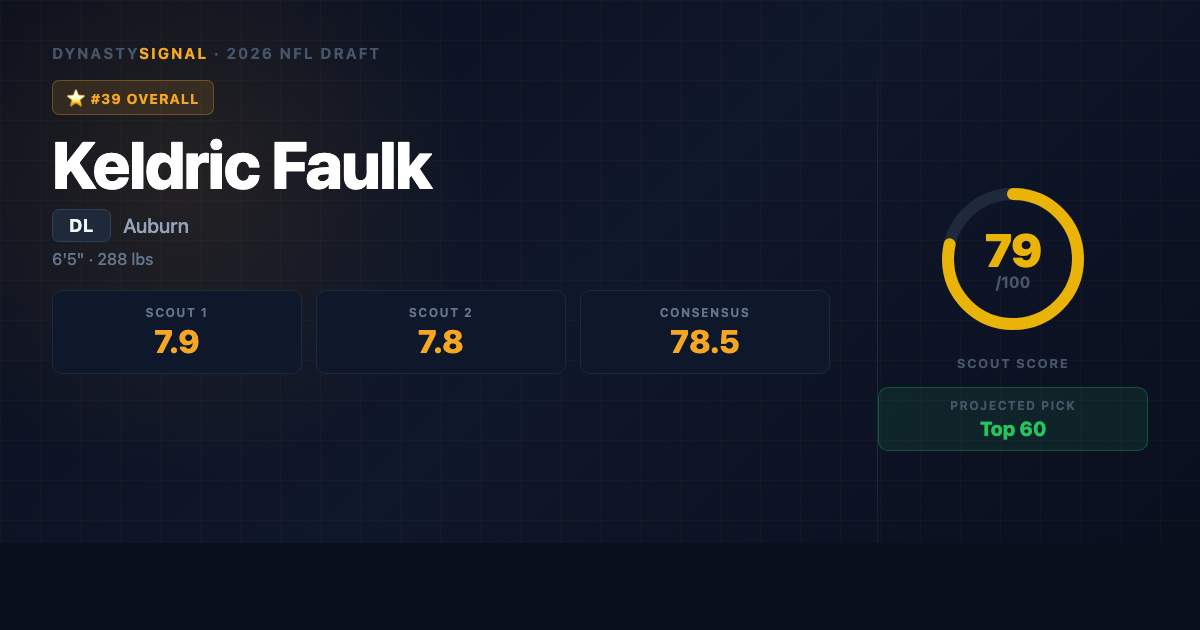
Keldric Faulk is 20 years old and already forcing draft rooms to decide how much they believe in physical projection. At 6'6", 288 pounds with functional length and a pass-rush get-off that plays fast on film, the Auburn EDGE brings the kind of size-speed combination that NFL teams have paid significant draft capital to acquire for decades. His 2024 stat line — 7 sacks, 12 TFL in limited snaps as an underclassman — came against a SEC schedule that included Oklahoma, Georgia, Alabama, and Kentucky. The production is real, not manufactured against inferior competition.
What makes Faulk such a divisive prospect is that his ceiling reads like a future cornerstone defensive end while his current toolkit reads like a player who is still assembling the pieces. His primary pass-rush weapons (speed-to-power, inside counter) are legitimate NFL moves at the college level. The bend around the arc, the first step burst, the motor — all show up consistently across the full film slate. What doesn't yet show up consistently is a third option when good tackles take his first two moves away.
At 20 years old as a draft-eligible junior, the developmental math is very favorable. Most NFL EDGE prospects at 6'6", 288 with this movement profile are either far less productive or significantly older. Faulk is a rare data point, and teams that believe in the physical projection will pay for it.
STRENGTHS
The frame is the argument, and it's not just a number. His 6'6" length is functional in hand-fighting — he keeps blockers off his body in pass-rush situations and uses those long arms to control the point of attack before tackles can get full extension. His first step burst exceeds size expectation: he fires off the line at a speed that prevents blockers from setting their feet, and the distance he covers in his first two steps is visibly ahead of everyone else on the line. Against Missouri in overtime (3rd & 4), that burst puts the tackle immediately on his heels before any contact registers. His inside counter off the speed rush — setting the tackle wide before cutting back through the B-gap — is his most refined secondary move, and it produced on film against both Oklahoma and Alabama.
The motor earns consistent marks across a seven-game film sample spanning Baylor, Missouri, Oklahoma, Kentucky, Georgia, Alabama, and California. He tracks ball carriers from across the field after losing his gap. He crashes down in pursuit. He shows up finishing plays at the Kentucky sack, still driving his legs all the way through the quarterback to the turf. That sustained effort through the whistle is the kind of trait that earns early playing time in NFL rotations, even before the pass-rush toolkit is fully assembled. Auburn confirmed its belief in his one-on-one upside by using him in multiple alignments — 5-tech hand-in-dirt, standing OLB, reduced interior — which is a coaching staff endorsement you take seriously.
CONCERNS
Run defense is the honest limitation right now. At 288 pounds, Faulk can be leveraged by heavier guards on gap runs — the LSU reps in the film show him engaged and eventually in on the pile, but he's not the one shedding blocks to make the play. He gets sealed when a guard or tackle wins the initial engagement, and against NFL teams that run power-gap concepts with 320-pound guards, that's a problem until he adds functional strength. Scout 2 graded his bend at 5/10, specifically flagging stiff hips around the arc versus more athletic tackles — a meaningful concern when the speed-to-power conversion is your primary weapon.
The position-fit debate will suppress him on certain team boards. At 288 pounds, he's too heavy for some 3-4 OLB schemes wanting 255–265, and potentially too light for teams wanting a true two-gapping 3-4 DE. That schematic ambiguity is a real draft risk regardless of talent level. His pass-rush move variety beyond speed and the inside counter is also thin — he'll need a reliable third option before NFL coordinators with game-planning resources neutralize what he has now.
SCOUT GRADES
Scout 1 graded Faulk at 79/100 projecting R1, Pick 18–30, emphasizing his elite physical profile, legitimate first-step burst, and high-ceiling development arc. The Josh Allen (Jaguars) primary comp reflects the archetype: raw-but-explosive EDGE who needed two to three NFL seasons to assemble the full toolkit. Scout 2 was more skeptical at 78/100, projecting R2, Pick 40–60, grading power at 9/10 but bend at 5/10 — arguing the stiff-hips limitation will cap his speed-to-power rush against athletic tackles. Both scouts agree he's a legitimate starter projection in the right system. The split is on timeline and ceiling: Scout 1 sees a franchise cornerstone once the polish arrives, Scout 2 sees a scheme-dependent power rusher with a Kwity Paye floor.
PROJECTION
Faulk projects as a 4-3 defensive end who plays primarily as a pass-rush specialist in Year 1, adding base-down responsibility as he adds NFL-program weight by Year 2–3. Teams running even-front, hand-in-the-dirt schemes — think teams that don't need their EDGE players covering tight ends or dropping into zones — get the most from this profile. The Rashan Gary comparison is instructive: enormous frame, elite athleticism, raw technique, late bloomer who needed three to four NFL seasons to unlock. Faulk is showing more production earlier than Gary did at Michigan, which is a positive data point on the development curve. In dynasty, he's the kind of prospect you target in the second half of the first round or early second round of rookie drafts and plan a Year 2–3 payoff window — the floor is quality rotational rusher, the ceiling with the right scheme is a legitimate double-digit-sack starter.
View Keldric Faulk's full player profile, measurables, and scouting breakdown →
🎬 All-22 Film Analysis Update
*Updated after All-22 film review by Scout1 and Scout2.*
Film Score: 78.5/100 (→ No change from base score of 78.5)
Composite Score: 83.5
Scout1 Assessment Keldric Faulk is a freakish-framed EDGE prospect out of Auburn — 6'6", 288 lbs, 20 years old — who has the physical tools to be a first-round pick in the 2026 draft, and the upside to eventually be a double-digit sack guy in the NFL. The case for Faulk is simple: you don't manufacture size-speed combo at this position, and he bends and accelerates like someone 40 pounds lighter. The case against him is equally straightforward — his pass rush toolkit is still being assembled, and teams will debat...
Scout2 Assessment Faulk's power pops but lacks refinement for top-32—contrarian fade on R1 hype, prime Day 2 value in run-heavy fronts.
*Film analysis is based on All-22 footage reviewed independently by two scouts. Scores reflect on-field evidence and may differ from pre-film model projections.*