
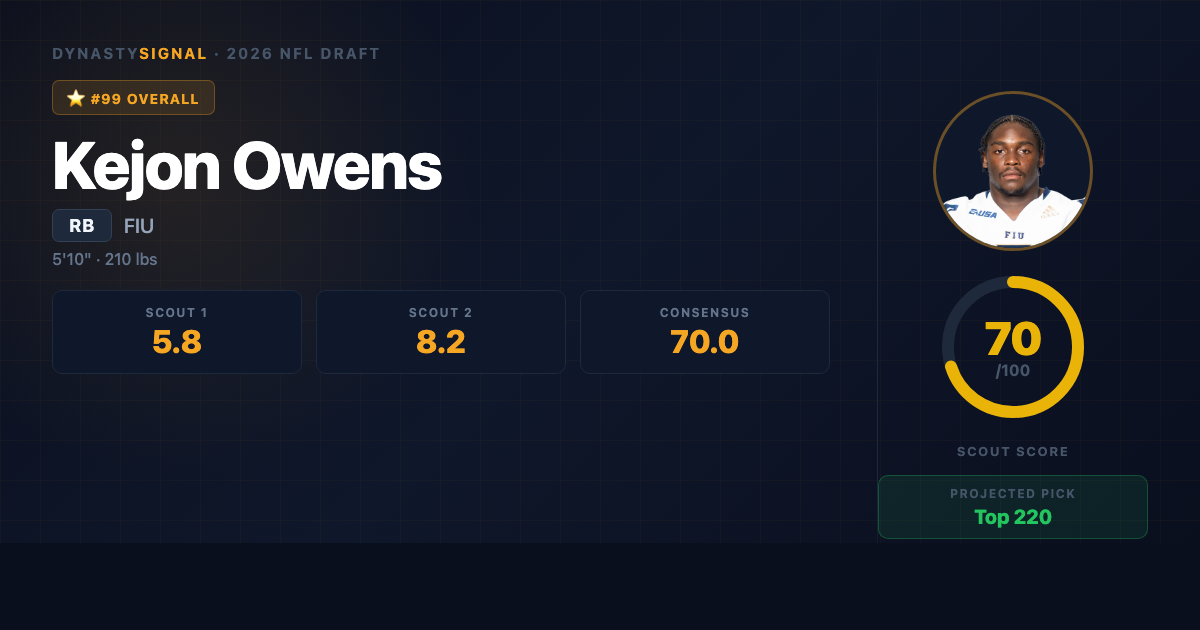
Kejon Owens doesn't come with a Power Four pedigree or a blue-chip recruiting backstory, but he comes with something that often matters more at the NFL level: a 6.26 yards-per-carry average across 213 carries with 11 touchdowns at FIU. That kind of production rate on genuine volume isn't an accident — it's a signature. Owens is a compact, power-speed blend running back out of Conference USA who has quietly built one of the most efficient statistical profiles in the 2026 class, and the film backs up every digit.
What makes Owens interesting beyond the numbers is the way he produces them. He's a one-cut-and-go runner with real patience behind his blockers, genuine contact balance, and the ability to threaten the edge when the crease opens. The case against him is familiar — Group of Five competition, limited receiving work on tape, and measurables that need combine confirmation — but the film shows a back who understands zone blocking concepts, finishes runs with authority, and plays with a non-stop motor that coaches at the next level tend to value. The floor here is a Day 3 change-of-pace back who earns short-yardage work; the ceiling, if the athleticism tests out, is a mid-rotation starter in a zone-based system.
STRENGTHS
The most encouraging trait on tape is Owens' vision and patience behind his blockers. He's not a north-south freight train who presses every gap blindly — he waits for the window, then attacks it with conviction. Film shows him repeatedly setting up blocks before committing to a crease, letting guards seal backside defenders before accelerating through. This zone-back instinct shows up consistently across multiple opponents and game environments, including against WKU where analysts specifically annotated his block-reading progression. He rarely guesses wrong at the line, and when he does identify the cutback lane, the burst to the second level is legitimate.
Contact balance and power are where Owens earns his paycheck. His stocky, compact build — estimated at 5'10", 200-plus pounds — gives him a low center of gravity that pays dividends in short-yardage and at the second level. He absorbs hits and keeps his legs churning rather than going down on first contact, a trait that shows up in his goal-line efficiency: 11 touchdowns on 213 carries means he's earning scores at the goal line, not getting them handed to him. He drags linebackers, shrugs arm tackles, and uses a physical stiff arm through traffic. Film also shows him rebalancing after backfield contact and generating positive yards — that second-effort mentality is real.
The speed profile is functional without being elite. His acceleration through the first five yards is legitimate — he gets to full gear faster than most backs at this level, and he shows he can turn the corner against Power Five-adjacent competition without getting run down. His agility and change-of-direction ability flash as legitimate weapons; he's slippery in tight spaces with the hip flexibility to create in the phone booth. The 6.26 YPC demands an honest accounting of that burst, and the tape delivers enough to believe the number isn't purely a product of inflated competition. A 4.48–4.55 forty projection suggests functional NFL speed — not a burner, but not a liability.
CONCERNS
The competition discount is real and must be applied honestly. FIU plays in Conference USA, and the best test visible in the film is WKU — a respectable program, but not Alabama or Georgia. The windows Owens is hitting, the arm tackles he's breaking, and the corners he's turning will all be harder at the NFL level where pursuit angles are tighter and safeties are faster. This doesn't invalidate the tape, but it means every grade needs a cautionary asterisk until he performs at a pre-draft event against Power Four-caliber athletes.
The receiving profile is the biggest unknown threatening his dynasty ceiling. Modern NFL backs need to be 3rd-down trusted, and Owens' tape is overwhelmingly a between-the-tackles rush package — limited receiving reps in the film, nothing that shows a developed route tree beyond flats and screens. Pass protection is similarly ungraded; there are no dedicated pass-pro reps in the available cut-up. These two gaps are the difference between a rotational early-down back and a genuine dynasty asset. Until he demonstrates receiving chops and protection reliability at the Senior Bowl or combine, his dynasty value carries a hard ceiling below bell-cow status.
SCOUT GRADES
Scout 1 evaluated Owens as a technically sound zone-back with genuine film merit, awarding an overall score of 58/100 and projecting him as a 6th-round pick (picks 185–220). The grade reflects respect for his vision, contact balance, and scheme fit in outside-zone concepts, tempered by significant discounts for competition level, the thin receiving sample, and unconfirmed athleticism metrics. The comp offered is Zamir White — a 2022 4th-rounder with a similar physical profile and 3rd-down question marks — with a secondary comp of Dameon Pierce, another power-speed finisher who found a short-yardage role in the right system.
Scout 2 came in considerably more bullish, awarding 82/100 and projecting a 4th-round landing spot (picks 100–130) with a bullish narrative that his Group of Five tape is being unfairly discounted against hyped Power Four alternatives. That scout flagged his burst and acceleration as elite within the film (9/10 burst/acceleration, 9/10 agility/COD) and comp'd his ceiling to De'Von Achane — a twitchy slasher with big-play pop — while placing his floor at Zach Charbonnet as a power grinder who flashes upside. The split between scouts is meaningful: both see the same film traits, but disagree sharply on how much the competition discount should deflate the grade. Combine testing will be the tiebreaker.
PROJECTION
For dynasty purposes, Owens is a dart-throw with real upside in the right landing spot. The ideal fit is a zone-heavy offense — think Shanahan-tree schemes, McVay-style systems, or AFC-style run-heavy gap concepts — where his one-cut instincts and contact balance play to their ceiling. An early career role as RB3 in a committee is the realistic floor, with handcuff appeal in Year 1. Year 2 becomes interesting if injuries create volume and he's demonstrated enough in the passing game to earn snaps on obvious passing downs.
The Year 3 ceiling, if everything breaks right, is a 1,000-yard contributor in a committee who earns 15-plus touches per game in the right system. He won't be a bell cow unless the receiving game develops significantly, but a physical early-down back who converts in short-yardage and threatens the edge on outside zones has genuine dynasty value. Watch his combine 40 time and any Senior Bowl receiving work closely — those two data points will determine whether this is a late-round stash or a mid-round target. Don't pay Day 2 dynasty capital until the athleticism is confirmed, but don't sleep on him entirely either.
View Kejon Owens's full player profile, measurables, and scouting breakdown →
🎬 All-22 Film Analysis Update
*Updated after All-22 film review by Scout1 and Scout2.*
Film Score: 70.0/100 (→ No change from base score of 70.0)
Composite Score: 69.5
Scout1 Assessment Kejon Owens is a compact, power-speed blend running back out of FIU who put up legitimate production (213 carries, 1,334 yards, 11 TDs — 6.26 YPC) in a Conference USA run-heavy scheme. He's a one-cut-and-go runner with functional burst, genuine contact balance, and the ability to hit the edge when the pocket opens. The case against him is straightforward: FIU's level of competition limits the sample, his receiving work is underdeveloped on tape, and he'll need combine measurables to confirm whet...
Scout2 Assessment Owens is a production-proven pest who'll outplay draft slot – grab in Rd 4/5 for committees needing spark.
*Film analysis is based on All-22 footage reviewed independently by two scouts. Scores reflect on-field evidence and may differ from pre-film model projections.*