
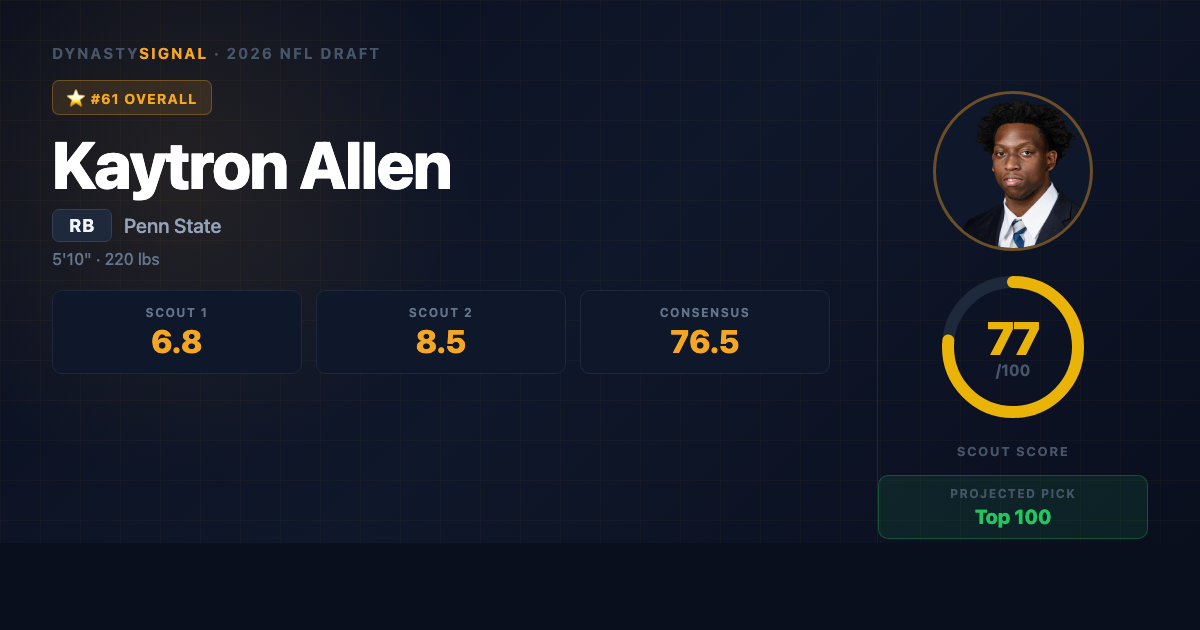
Penn State's all-time leading rusher doesn't need a highlight reel full of spin moves to make his case for the NFL — Kaytron Allen makes his case in the fourth quarter, when the game is on the line and a team needs four yards right now. The 5'11", 217-pound senior closed his college career with 1,303 rushing yards, 6.2 yards per carry, and 15 touchdowns in 2025 — numbers that rank 3rd, 7th, and 2nd, respectively, among the top running backs in the 2026 draft class. His PFF run grade of 90.6 in 2025 placed him 4th in the entire class, and his miss-tackle force rate of 30% ranked 2nd. When you strip away the speed-obsessed noise that dominates draft discourse, what's left is a running back who earns every yard the hard way.
The dynasty community should care about Kaytron Allen because workhorse backs with elite contact balance, clean vision, and reliable ball security age well — and they're available at a discount in a class that worships burst metrics. Allen's 585 career carries produced just four fumbles. He's been trusted in short-yardage and goal-line situations throughout his Penn State career, converting with the kind of reliability that coaches value and fantasy managers overlook until it's too late. The questions are real — he's not a receiving threat, and his top-end speed won't scare anyone — but for dynasty managers willing to look past the 40-yard dash, the Nittany Lion's senior tape tells the story of a back who is very good at football.
STRENGTHS
Allen's defining trait on film is contact balance that borders on elite. His 2025 miss-tackle force rate of 30% ranked 2nd in the entire draft class, and the tape confirms what the numbers say. In goal-line and short-yardage situations against Indiana and UCLA, Allen keeps his pad level low and his legs churning well past first contact — he's routinely falling forward for an extra yard or two after what looks like a certain stop. His center of gravity is exceptionally low for his frame, and his leg drive is continuous through arm tackles and ankle grabs alike. Lineman and film analyst Landon Tengwall's breakdown explicitly highlights how Allen stays upright through multiple defenders because his body mechanics at contact are fundamentally sound. This isn't just toughness — it's technique, and it translates directly to the NFL.
His vision and patience as a one-cut runner are the second pillar of his profile. Allen does not dance. He sets up his blockers, identifies the landmark, waits for the crease to develop, and commits with one decisive cut. Annotated film against Nebraska shows him correctly reading a double-team developing on the backside guard before redirecting through the opened lane — not spectacular, but perfectly efficient. Film sources consistently show pre-snap alignment reads, correct identification of blocking scheme concepts before the snap, and immediate acceleration through the correct gap post-cut. While he doesn't show the instinctive anticipation of a top-tier prospect, his pattern recognition is reliable enough to translate cleanly to the NFL level, particularly in gap and power schemes.
Ball security and goal-line production round out Allen's strengths case. Four fumbles over 585 career carries is an exceptional ratio — roughly one fumble per 146 touches — and scouting reports explicitly flag ball security as an asset, not just an absence of weakness. Penn State trusted him repeatedly in clutch situations, and his 15 touchdown season (2nd in the draft class) reflects both opportunity and conversion efficiency. He's the back coaches call when they need four yards, and he delivers. That kind of trust, built over three college seasons of consistently protecting the football, is genuinely rare.
CONCERNS
The most significant limitation in Allen's profile is receiving production — and dynasty managers in PPR formats need to understand how serious this is. His career receiving lines read 14/81, 14/132, and 18/68 across his three seasons. That's 18 catches as a career high, on which he averaged just 3.8 yards per reception in 2025. Penn State simply did not deploy him in the passing game — no slot alignments, no route running sequences, no meaningful usage as a third-down weapon. At the NFL level, backs who can't contribute as receivers typically see their snap counts capped in two-minute drill situations and on key third downs, limiting the ceiling for a fantasy asset. Until he demonstrates otherwise at the Senior Bowl or combine, he profiles as a handoff-first back who checks down when asked and rarely more.
Speed is the other honest concern. Allen does not have the burst to run away from NFL-caliber pursuit angles in the open field. Film from the Nebraska and UMass games shows defenders closing on him in ways that wouldn't happen against truly elite speed backs, and his long speed grades from evaluators land in the C+/B- range. In a draft class that skews toward athleticism, this knocks him down board. His 2025 elusive rating of 101 (5th in class) speaks to his run setup and contact balance rather than raw athleticism — he's not getting caught easily, but he's not pulling away from anyone either. The risk in the NFL is a defense with disciplined gap control and an athletic linebacker corps that can limit his yards after contact and neutralize his primary advantage.
SCOUT GRADES
Scout 1 brings a measured assessment of Allen, landing on a score of 68/100 with a projected draft range of Round 3, picks 75–100. The evaluation calls Allen a reliable RB2/3 whose contact balance and ball security are legitimate NFL traits, but draws a hard line at his receiving profile and lack of top-end speed as ceiling-capping limitations. The primary NFL comparison is Tyler Allgeier — a fifth-round back who carved out a meaningful role in Atlanta's run-heavy scheme — and Scout 1 sees that as the realistic median outcome: a 900-yard, double-digit touchdown season in the right system, committee risk everywhere else.
Scout 2 takes a notably more aggressive stance, grading Allen at 85/100 and projecting him as a potential Day 2 pick at Round 2 (picks 40–60) or early Round 3. The contrarian view here is that the draft market is systematically undervaluing Allen because speed metrics dominate pre-draft conversation — and that his vision (graded 9/10), power (9/10), and contact balance (9/10) represent a profile that outperforms expectations at the NFL level regardless of 40-yard dash time. Scout 2's ceiling comp is James Conner, his floor is Zach Moss, and he explicitly targets run-first teams like Pittsburgh, Baltimore, and Cleveland as ideal landing spots where Allen's traits play up. The spread between the two evaluations — 68 vs. 85 — reflects genuine disagreement about how much the receiving limitation matters and whether his speed cap is a disqualifier or simply a style preference in a speed-biased market.
PROJECTION
For dynasty purposes, Kaytron Allen is a landing-spot investment. His NFL role is almost certainly a power RB1 or RB2 in a gap/power scheme — he fits best in offenses that commit to the run game and don't ask their backs to double as slot receivers. The dynasty dream scenario is Pittsburgh, Baltimore, or another AFC North team that hands him 200+ carries by Year 2. In that environment, a 1,000-yard, 10-touchdown season is genuinely achievable, and the rushing production would carry significant non-PPR value even without meaningful receiving contributions. His workhorse durability — 585 college carries with minimal missed time — suggests he can handle that kind of NFL workload.
In PPR dynasty leagues, Allen requires a heavy discount relative to his ADP. The receiving ceiling is too low to compete with the elite RBs in this class on a per-touch basis, and committee risk is a real possibility depending on how teams deploy him. Target him in the 2nd or early 3rd round of rookie drafts in non-PPR or half-PPR formats where rushing volume carries more weight. Avoid overpaying in full PPR settings unless his landing spot makes a major statement about role. The Year 1–2 trajectory is 700–1,100 rushing yards and 8–12 touchdowns depending on workload; Year 3 is where the true upside question gets answered — either he's locked in as a featured back or he's rotating in a committee, and by then you'll know whether the investment paid off.
View Kaytron Allen's full player profile, measurables, and scouting breakdown →
🎬 All-22 Film Analysis Update
*Updated after All-22 film review by Scout1 and Scout2.*
Film Score: 78.5/100 (→ No change from base score of 78.5)
Composite Score: 78.5
Scout1 Assessment Kaytron Allen is Penn State's all-time leading rusher for a reason — he's a thick, downhill, one-cut power back who makes his bones running through arm tackles, protecting the ball, and converting when the stakes are highest. His 2025 breakout (1,303 yards, 6.2 YPA, 15 TDs) would be more impressive if it didn't come partly on the back of Penn State's loaded offensive line and a senior carrying against softer competition late in the year. The case for Allen is a reliable, workmanlike RB2/3 who ge...
Scout2 Assessment Kaytron Allen is the anti-hype RB prospect: no TikTok spin moves, just vision/power that racks up 1,500-yard seasons. Scouts sleeping on him for flashier backs—snag in Rd3, watch him outproduce half the class.
*Film analysis is based on All-22 footage reviewed independently by two scouts. Scores reflect on-field evidence and may differ from pre-film model projections.*