
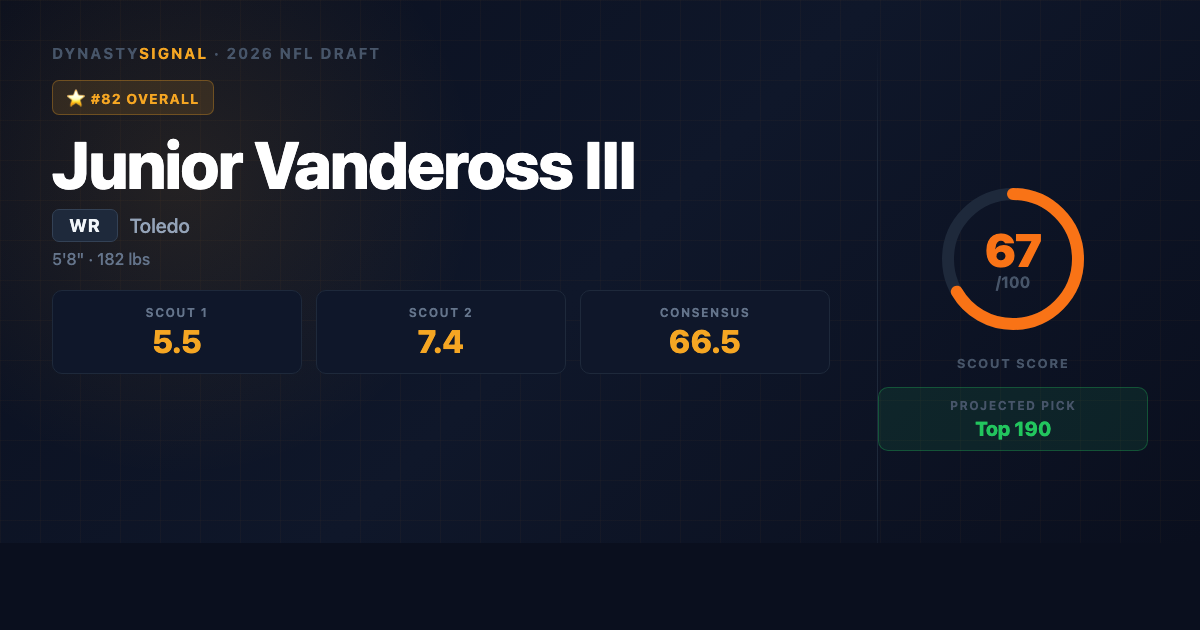
Junior Vandeross III did something at Toledo in 2025 that most MAC receivers only dream about: he became the clear alpha in an offense that trusted him to carry the load, finishing the season with 82 catches, 1,002 receiving yards, and 11 touchdowns. A 13.4% touchdown rate on 82 receptions is extraordinarily high for a slot receiver — that's not a gadget guy on limited snaps, that's a legitimate primary weapon finishing drives. At an estimated 5'10"–6'0" and 175–195 lbs, Vandeross is built for speed, and the film confirms the tool is real.
What separates Vandeross from the anonymous stack of MAC receivers who never crack an NFL roster is the combination of vertical threat and after-catch electricity. He doesn't just run fast — he accelerates *away* from defenders after the catch in a way that forces defensive coordinators to account for him on every snap. The real question heading into the 2026 draft isn't whether his speed translates; it's whether the rest of his game is complete enough to earn a genuine role in an NFL offense, or whether he's a system product who needs a very specific environment to survive.
STRENGTHS
The lead trait jumps off the tape immediately: Vandeross has legitimate, sustained straight-line speed that doesn't top out quickly. On deep routes against Ball State defenders, he didn't just beat them to the spot — he *kept pulling away*, his stride long and fluid as the gap between him and the coverage widened through the catch point. That's functional football speed, not just a Combine 40 number. He also brought that speed onto a Pac-12 road field against Washington State in non-conference play and wasn't erased — he made plays, which matters when the rest of his résumé is MAC competition. At the NFL Combine, his 40 time will have scouts buzzing.
Vandeross's after-catch ability is the legitimate No. 2 trait on this evaluation. He catches the ball and instantly shifts into another gear — juking linebackers in open space, spinning through arm tackles, and turning routine slot catches into chunk gains. He shows strong sideline awareness, keeping his feet in bounds on extended plays in ways that suggest football IQ beyond raw athleticism. His hands are reliable: he plucks through contact, showed a fade/back-shoulder grab in the end zone with both hands fully extended at the high point against tight coverage, and showed the willingness to dive for the football. Scout 2 graded his hands an 8/10 with specific callouts for clutch catches in traffic — this isn't a receiver who only operates in clean windows.
His route tree, while limited, is functional for his skill set. He wins off vertical stems by threatening corners deep and breaking off that threat into intermediate crossers and slants. He finds soft spots in zone coverage with genuine football awareness, and his multi-alignment versatility — working both outside and in the slot — gives offensive coordinators flexibility in deployment. Eleven touchdowns in 2025 tells you he also has some red zone instinct or, at minimum, is getting deployed in high-leverage situations and finishing them.
CONCERNS
The undersized frame is the primary filter here. Both scouts flagged it independently: at an estimated 175-195 lbs with a lean, wiry build, Vandeross does not have the physicality to consistently win against NFL press coverage. The film shows little evidence of a trained release package — when corners crowd him at the line of scrimmage, he relies on athleticism to escape rather than technique. NFL corners who run 4.3-4.4 and can physically jam him at the line will disrupt his timing before his speed ever becomes a factor. He needs to show a press release at the Combine process, because teams will scheme to take it away immediately.
The MAC competition discount is real and the film doesn't fully resolve it. Most of his dominant plays come against Ball State, Northern Illinois, and Central Michigan secondaries — players who will not be in the league. The Washington State appearance is a positive data point, but it's limited. Compounding this is a blocking grade that is nearly nonexistent: neither scout identified a single quality blocking rep, and with his lean frame, sustained perimeter blocking against NFL safeties is not a reasonable expectation. In a modern NFL offense where receivers block on 35-40% of plays, that's a meaningful on-field limitation. He may be a situational sub-package player rather than a three-down starter.
SCOUT GRADES
Scout 1 landed at 59/100 with a projected pick range of Round 5–6 (Picks 140–190), characterizing Vandeross as a day-three dart throw who needs a specific RPO-heavy, manufactured-touch system to unlock value. The grading highlighted elite speed (8.0/10) and YAC ability (7.5/10) as genuine weapons, while flagging route running (5.5/10) and blocking (3.5/10) as real limitations. The primary NFL comparison is Mecole Hardman — an undersized speed receiver who required years of development and scheme investment to become a consistent contributor. Scout 1 specifically cautioned that his 11-touchdown rate may be scheme-inflated and recommended teams research how those scores were generated before projecting red zone value.
Scout 2 was more optimistic, grading Vandeross at 74/100 (B-) and projecting a Round 4 pick (100–130). The higher grade was driven by hands and body control (8/10) and YAC ability (8/10), with Scout 2 specifically noting clutch catches in traffic and post-catch electricity as legitimate NFL traits. The ceiling comp is Roman Wilson — a receiver with route polish and hands who could develop into a starter if the release package improves — while the floor is Jalen McMillan: slot-savvy with YAC pop but a speed ceiling that limits the upside. The scouts disagree on draft range by roughly a full round, with both agreeing the profile is scheme-dependent and the competition level needs discounting.
PROJECTION
For dynasty managers, Vandeross profiles as a late-round rookie draft stash — a player you grab in rounds 4-6 of startup drafts and store on your taxi squad while his NFL situation develops. The Mecole Hardman comparison is instructive for dynasty purposes: Hardman's career-high receiving totals came in years two and three after the Chiefs had time to scheme him into the offense. Vandeross will likely follow a similar trajectory — Year 1 as a gadget/depth piece, soaking up the playbook and earning trust on special teams, with the opportunity to develop into a flex/WR3 by Year 2 if he lands in the right environment.
The landing spot will be everything. A pass-first, motion-heavy offense — think Miami Dolphins, Kansas City Chiefs, or any McVay-tree coordinator — gives Vandeross the quick-hit catches and RPO touches that play to his strengths. A run-heavy power offense asks him to block, limits his role to vertical decoy, and accelerates the bust timeline. Watch where he's selected: if a team in the top half of the NFL draft picks him in round 4, that's a signal worth acting on in rookie drafts. If he falls to a run-first team in round 6, temper expectations significantly. The tools are real. The ceiling is a dangerous WR3 with big-play upside. The floor is a practice squad speed specialist who never sticks.
View Junior Vandeross III's full player profile, measurables, and scouting breakdown →
🎬 All-22 Film Analysis Update
*Updated after All-22 film review by Scout1 and Scout2.*
Film Score: 66.5/100 (→ No change from base score of 66.5)
Composite Score: 66.5
Scout1 Assessment Junior Vandeross III is a speed-first slot/flex receiver from Toledo who dominated the MAC as a true alpha, putting up 82 catches, 1,002 yards, and 11 touchdowns in 2025. He wins with straight-line speed and the ability to threaten the defense vertically, turning quick catches into chunk gains and stressing defenses that sit in soft zones. The case against him is real: he's undersized, his route tree appears limited to what his speed can manufacture rather than precision technique, and contested...
Scout2 Assessment **The Short Version** Vandeross is a savvy slot operator with reliable hands and YAC grit, but his twitchy release and top-end speed are MAC mirages—expect a Day 2 afterthought in a league that demands separators. Contrarian call: Not a riser, he's a peak-now producer who flames out without schemed volume.
*Film analysis is based on All-22 footage reviewed independently by two scouts. Scores reflect on-field evidence and may differ from pre-film model projections.*