
Joey Aguilar's path to Neyland Stadium reads like a screenplay Hollywood would reject for being too on the nose: a Bay Area kid riding BART to practice at City College of San Francisco, grinding through Diablo Valley College, earning a shot at Appalachian State, then stepping into Tennessee's starting role mid-cycle when five-star Nico Iamaleava walked out the door over an NIL dispute. Aguilar didn't just survive the moment — he threw for 3,444 yards, 24 touchdowns, and completed 66.8% of his passes in his lone SEC season, winning games and earning respect from Josh Heupel, one of the more respected offensive minds in college football. The backstory is real, and so is the production.
The honest evaluation, though, is more complicated. Aguilar turns 25 before his first NFL regular-season snap, he carries 34 career FBS interceptions on his ledger, and his entire profile is built around Heupel's lightning-tempo spread — a system that pre-processes his reads and compresses the decision window in ways no NFL offense replicates at scale. His career 62.4% completion rate over 1,254 attempts and 10,325 yards across App State and Tennessee establish legitimate FBS production. Whether that translates to the professional level is the central question — and the answer is far from obvious.
STRENGTHS
Aguilar's most translatable skill is his pre-snap processing. The Tennessee film shows him repeatedly diagnosing Middle Field Closed coverages before the snap and attacking boundary isolation routes with conviction and timing. This isn't just tempo-induced reaction time — it reflects a quarterback who has put in the mental reps to understand defensive structure. His quick release and willingness to get the ball out on time on intermediate routes allows the offense to function cleanly, and he demonstrated that ability consistently under real pressure, including an OT comeback situation against Mississippi State where Tennessee was trailing late and needed a drive. Veterans who operate this way in spread systems can occasionally adapt those concepts to NFL quick-game packages.
In the film against Kentucky, Aguilar delivered a clean ~30-yard completion that put a receiver in stride near the red zone — the kind of trajectory and placement on an intermediate-to-deep throw that suggests at least functional arm talent when he has a clean pocket and his mechanics are locked in. He also made key throws late in drives under game-script duress. His 52-yard touchdown to Chris Brazzell II at Tennessee confirms he can challenge the field vertically when the opportunity presents. It's not an elite arm, but it plays at functional levels with good footwork underneath him.
Character and work ethic are the intangibles that scouts routinely mention, and Aguilar's profile demands that acknowledgment. Josh Heupel spoke highly of him in interviews leading up to the season. Players who fight through two JUCO stops, rebuild their recruiting profile from scratch, and still compete at Power Four level tend to be low-maintenance professionals. Those traits matter in NFL locker rooms, particularly for a player whose path to contributing likely runs through being the best backup in a room.
CONCERNS
The age concern is the loudest alarm on Aguilar's draft profile and it doesn't go away no matter how clean the production looks. He turns 25 in June 2026 — before his first preseason snap as a professional. Late-round quarterback projects need time to develop, and NFL teams simply are not in the business of developing 25-year-old backup quarterbacks who were system starters in college. He enters his NFL window at exactly the wrong age: too old to be a project, not accomplished enough to be a proven commodity. His interception rate compounds the concern — 34 picks across 1,254 FBS attempts reflects a willingness to push into coverage when the first read disappears, a habit that NFL defensive coordinators will exploit immediately.
The scheme dependency is the hardest thing to unsell. Heupel's system does enormous amounts of cognitive work for the quarterback before the snap. Quick cadences, horizontal spacing, and defined pre-snap reads compress the decision window and eliminate the kind of extended pocket work — five- and seven-step drops, third-level progressions, anticipation throws into tight NFL windows — that every NFL offense demands in some form. There is no film evidence of Aguilar working through a true three-level progression or manufacturing positive plays when his initial read is taken away. Within-game inconsistency backs this up: against Kentucky in a blowout win, a 75-yard touchdown opening drive was immediately followed by back-to-back three-and-out punts (-7 yards and 2 yards). When defenses take away his first key, production evaporates.
SCOUT GRADES
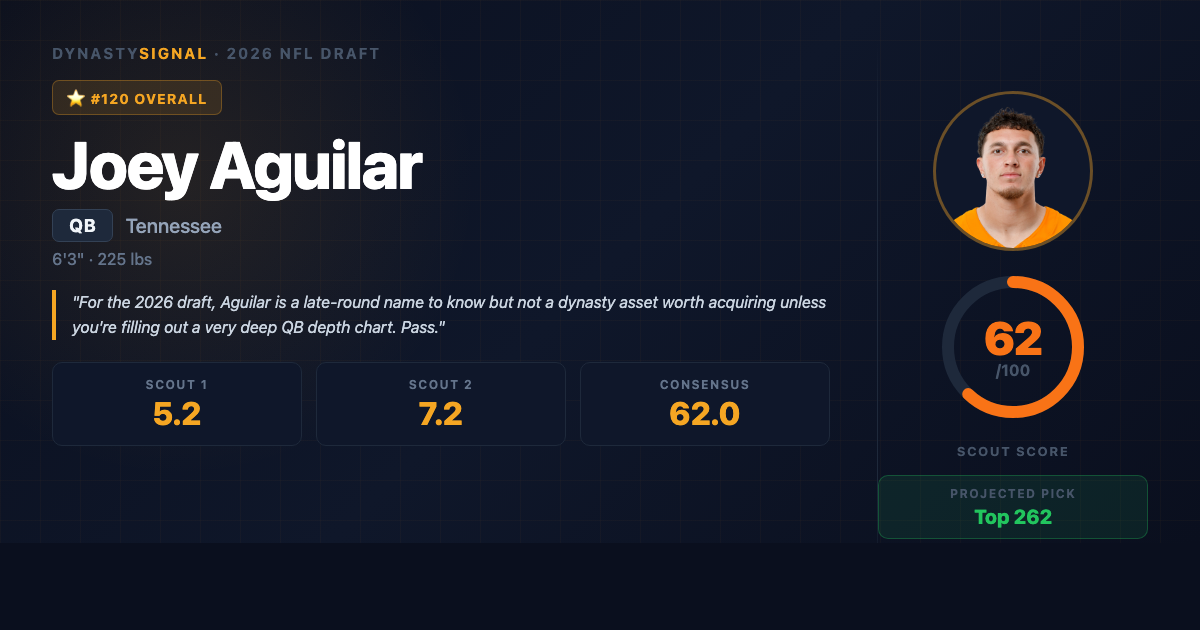
Scout 1 evaluated Aguilar as a functional but limited prospect, grading his processing and accuracy at B- while the arm, mobility, and pocket presence grades clustered around C+. The key finding was that Aguilar profiles as a smart game manager who avoids disasters in Heupel's system but owns no elite trait that survives the transition to professional football. Scout 1 drew the primary comparison to Cooper Rush — a late-round/undrafted game manager who earned NFL roster spots through professionalism and system fit, not upside — and pegged Aguilar's projected landing zone at Round 6-7 or undrafted free agency with a composite score of 52/100.
Scout 2 arrived at a sharply different conclusion, giving Aguilar a 72/100 with a third-round projection (picks 80-100), driven largely by an elite mobility grade (9/10) and solid accuracy marks (7/10) on rhythm throws. Scout 2 was notably more bearish on the arm (6/10) and pocket presence (5/10 — citing early bail-outs and happy feet under pressure), and flagged similar scheme-dependency concerns, but viewed Aguilar's athleticism as a difference-making floor-raiser. The scouting divergence here is meaningful: the two evaluators watched the same film and landed 20 points apart, which typically signals a player whose value is genuinely contingent on scheme fit and NFL team context. The consensus range is Day 3 with a chance to stick on a roster long-term.
PROJECTION
For dynasty managers, Aguilar is a name to file, not a pick to burn. His NFL role — if he gets drafted and sticks — is backup quarterback in a spread-influenced system, with a ceiling somewhere in the Cooper Rush / Chad Henne range: a respected veteran backup who can start four to six games in a season without embarrassing the organization, but who won't develop into a franchise signal-caller at 25. If he lands with a team like the 49ers or Rams that runs spread-adjacent concepts with quick-game elements, his scheme fit gets marginally better and the floor rises slightly.
The year 1-3 dynasty trajectory is essentially flat. There is no development arc here that produces a startable fantasy asset on a consistent basis. If a starting quarterback gets hurt in Year 2 and Aguilar is the backup, there's spot-start streaming value — nothing more. He is not worth spending dynasty capital on in any meaningful way. The story is compelling. The profile is not. Monitor his landing spot and move on.
View Joey Aguilar's full player profile, measurables, and scouting breakdown →
🎬 All-22 Film Analysis Update
*Updated after All-22 film review by Scout1 and Scout2.*
Film Score: 62.0/100 (→ No change from base score of 62.0)
Composite Score: 61.5
Scout1 Assessment Joey Aguilar is a 24-year-old graduate transfer who worked his way from two JUCO stops to Appalachian State and finally Tennessee — a genuinely compelling backstory that shouldn't be confused with a compelling NFL draft profile. He's a system-appropriate signal-caller in Heupel's lightning-tempo spread who processes quickly, gets the ball out, and manages games without much drama. The case for him is a late-round dart throw on a backup with built-in SEC reps and real veteran savvy; the case agai...
*Film analysis is based on All-22 footage reviewed independently by two scouts. Scores reflect on-field evidence and may differ from pre-film model projections.*