
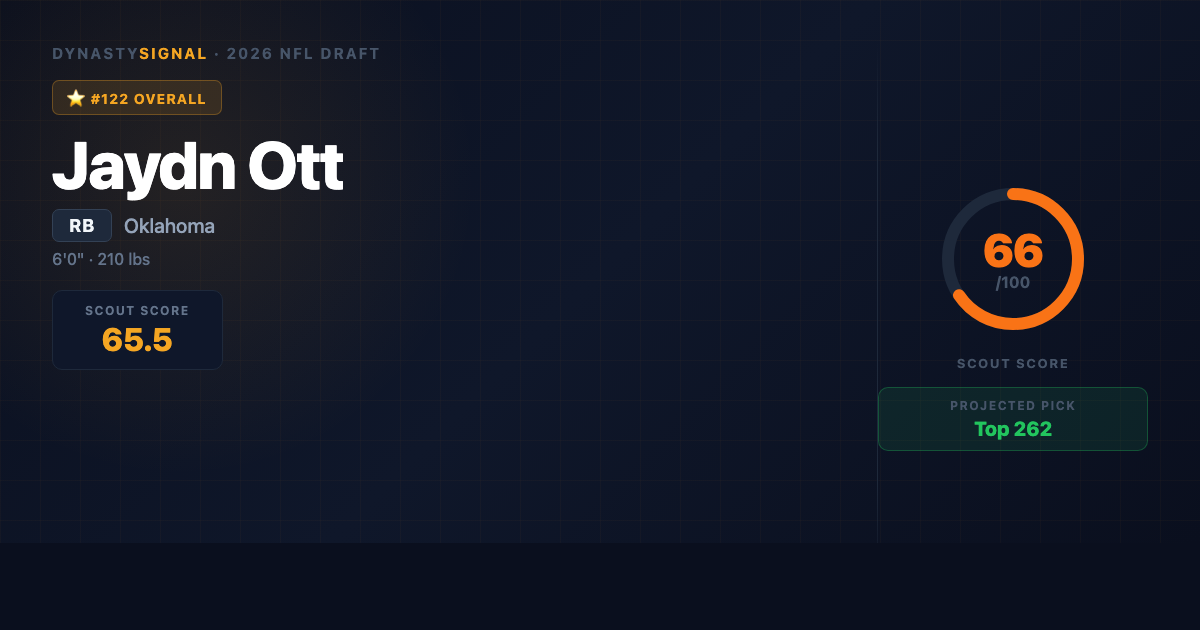
When Jaydn Ott was healthy at Cal, he looked like a Day 2 NFL pick. Back-to-back 5.3 YPC seasons, a 1,315-yard, 12-touchdown campaign in 2023, and a PFF rushing grade of 90 — the kind of résumé that gets front offices excited. He is a zone-read specialist with legitimate home-run speed, natural receiving chops, and the instinctive vision to make defenders miss in space. At 5'11" and 200 pounds, he plays with a lower center of gravity than his frame suggests, and when he hits open field, cornerbacks and safeties simply get left behind.
Then came 2024: a knee injury gutted his production to 385 rushing yards at 3.3 YPC. Then came 2025: a transfer to Oklahoma, a new scheme — and a catastrophic 68 yards, zero touchdowns, and a PFF total grade of 53 across an entire season. Now entering the 2026 draft, Ott is the most polarizing back in this class. The gap between his ceiling and his recent reality is enormous, and the two scouting evaluations on him reflect exactly that tension. Dynasty owners need to understand both sides before they decide where he fits on their boards.
STRENGTHS
The most undeniable trait on Ott's film is his breakaway speed. Once he clears the second level, no college defender catches him — and several clips from the Cal 2024 tape confirm this isn't scheme-aided illusion. On the Miami TD run, he turns the corner and no safety gets a hand on him in the open field. In the LA Bowl against UNLV, he hits a crease and the gear shift is instantaneous. His first step out of cuts is elite, and his 9/10 burst grade from scouting reflects what the film actually shows rather than wishful thinking. This is legitimate NFL-playable speed that will translate on jet sweeps, screens, and designed runs to the perimeter.
What makes the speed truly dangerous is the vision it's packaged with. Ott is a natural zone-read back who reads blocks with patience and discipline. He doesn't hesitate — he processes. Watch him against UC Davis and Oregon State: he's setting up the cutback lane before the hole opens, then attacking it with conviction when it does. His 8/10 vision grade is earned on tape. He identifies creases efficiently, understands where the crease will be before it develops, and has the lateral quickness to redirect on a dime. His agility and change-of-direction — also graded 8/10 — means he can make that second read work even when the first opening closes.
His receiving ability adds genuine NFL dimension. In a run-first Cal offense, he posted 746 career receiving yards and six touchdowns. In 2024, despite being limited to 385 rushing yards by injury, he caught enough to post 222 receiving yards — evidence that his staff leaned on him as a check-down weapon when his body couldn't carry the full workload. His hands look reliable in traffic (a contested catch against Stanford on a 3rd-and-19 stands out), and he runs routes competently from the backfield. A creative offensive coordinator in a pass-heavy NFL system can get real production out of Ott as a receiving back — and that's the version of him that dynasty owners should be pricing.
CONCERNS
The injury history isn't a footnote — it's the central question of this profile. Ott went from a PFF-90, 1,315-yard season in 2023 to a 385-yard injury-shortened 2024, and then to a 68-yard disaster at Oklahoma in 2025. That trajectory forces an uncomfortable question: is this a player who can no longer stay healthy, or one who was placed in the wrong scheme at the wrong time? The honest answer is probably both, and neither is particularly comforting. He arrives at the NFL with four collegiate seasons of mileage, at least one documented knee issue, and a body that has already shown it can break down under load. Durability will be the first question every team's medical staff asks.
The pass protection grades are genuinely alarming. PFF pass blocking grades of 44 (2023 Cal), 54 (2024 Cal), and 24 (2025 Oklahoma) form a troubling downward arc that ends near the statistical floor for draftable backs. A running back who cannot be trusted in obvious passing situations loses a third of his snaps at the NFL level, and no amount of receiving upside compensates for being a liability on 3rd-and-long. The Oklahoma collapse — whether caused by injury, scheme mismatch, or both — produced nearly unusable tape and reinforced the concern that Ott's skill set requires a very specific offensive environment to function. NFL teams building their evaluations on his Cal peak will have to explain away an entire season of negative evidence.
SCOUT GRADES
Scout 1 lands at 49/100 with a UDFA/late seventh-round projection (picks 240–262). The evaluation is sobering: it acknowledges the genuine explosiveness and zone-read IQ while concluding that the pass protection floor, the scheme dependency exposed by the Oklahoma transfer, and the injury-degraded production combine to make him a borderline draftable prospect. The comp offered is Chase Edmonds — a speed-first zone back with receiving upside who thrived in the right system but never held a featured role outside of it — with a Duke Johnson floor as a passing-game specialist if the rushing production never fully returns. The core argument: his ceiling is real but fragile, and teams gambling on it in rounds 4–6 may never see it.
Scout 2 is sharply more optimistic, grading him B (82/100) with a second-round projection (picks 40–60). This evaluation leans heavily into the tape from his Cal prime, awarding elite marks for burst and acceleration (9/10), vision (8/10), contact balance (8/10), and agility (8/10). The concern about size bias running his draft stock down resonates — Ott plays far more physically than his 200-pound frame suggests, and his receiving chops (7/10) give him genuine three-down upside in the right offense. Scout 2's comp is more ambitious: a Jerome Ford floor and a Rhamondre Stevenson–lite ceiling if health and scheme alignment converge. The wide gap between these two evaluations — 33 points — is itself the most important data point in this profile.
PROJECTION
In dynasty, you're betting on ceiling with a discount built in for risk — and Jaydn Ott is the purest expression of that framework in the 2026 class. If he lands in a zone-heavy spread system (think Kansas City, the Rams, or a similar RPO-driven offense), gets legitimate snaps in the passing game, and stays healthy through training camp, the Chase Edmonds comp is achievable: a dynamic RB2/flex option who contributes in the passing game and punishes defenses in space. That version of Ott is worth a late-round dynasty investment right now, particularly in PPR or Superflex formats where receiving backs carry a premium.
The floor, however, is a practice-squad roster move or a cut before Week 1. If the pass protection doesn't improve and the injury history continues, no offensive coordinator will trust him enough to give him the volume necessary to produce at the NFL level. In dynasty drafts, treat him as a late-round flier — UDFA or post-draft pickup range — and prioritize landing cost over projection. Don't pay for who he was at Cal in 2023. Pay for what he might become if everything breaks right in year one, and keep your expectations calibrated accordingly. The talent is real. The risk is equally real.
View Jaydn Ott's full player profile, measurables, and scouting breakdown →
🎬 All-22 Film Analysis Update
*Updated after All-22 film review by Scout1 and Scout2.*
Film Score: 65.5/100 (→ No change from base score of 65.5)
Composite Score: 65.5
Scout1 Assessment Jaydn Ott is a former Pac-12/ACC zone-running specialist who posted back-to-back 5.3 YPC seasons and a PFF-90 rushing grade at Cal before his career hit a wall — injuries in 2024 gutted his production (385 yards, 3.3 YPC), and his transfer to Oklahoma in 2025 was a disaster (68 yards, 0 TDs, 3.2 YPC, PFF 53 total). The case for him is real: legitimate breakaway speed, natural receiving chops, and flashes of elite vision in zone concepts — this is a guy who, in the right system, looks like a star...
*Film analysis is based on All-22 footage reviewed independently by two scouts. Scores reflect on-field evidence and may differ from pre-film model projections.*