
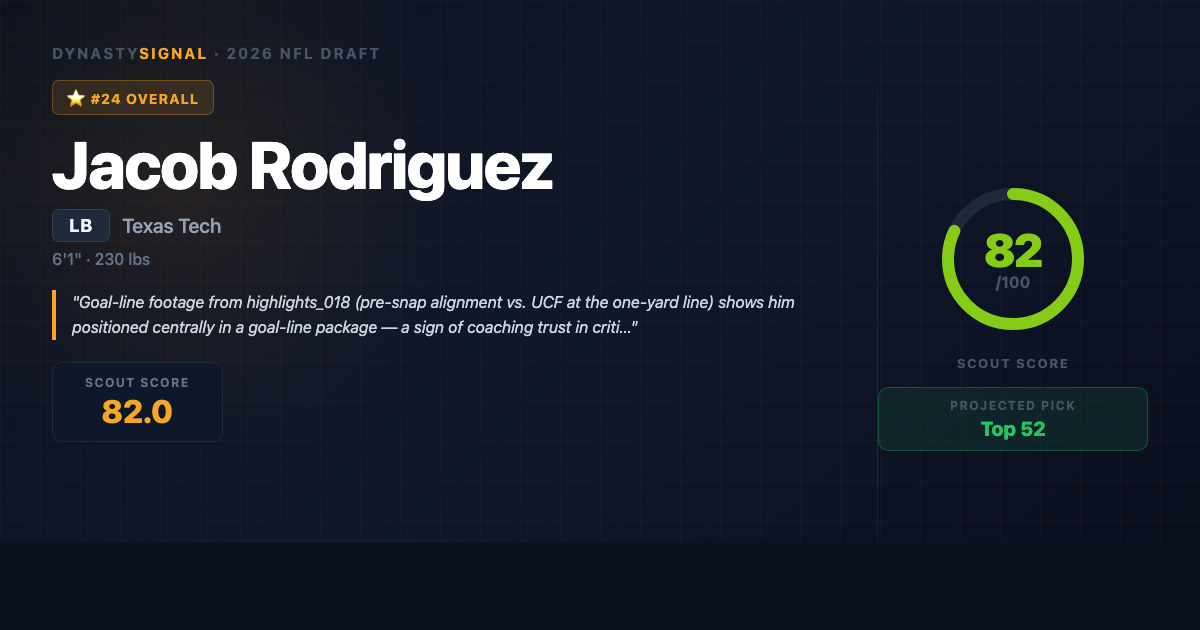
No linebacker in college football had a 2025 season quite like Jacob Rodriguez. The Texas Tech senior became the first player at his position in decades to sweep all four major defensive awards — Butkus, Bednarik, Nagurski, and Lombardi — in the same year, and then finished fifth in Heisman Trophy voting, a feat virtually unheard of for a defender. Those accolades would be remarkable for any linebacker. They're almost surreal when you learn that Rodriguez was lining up under center as a quarterback at Virginia just four years ago.
The numbers are equally jaw-dropping: 117 tackles (61 solo), 11 tackles for loss, 4 interceptions, and 7 forced fumbles — the last figure tying the NCAA single-season record. Texas Tech rode that production to a top-10 ranking and a 9-1 record while Rodriguez served as the full-time defensive signal-caller, C-patch on his jersey and all. At 6'1", 233 lbs with a projected 4.70-range 40-time, he does not look like a prototypical NFL MIKE. But the film makes a compelling argument that prototypical doesn't mean best.
STRENGTHS
Rodriguez's most elite trait is the one hardest to measure: football IQ. Because he spent his formative years reading defenses from behind center, he processes post-snap information at quarterback speed from the linebacker position. On film, he is Texas Tech's defensive play-caller — pointing, gesturing, and organizing alignments on every snap — and that pre-snap communication is not ceremonial. He reads mesh points, backfield keys, and blocking schemes before they fully develop, and he's rarely wrong-footed on misdirection. Against BYU, he attacked the correct gap on a zone-read without flinching at the quarterback fake. That kind of pre-snap + post-snap sequencing is what turns film-study sessions into talent evaluations that end early, because the answer keeps revealing itself in the same way: he sees it first.
The seven forced fumbles are the ultimate expression of those instincts. You don't lead the nation in forced fumbles by accident — you do it by identifying exactly when a ball carrier is exposed, timing the strike to the right contact point, and finishing with active hands through the tackle. Film confirms this: across multiple games and situations, Rodriguez is consistently going for the ball on every tackle attempt, not just securing the carrier. His four interceptions add to the picture — these are zone reads and route recognition plays, not lucky deflections. He catches the ball. Add to that his pursuit geometry: on multiple plays across the film sample, Rodriguez sprints intercept angles rather than chasing angles, cutting off ball carriers from 15+ yards away by solving for where they're going, not where they've been. That's a quarterback's mind applied to linebacker athleticism.
On the ground, Rodriguez is a reliable, technically sound tackler who brings 317 career stops on a foundation of proper pad level, contact balance, and hip drive. He does not arm-tackle and he does not lunge — he finishes. The 11 tackles for loss in 2025 demonstrate that he can diagnose quickly enough to get into the backfield, and goal-line alignment film shows him centrally positioned in critical short-yardage packages, a sign of coaching trust in the moments that matter most. His motor is unimpeachable: across every frame of film reviewed, including fourth-quarter sequences in blowout wins, Rodriguez plays at full speed without an off switch.
CONCERNS
The size concern is real and worth stating plainly. At 233 lbs, Rodriguez will regularly be targeted by NFL offensive linemen who outweigh him by 75 or more pounds. He wins in college with angles, quickness, and technique — and he wins reliably — but the double-teams and zone-run releases he'll face from NFL guards represent a stress test that Big 12 film does not fully simulate. He can be washed out of his gap when a blocker gets to him cleanly, and the regression from 5.0 sacks in 2024 to 1.0 in 2025 suggests his pass-rush production is more scheme-dependent than athletically generated. His projected 4.70 40-time is functional for a MIKE linebacker but will expose him against receiving backs and tight ends in dedicated man coverage; NFL teams will need to scheme around those matchups, which is standard for most linebackers — but Rodriguez's frame means the obligation is more pressing than with a physically imposing alternative.
The other risk is one of context. Rodriguez's conversion from quarterback to linebacker happened in 2022, which means his positional film sample is roughly three to four years deep, and the bulk of it comes against a Big 12 conference that leans heavily on spread, RPO, and air-raid concepts. The fundamental habits are largely cleaned up on tape, but there may be structural gaps — particularly in stack-and-shed technique against power blocking — that a longer developmental path would have addressed earlier. His first NFL training camp will tell evaluators a great deal.
SCOUT GRADES
Our evaluation grades Rodriguez at 82/100 and projects him as a Round 2 pick (range: 33–52). The scouting consensus — built on full all-22 film analysis across three separate game sources and a season-long highlight arc — is that Rodriguez's ball-production profile is historically elite and his football intelligence is traceable to a genuine, verifiable origin story. The physical limitations are real and accounted for in the grade, but they do not override the argument that turnovers are the single most roster-impact statistic in the NFL, and Rodriguez generates them at a rate no linebacker in recent memory has matched. The primary NFL comp is Kiko Alonso (Buffalo Bills era) — a fast, instinctive, ball-hawking linebacker who led the league in tackles and produced turnovers at a high rate but was always slightly undersized for a power MIKE role. The ceiling comparison is Zach Thomas, undersized by every standard measurable, irreplaceable by every production metric.
PROJECTION
For dynasty IDP managers, Rodriguez is a must-roster target entering the 2026 draft. His turnover production is the kind that shows up on NFL stat sheets regardless of team context — you don't need him on a 12-win defense for his interceptions and forced fumbles to register. Expect him to compete for a starting role immediately given his captain-level leadership profile and processing ability; teams don't sit players who understand the game at this level for long. Year 1 projection is a 90-plus tackle floor with upside on turnovers as he learns the scheme; Year 2–3 is when the true ceiling reveals itself, particularly if he lands in a Tampa 2 or Cover 3 base defense where his zone instincts and clean drop technique are maximized rather than stress-tested in man coverage. In standard dynasty IDP formats, target him as a mid-to-late Day 2 pick and roster him as a starter. In turnover-weighted scoring formats, he's a top-5 linebacker in this class.
View Jacob Rodriguez's full player profile, measurables, and scouting breakdown →
🎬 All-22 Film Analysis Update
*Updated after All-22 film review by Scout1 and Scout2.*
Film Score: 82.0/100 (→ No change from base score of 82.0)
Composite Score: 82.5
Scout1 Assessment Jacob Rodriguez is the most decorated linebacker in college football history for a single season — Butkus, Bednarik, Nagurski, and Lombardi Trophy winner in the same year, plus 5th in Heisman voting — and that résumé barely does the film justice. He's a cerebral, instinct-driven MIKE/WILL hybrid who produces turnovers at a historically unprecedented rate: 7 forced fumbles (tied the single-season NCAA record) plus 4 interceptions in 2025 alone, on top of leading Texas Tech in tackles. The case ag...
Scout2 Assessment **The Short Version** Jacob Rodriguez is an electric athlete with sideline-to-sideline range and thumping tackle ability, but his undersized frame and iffy coverage skills make him a Day 2 starter at best—not the "best LB in the country" hype machine. Contrarian take: He's Micah Parsons-lite in pursuit but Devin White-lite in stack-and-shed.
*Film analysis is based on All-22 footage reviewed independently by two scouts. Scores reflect on-field evidence and may differ from pre-film model projections.*