
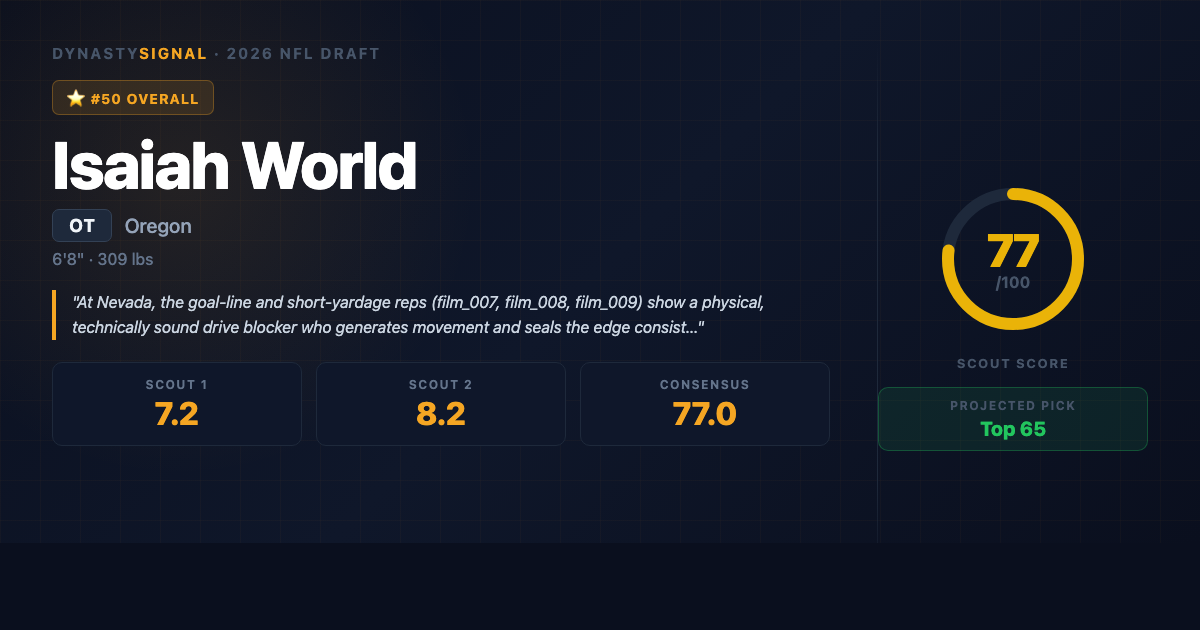
Oregon's left tackle made the jump most transfer linemen can't — two All-MWC nods at Nevada, then holding down the blind side for a Big Ten title contender in his first year with the Ducks. Isaiah World arrives at the 2026 NFL Draft as a physically imposing offensive tackle whose run-blocking pedigree and arm length make him a legitimate Day 2 target, even if a looming question about his athleticism ceiling follows him into every draft board conversation.
World spent three seasons at Nevada building credentials before transferring to Oregon, where he graded out at 97.7% blocking efficiency, allowed just one sack, and earned All-Big Ten Honorable Mention in his only Power conference season. In the Oregon–Minnesota game, he helped quarterback Dillon Moore go 26-of-29 for 298 yards and two touchdowns behind a clean pocket — Moore's 86 rushing yards in the first quarter alone came behind an offense winning on the left side on virtually every snap. World is 6'5¼", 321 pounds with 34½" arms and the kind of frame that NFL scouts put in front of a run-game coordinator and say, "this is what we need."
STRENGTHS
World's calling card is run blocking, and the film makes it clear. In the Oregon–Minnesota cut-ups, he drives defenders through the whistle — the close-up pile frame (highlights_2_007) shows him chest-over-defender, still generating movement well after the initial engagement. On film_006 from his Nevada days, he drives a defensive tackle clean into the backfield, the kind of displacement that shows up in rushing stats two plays later. He works to the second level with surprising quickness for a 321-pound man, reaching downfield defenders on zone assignments in a way that fits how modern NFL offenses deploy their tackles in run-game designs.
His pre-snap discipline stands out on every reel reviewed. World's stance is identical regardless of play type — he doesn't telegraph run vs. pass to the defense (highlights_2_001, highlights_2_008). His 34½" arms keep rushers from getting into his frame; on Boise State film (film_015, film_016), he holds a textbook pass set — hips down, base wide — without getting reached inside. Pad level is consistently at or below his opponents on contact (highlights_2_003, film_005), the single most reliable predictor of sustained tackle success. Oregon's zone-blocking scheme demanded combo timing and second-level range, and he handled both without visible strain in his first Big Ten season.
CONCERNS
Both reports flag World's movement quality as the draft's central question on this prospect. Scout 2 noted that speed rushers bent the edge in the Minnesota game (highlights_2_011, highlights_2_017), with World's hips not redirecting cleanly when forced to mirror outside arc moves or absorb a change-of-direction counter. Nevada film shows similar heaviness when he's asked to pull or engage in space (film_011, film_012) — he gets there, but not with the fluid ease that projects to protecting against elite NFL edge speed every week. Scout 2's footwork grade was a C, a sobering data point against the otherwise encouraging tape.
The limited Power conference sample compounds the uncertainty. Twelve pressures allowed and eight penalties in 2025 aren't individually disqualifying, but together they suggest a player still refining his craft at the top level — not dominating it. One year of Big Ten film is encouraging, not conclusive.
SCOUT GRADES
The two scouting reports landed 10 points apart — a genuine divergence worth noting. Scout 1 scored World at 72/100 and projects him in the Pick 50–65 range, leaning on technical soundness and a Dion Dawkins-type floor: a reliable starting tackle who maximizes a run game without necessarily being a franchise blindside cornerstone. Scout 2 scored him at 82/100 (Pick 35–50), weighting his physical power profile more heavily and projecting Jawaan Taylor as the ceiling — with Cam Robinson as the cautionary floor if pass protection doesn't develop. DynastySignal's blended score of 77.0/100 and projected range of Pick 35–65 reflects that honest split. For dynasty purposes, landing spot is everything — World in a run-heavy AFC North scheme is a very different asset than World tasked with protecting a pass-first quarterback on 40 dropbacks a game.
PROJECTION
World's NFL floor is a starting right tackle who dominates the run game and handles power rushers cleanly. His ceiling — the one Scout 2 is buying — is a legitimate blindside starter in a zone-blocking offense, the kind of player who earns Pro Bowl consideration by Year 4 if the footwork refines under NFL coaching. Teams running gap-and-drive concepts, built around a physical ground game, are the ideal landing spot; pass-first offenses represent a schematic risk that could accelerate the Cam Robinson outcome.
For dynasty managers, World is a developmental hold with a clear path to multi-year starting value. He won't generate fantasy-relevant production directly, but an offensive tackle who anchors a ground game for five or six seasons is exactly the kind of infrastructure asset that pays off when scheme and situation align. Target him in dynasty startup drafts with realistic expectations — and pay close attention to which team's phone call he takes on Day 2.
View Isaiah World's full player profile, measurables, and scouting breakdown →
🎬 All-22 Film Analysis Update
*Updated after All-22 film review by Scout1 and Scout2.*
Film Score: 77.0/100 (→ No change from base score of 77.0)
Composite Score: 76.5
Scout1 Assessment Isaiah World is a big, powerful left tackle who earned his way up the mountain — two All-MWC nods at Nevada, then transferred into one of college football's premier programs and held down the blind side for an Oregon offense that rolled to a Big Ten title run. He's a run-game bully with the size and arm length to wall off edge rushers, and his 97.7% blocking efficiency grade tells you he's doing his job on the vast majority of snaps. The case against: his height measurement is borderline for lef...
*Film analysis is based on All-22 footage reviewed independently by two scouts. Scores reflect on-field evidence and may differ from pre-film model projections.*