
There's a version of Hank Beatty's story that gets buried in the depth chart. He arrived at Illinois as a three-star quarterback from Rochester, IL — the same kid who once logged 1,000+ yards passing, rushing, and receiving in a single game to win the Illinois Gatorade Player of the Year award — and then spent two full seasons accumulating just 90 receiving yards. Two years. Ninety yards. Most prospects in that situation transfer, fade, or stop showing up to film study. Beatty stayed, switched fully to receiver, and in 2025 put himself in the national top 10 in receiving yards while breaking Red Grange's Illinois punt return record with a 133-yard outing in Week 1. The trajectory alone is worth a closer look.
The production is real. Through nine games of his senior season, Beatty was averaging 18.9 yards per punt return — a record-setting pace — while logging a 186-yard receiving game at Purdue against Big Ten competition. At 5'11" and 185 lbs he's not the prototype, but his former-QB football IQ, elite YAC ability, and alignment versatility give NFL teams something genuinely useful: a Z/slot hybrid who contributes on day one in the return game and flashes legitimate upside as a pass-catcher in space. That combination — floor locked in, ceiling still developing — is exactly what late-round scouts should be hunting.
STRENGTHS
The calling card is speed and burst in the open field, and the tape backs it up. On his 69-yard punt return touchdown, Beatty identified the return lane immediately and transitioned from catch speed to acceleration without hesitation — no dance steps, no stutter. By the time he hit open grass around the 40, the coverage unit had no realistic pursuit angle. His stride is long and fluid with a forward lean and full arm drive that eats up ground efficiently, and he forced a missed tackle near midfield before pulling away to prove the straight-line speed doesn't come at the expense of lateral quickness. His 2025 Big Ten receiving film — including that Purdue performance — validates that this speed isn't just an FCS showcase. It shows up against Power Five competition, which is what scouts need to see.
What separates Beatty from a generic burner is his football IQ, and his quarterback background is the reason. On the Rutgers red-zone touchdown, he found the soft spot in zone coverage, got to his landmark efficiently, and settled without drifting through his window — the kind of spatial awareness most receivers spend years learning. He processed the defense like a player who has stood behind center and identified coverage pre-snap, because he has. That same IQ translates to the return game: his block-reading and open-field decision-making show a player who understands where gaps will form before they open. His alignment versatility — lining up as a detached outside X, in the slot, and in an attached wing role — adds pre-snap complexity that creative offensive coordinators can exploit.
The YAC profile rounds out the case. Beatty runs with low pad level, forward lean, and genuine contact tolerance — he drives through first contact rather than bracing for it. Multiple film frames show him threading through traffic with a runner's mentality, extending runs when a lesser player would go down. Ball security has been consistent across every possession rep reviewed: the ball is properly tucked and protected under contact. For a player whose NFL floor is return specialist, these traits mean his contributions won't be limited to special teams. In the right scheme, he's a chunk-play weapon on short throws to open space.
CONCERNS
The size limitation is real and carries downstream consequences. At 5'11" and 185 lbs — and some independent observers have noted those numbers may be generous — Beatty does not project as an outside receiver who can handle press man coverage from NFL corners. There is no film evidence of him winning at the line of scrimmage against physical corners, no contested-catch reps, no back-shoulder fights in traffic. His Rutgers touchdown was a clean, uncontested reception with eight yards of cushion before the ball arrived. That's not a criticism of the play call — it worked — but it means scouts are projecting his contested-catch ability rather than grading it from tape. His red-zone role at the next level is a legitimate question mark, and if his role is purely limited to space-creation situations, his fantasy ceiling depends heavily on scheme and target volume.
There's also the production context to weigh carefully. Beatty's most celebrated highlight — the 69-yard punt return TD — came against FCS Western Illinois in a 37-0 blowout in Week 1. The coverage unit's effort was understandably limited in garbage time. His Big Ten return numbers (14.1 avg in 2024, record-setting pace in 2025) are legitimately excellent and stand on their own, but the highlight reel leans on that FCS moment. And the two wasted developmental years (2022–2023) are a flag: teams will ask whether his senior explosion was a player arriving or a favorable context. NFL rosters offer far fewer guaranteed reps than a Bret Bielema offense that wanted to use him.
SCOUT GRADES
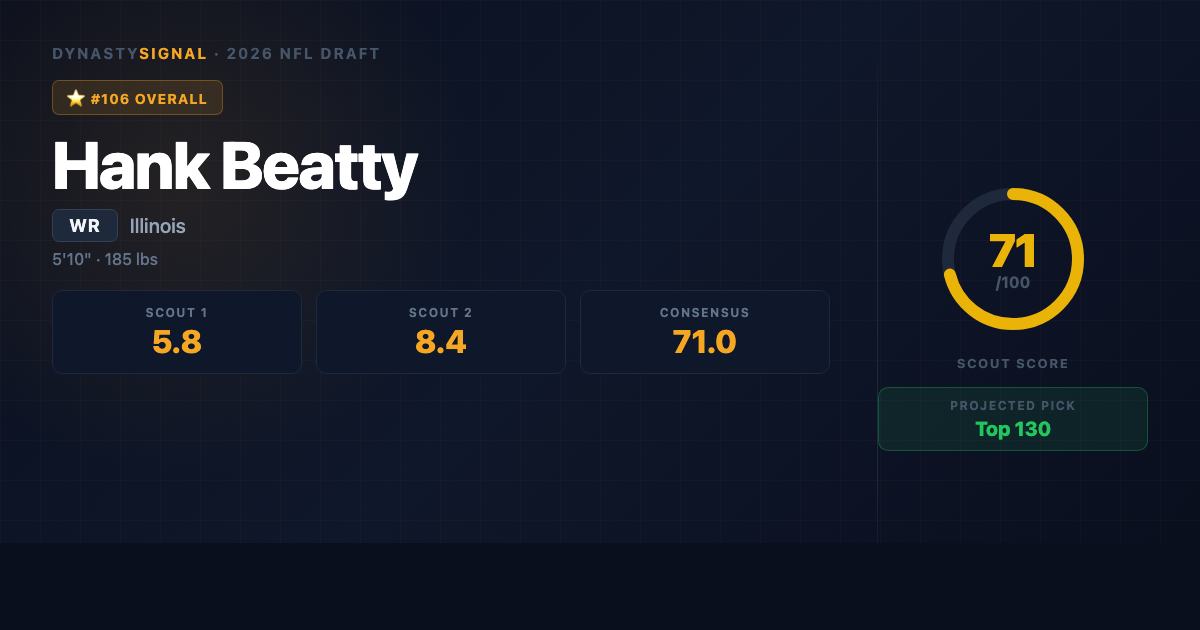
Scout 1 graded Beatty at 58/100 with a projected draft range of Round 5–6 (picks 155–210). The evaluation leaned heavily on the film limitations — one meaningful route rep, no contested-catch evidence, and return production that carries an FCS context caveat. Scout 1 acknowledged the tools are real (B+ for athleticism and YAC, B- for hands) but docked the overall grade for the ceiling cap imposed by his size and the absence of press-coverage evidence. The comp was Dontayvion Wicks and Kalif Raymond — a range that captures both the upside and the risk of a player whose NFL role could be WR3 flex or career PR specialist depending on development.
Scout 2 was considerably more bullish, grading Beatty at 84/100 with a projected pick in Round 3 (picks 70–100). Scout 2 flagged the same size concern but pushed back on the conventional view, arguing that Beatty's YAC vision, elusiveness, and toughness make him a Day 2 steal that size-focused evaluators will miss. The film grades reflected that conviction: 9/10 on YAC, 8/10 on athleticism and scheme fit. The comp range was ambitious — Tyler Lockett as a floor, Deebo Samuel as a ceiling — which speaks to the belief that Beatty's versatility and explosiveness can transcend his measurements in the right system. Two scouts, a 26-point gap in grade, and a three-round gap in projection: Beatty is genuinely polarizing in a way that makes him interesting.
PROJECTION
For dynasty purposes, Beatty is a late-round flier with a locked-in floor and a developing ceiling. His special teams value guarantees him an NFL roster spot — a player who averages 18.9 yards per return in a Power Five conference gets a uniform — and that floor provides the volume opportunity dynasty managers need to hold a player through Year 1. If he lands in a West Coast or spread-heavy system (the names that surface most often: Kansas City, San Francisco, Miami), the offensive role can expand quickly. A realistic Year 2 trajectory is 45–55 receptions, 550–650 yards, and 3–4 touchdowns as a slot/flex piece, with return yards as a weekly bonus.
The ceiling case rests on whether his route tree and contested-catch ability develop with NFL coaching. His quarterback background gives him a foundation that pure athlete-types lack — the processing is there, the scheme understanding is there — but translating that into consistent NFL production requires a coaching staff willing to invest snaps and a QB who trusts him in traffic. Scout 2's Deebo Samuel comp is aspirational, but it's not insane. Beatty has Samuel's YAC mentality and versatility, and Samuel was also an undersized player whose dynasty value came from scheme deployment rather than prototype measurements. Don't reach — but in a startup draft, he's a worthwhile late pick with genuine upside in the right landing spot.
View Hank Beatty's full player profile, measurables, and scouting breakdown →
🎬 All-22 Film Analysis Update
*Updated after All-22 film review by Scout1 and Scout2.*
Film Score: 71.0/100 (→ No change from base score of 71.0)
Composite Score: 71
Scout1 Assessment Hank Beatty is a late-blooming dual-threat playmaker who arrived in Champaign as a multi-skill high school quarterback and spent two years buried on the depth chart before exploding into one of the Big Ten's most dynamic weapons in his final two seasons. He is not a prototypical outside receiver — at 5'11" and 185 lbs he won't project as an X in any NFL system — but his speed, football IQ, elite return ability, and alignment versatility give him a legitimate roster argument as a Z/slot hybrid wh...
Scout2 Assessment Beatty defies measurables with proven Big Ten production – prioritize playmaking over height; Day 2 upside as returner/YAC spark > boom/bust tall prospects.
*Film analysis is based on All-22 footage reviewed independently by two scouts. Scores reflect on-field evidence and may differ from pre-film model projections.*