
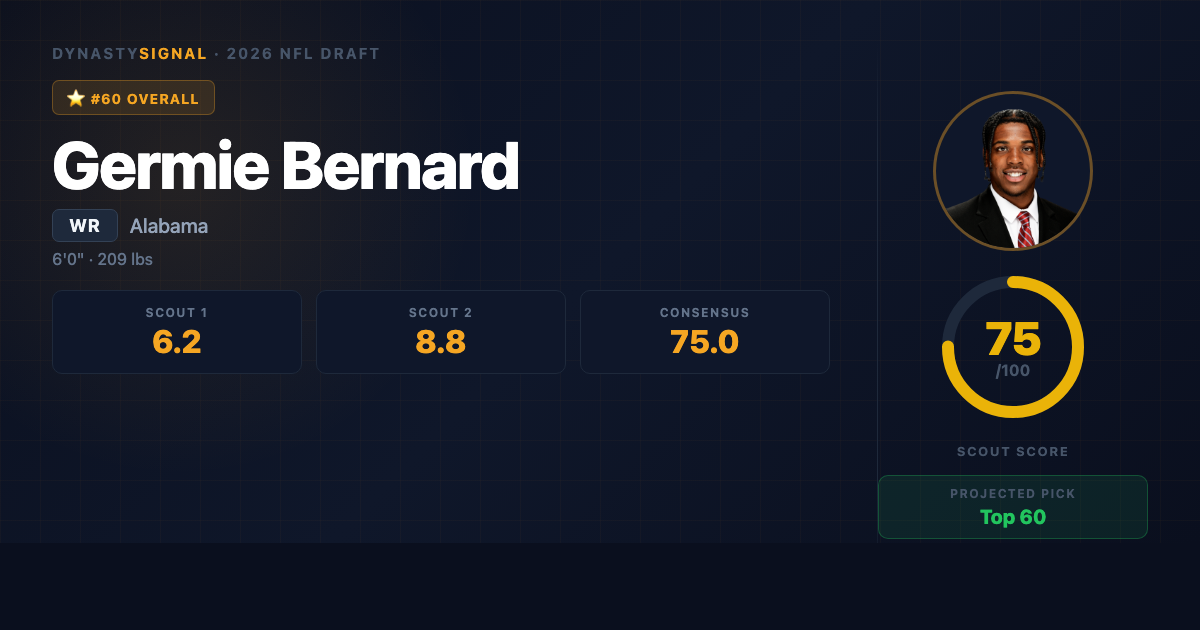
Germie Bernard did what most college receivers never have to: survive. Three schools in four years — Michigan State, Washington, Alabama — and at every stop he had something to prove. By the time the 2025 season kicked off in Tuscaloosa, Bernard wasn't just on the roster; he was the guy, absorbing 97 targets across 13 games as Alabama's undisputed WR1 against the most punishing schedule in college football. FSU, Georgia twice, Tennessee, LSU, Oklahoma twice — Bernard ran routes against all of them and kept his name in the conversation. That kind of résumé doesn't happen by accident.
What makes Bernard genuinely interesting for dynasty is the layer beneath the surface stats. The 802 yards and 7 touchdowns are fine — they're not jaw-dropping — but the 17 missed tackles forced (top-20 nationally), the 80.7 PFF drop grade, and the fact that he ran 93.6% of Alabama's team routes as a true multi-role piece paint a more compelling picture. He's not a track guy (4.52 forty), and his 61.9% catch rate in 2025 gives scouts pause. But the physical profile, the YAC production, and the way he presses defenders after the catch suggest an NFL floor that's higher than his current buzz implies.
STRENGTHS
Bernard's calling card is what happens *after* the catch, and the tape backs it up. At 6'1"/204 pounds, he doesn't just absorb contact — he looks for it. Against Tennessee on a late-drive crossing route with the SEC on ABC and the clock winding under a minute, he caught the ball, took a shot from a safety, dipped his shoulder, broke the arm tackle, and turned upfield for a critical gain. Against South Carolina, he ran *through* a smaller corner on a crossing route using that 204-pound frame like a battering ram. Seventeen missed tackles forced at his size is a legitimate calling card, not a scheme artifact.
His hands are cleaner than the catch-rate number suggests. The 80.7 PFF drop grade is the strongest numerical mark on his profile, and the film supports it — he attacks the ball away from his body rather than body-catching, secures it through contact, and has the hand strength to finish tough catches in traffic. Against Georgia in the red zone he rose cleanly over a press corner at the high point in a tight window and came down with it. The route running is sound at the stem — crisp hip dip on curls and comebacks, body under control — and he's adept at finding vacated zones in two-high and Cover-3 shells, the hallmark of a receiver who understands coverage concepts beyond the play-sheet.
The positional versatility is underrated. Bernard ran 61% of his snaps outside and 35.6% in the slot over a full SEC season — he's not a slot-only piece forced wide, he's a genuine X who can move around the formation. NFL coordinators prize that flexibility. Absorbing Alabama's full route-tree offense after transferring in and immediately becoming the WR1 target leader says something real about his football IQ and adaptability.
CONCERNS
The 4.52 forty is the ceiling question and it's a legitimate one. Against FSU's press corners, Bernard was visibly re-routed at the line of scrimmage — defenders with closing speed got their hands on him and disrupted his timing. At the NFL level, those corners are faster and more physical. When a receiver can't credibly threaten the seam or the sideline vertically, defenses can shade coverage, compress his release windows, and take away the intermediate routes that define his game. His yards per route run (1.71, ranking outside the top 170 among qualified FBS receivers) tells you he's a system-dependent piece at this stage of his career, not a creator.
The contested-catch rate is the other real flag. For a 6'1" receiver being evaluated partly on red-zone potential, a 35.7% mark (5-of-14) on contested balls is well below acceptable. He needs to be north of 50% to justify the body type as a jump-ball asset — he isn't there. His catch rate also slid from 68.5% in 2024 to 61.9% in 2025 as the defensive quality and target difficulty increased. Some of that is Alabama's QB situation and off-target throws, but the regression against tougher competition is worth monitoring in pre-draft interviews.
SCOUT GRADES
Scout 1 came away measured, landing a 62/100 overall grade with a projected pick range of Round 2, picks 45–60. The film evaluation flagged his route running as functional but not elite (B/6.5), athleticism as a real limiting factor (C+/5.5), and hands as above average within structure but below average in contested situations (B-/6.0). The YAC profile earned the report's strongest mark (B+/7.0), and the overall verdict was a reliable complementary piece with WR2 upside in the right system — a Jarvis Landry archetype who beats zones, wins at intermediate depths, and is physical enough after the catch to produce without elite speed. Projected dynasty value: late second round of rookie drafts, with peak production arriving in years two and three.
Scout 2 was considerably more bullish, grading Bernard at 88/100 with a matching Round 2 pick projection (picks 40–60). The second evaluation rated his route running at 9/10, hands at 9/10, and body control/YAC at 9/10 — crediting elite tempo variation, a quick-twitch release package, and a "contortionist RAC threat" profile that draws a ceiling comp of Deebo Samuel in the right scheme. The floor comp was Tyler Lockett — a reliable slot separator and chain-mover. Where Scout 2 diverges from Scout 1 most sharply is in the scheme-versatility assessment: the second report sees Bernard as a spread-offense weapon capable of 700–900 yards in year two with the right offensive coordinator, and a dynasty ADP climber from a 4th-round rookie add to a 3rd-round asset by year three.
PROJECTION
The honest dynasty answer on Bernard is: landing spot first, talent second. In a timing-based, zone-friendly offense with a rhythm quarterback — think spread concepts, quick game, RPO principles — he has a realistic path to WR2 production by year two. He's the kind of receiver who makes a smart coordinator look good, finds the soft spots in zone coverage, and turns 8-yard completions into 13-yard gains. That has PPR value. If he lands in Kansas City, Philadelphia, Los Angeles (Rams), or San Francisco — teams the tape analysis specifically flagged as structural fits — he's worth targeting in the back half of the second round of 2026 rookie drafts.
The risk is the wrong situation. Drop him into a man-heavy system, behind two established receivers, and Bernard can quietly disappear for two years before emerging as a WR3 on a team that never throws 100 times per game. He's 22 at draft time (born December 2003), which is age-appropriate but means there's no development runway to spare. Don't reach for him in the first round of rookie drafts. Do monitor his NFL landing spot and pounce if the scheme is right — the physical YAC toolkit and route intelligence are real enough to reward patience.
View Germie Bernard's full player profile, measurables, and scouting breakdown →
🎬 All-22 Film Analysis Update
*Updated after All-22 film review by Scout1 and Scout2.*
Film Score: 75.0/100 (→ No change from base score of 75.0)
Composite Score: 75
Scout1 Assessment Germie Bernard is a 6'1", 204-pound multi-role receiver who spent two stops (Michigan State → Washington → Alabama) before emerging as Alabama's clear WR1 in 2025, commanding 97 targets across 13 games. He's a zone-beater who works both outside and in the slot, wins with body control and physicality after the catch rather than elite speed, and brings genuine YAC ability with 17 missed tackles forced — top-20 nationally. The case against is real: a 4.52 forty and a 61.9% catch rate in 2025 raise ...
Scout2 Assessment Bernard’s the 2026 draft’s best-kept secret – elite craft trumps size myth. Target late Day 2; he’ll outproduce his slot in rookie drafts.
*Film analysis is based on All-22 footage reviewed independently by two scouts. Scores reflect on-field evidence and may differ from pre-film model projections.*