
Eric Rivers has done something rare in modern college football: he's gotten *better* every time he's moved up a level. He started as a ghost at Memphis — zero catches in seven games — then erupted at FIU for 62 receptions, 1,172 yards, and 12 touchdowns in 2024, before transferring to Georgia Tech and proving it wasn't a Conference USA mirage. Against a real ACC schedule in 2025, Rivers posted 46/658/7 TDs while doubling as a jet-sweep weapon for 68 yards on the ground. That ascending arc, from zero to boom to legitimate Power 4 contributor, is exactly the kind of trajectory dynasty rosters are built on.
What makes Rivers genuinely interesting heading into the 2026 draft is the combination of elite speed and scheme versatility. His 66-yard jet sweep against Clemson and a 77-yard run in the BYU bowl game aren't just box score novelties — they signal that Georgia Tech's staff trusted him enough to put the ball in his hands against ranked competition. At 5'11" and roughly 180 lbs, Rivers isn't going to win size battles at the catch point, but he doesn't need to. He's a chess piece: a player who stresses safeties vertically, creates conflict with pre-snap motion, and turns routine completions into chunk gains after the catch.
STRENGTHS
The film on Rivers starts and ends with his speed, and the Clemson game is exhibit A. On a 3rd-and-8 deep route, Rivers runs clean past an ACC corner — the defender is trailing by two full yards at the catch point. That's not scheme-generated separation; that's genuine vertical burst against a legitimate opponent. The same speed shows up in open-field pursuit angles after the catch, where multiple film sources document him running away from defenders in space. His estimated 40 time sits in the 4.38–4.43 range based on film evaluation, and a legitimate Combine result in that window will significantly raise his draft stock.
Beyond pure speed, Rivers brings an impressive set of contact qualities for a player his size. The Boston College end zone contested catch — two defenders in his space, imperfect throw near the back pylon — shows real body control, hand extension, and competitive DNA. He attacks the ball rather than waiting for it to arrive, secures through contact, and shows the toe-drag sideline awareness you want to see on a smaller frame. His route running is functional-to-crisp with solid stem sales and sharp breaks on digs and slants — multiple film sources document him winning against zone coverage by sitting into soft spots rather than just burning corners with speed alone. The blocking grades are adequate for a lean receiver in a run-heavy system; Georgia Tech's staff kept him on the field during their 60%+ rushing attack, which tells you something about his willingness.
The production arc deserves credit on its own merits. A 62/1172/12 TD season at FIU will always carry the Conference USA asterisk, but Rivers followed it up with a meaningful Power 4 season — 7/119 at Boston College, 3/97 against NC State, a 66-yard run and 72 receiving yards against Clemson. That's a guy who leveled up and maintained output, not a player who was exposed by better competition.
CONCERNS
The elephant in the room is his frame. At 5'11" and 180 lbs, Rivers is on the lighter end even for a slot receiver, and the NFL game will demand he handle physical press coverage from corners who outweigh him by 20-plus pounds. He doesn't consistently win against press on film — his release efficiency is real, but a truly physical corner at the next level could disrupt his timing in ways ACC defenders couldn't. He'll need to add 8–12 lbs of functional muscle to hold up through a 17-game season without getting knocked around at the line of scrimmage.
The production is also lumpy. His big Georgia Tech games came against specific opponents — BC's porous secondary, NC State in a bounce-back game, Clemson allowing the big plays downfield. Against Georgia (1/14), Virginia Tech (2/29), and Pitt (2/20), he largely disappeared. That inconsistency against the ACC's better defenses raises legitimate questions about what happens when a coordinator takes away the vertical shot and forces him to win on possession routes in traffic. His best statistical season (the FIU explosion) came against competition that doesn't fully prepare you for NFL speed, and he has no exposure to SEC or Big Ten-caliber pass defense. The talent is real; the question is whether the system dependency is a feature or a bug.
SCOUT GRADES
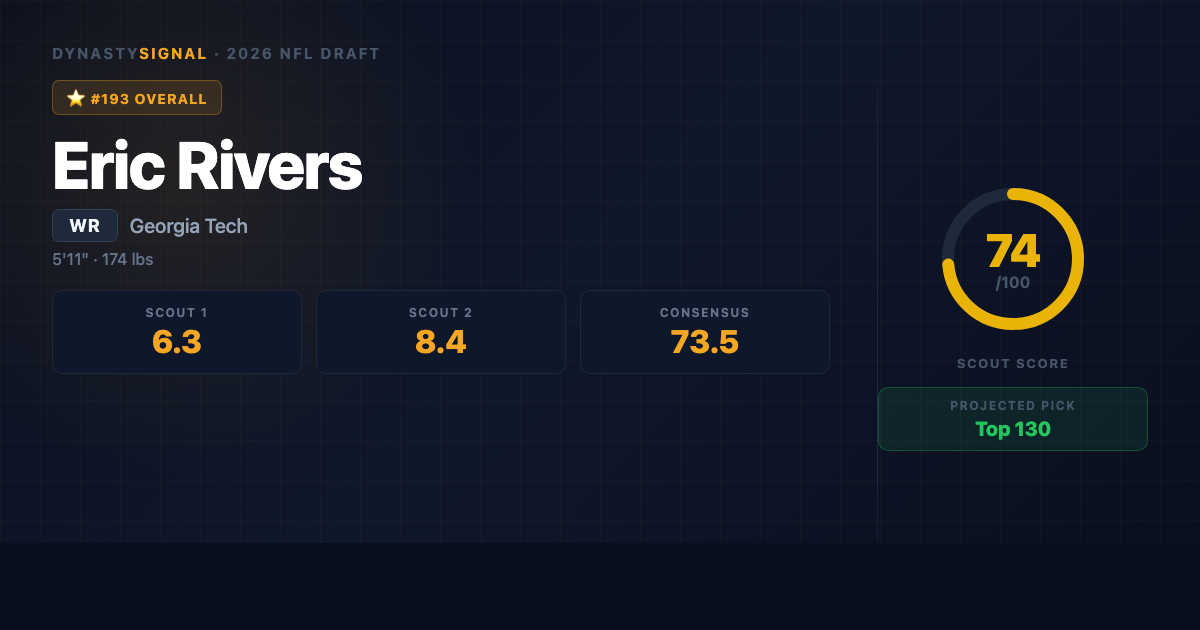
The two scouts saw the same player and came away with very different verdicts. Scout 1 grades Rivers at 63/100 with a Round 5 projection (picks 140–165), viewing him as a Day 3 scheme-dependent flier whose speed is legitimate but whose level-of-competition concerns, inconsistent weekly production, and thin contested-catch volume limit the upside. The floor comp is Jaelon Darden; the ceiling is Tyler Lockett — and Scout 1 sees the floor as the more likely outcome without an ideal landing spot.
Scout 2 is considerably more bullish, grading Rivers at 84/100 with a Round 2 projection (picks 45–55) — a contrarian take that leans hard into the film-level separation data, the elite release quickness, and a YAC profile that draws an Amon-Ra St. Brown ceiling comparison with a Tyler Lockett floor. Scout 2 sees a "twitchy slot assassin" who will be undervalued by a draft process focused on bigger names, and projects a trajectory from Year 1 gadget role to Year 3 WR2 in a motion-heavy offense. The gap between the two evaluations is wide, but the common thread is scheme dependency — both scouts agree Rivers needs the right OC to unlock his ceiling.
PROJECTION
In dynasty, Eric Rivers is a pre-draft stash with genuine upside if the landing spot cooperates. A Day 2 pick (which Scout 2's aggressive grade anticipates) into a creative offensive system — think Kansas City, San Francisco, or Green Bay — would immediately elevate his dynasty value into the late-WR3/flex range. Even a Day 3 selection lands him in a depth chart position where he can compete for a gadget role in Year 1, earn offensive snaps in Year 2, and develop into a functional WR3 by Year 3 if the speed translates cleanly (and historically, speed at his level does translate).
The key data point to watch is the Combine 40. If Rivers runs a confirmed 4.38–4.40, the draft board conversation changes immediately — that speed profile at his usage level is a legitimate differentiator, and teams will pay for it. Dynasty managers should acquire him at Day 3 value now (late-rookie pick range or final-bench stash price) and be prepared to buy aggressively if the Combine confirms what the film suggests. The upside is real; the variance is high; the price is still low.
View Eric Rivers's full player profile, measurables, and scouting breakdown →
🎬 All-22 Film Analysis Update
*Updated after All-22 film review by Scout1 and Scout2.*
Film Score: 73.5/100 (→ No change from base score of 73.5)
Composite Score: 73
Scout1 Assessment Eric Rivers is a lean, speed-oriented flex receiver with legitimate deep threat ability and dangerous after-the-catch production — the kind of player who can make an NFL roster if he lands in the right offensive system. He's a transfer who went from Memphis to FIU (where he exploded for 62/1172/12 TDs in 2024 at Group of 5 level) before proving he can do it against Power 4 competition at Georgia Tech in 2025. The case for him is real vertical speed — he was running away from Clemson corners on 3...
Scout2 Assessment Rivers is the anti-flash prospect who racks up Day 1 snaps/targets—draft capital undersells his tape. Target in R2; he'll mock the doubters by 2028.
*Film analysis is based on All-22 footage reviewed independently by two scouts. Scores reflect on-field evidence and may differ from pre-film model projections.*