
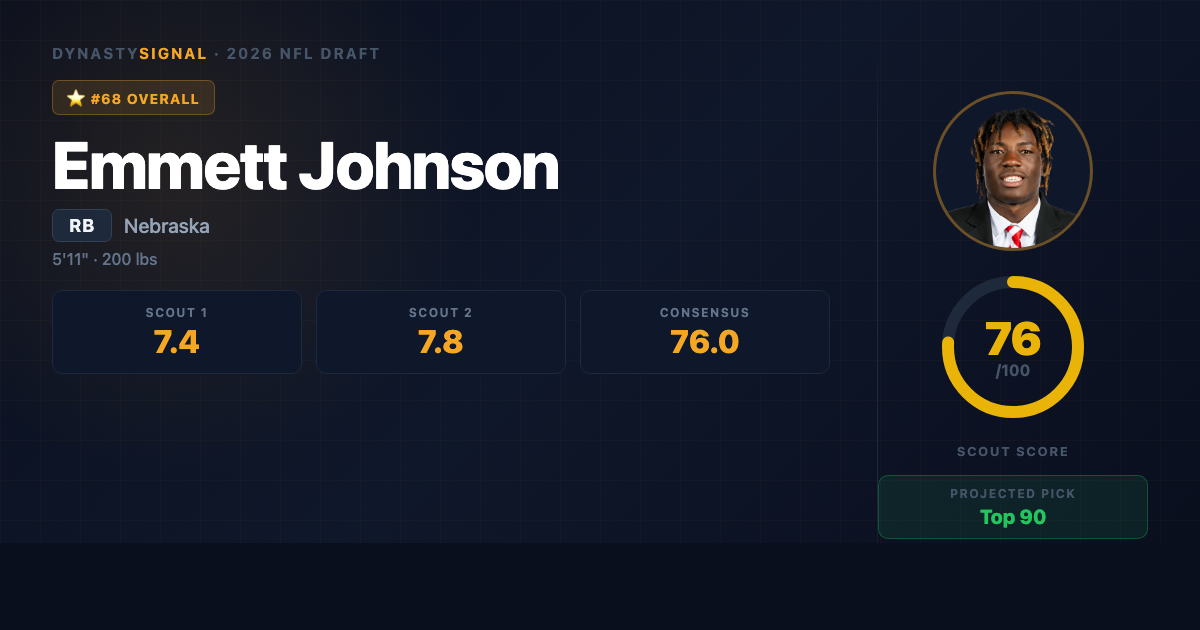
Nebraska's Emmett Johnson enters the 2026 NFL Draft as one of the more complete running back prospects in this class — a player who does enough things well to hold up on every down and enough things at an elite level to make NFL defensive coordinators uncomfortable. In 2025, the 5-11, 200-pound redshirt junior rushed for 1,451 yards on 251 carries (5.8 YPC) with 12 touchdowns against Big Ten competition, adding 46 catches for 370 yards through the air. That dual-threat production against a conference that routinely sends defensive linemen and linebackers to the first round is not a statistical mirage — it's a genuine signal.
What separates Johnson from the other Day 2 backs in this class is deceptive versatility. He posted a 70-yard rush long and a 56-yard reception in the same season, suggesting home-run ability in both phases. He lined up wide on occasion at Nebraska, his coaching staff trusted him in critical short-yardage situations (12 rushing TDs), and he caught the ball with natural hands rather than body-catching. The question isn't whether Johnson can play in the NFL — it's what ceiling he reaches once a team identifies how to deploy him correctly.
STRENGTHS
Johnson's most translatable trait is his vision in zone-blocking schemes. On film against Iowa, he demonstrates textbook zone-read patience — pressing the A-gap while tracking the blocking combo, then cutting decisively when the crease shifts rather than guessing early. He is not a back who buries himself into congestion; he processes, sequences, and then accelerates. Nebraska's outside zone-heavy system under coordinator Marcus Satterfield is essentially a pro-style offense, which means the reads Johnson made on Saturdays will look familiar on an NFL whiteboard from day one.
His second calling card is legitimate big-play speed. The 70-yard rush is on film and it's clean — he outruns a pursuing defensive back who had inside leverage, turning a crease into a touchdown with pure functional game speed. That burst also shows up in the pass game: a 56-yard reception started as a schemed mismatch and became a statement about his acceleration through the second level. The film also confirms genuine contact balance that punches above his weight class. In Iowa's snow game, he absorbs a shoulder hit and stiff-arms through to continue his path; against Northwestern, he fights through contact from two defenders at the second level while staying upright for additional yardage. He plays physically for a 200-pound back.
As a receiver, the 46-catch, 8.0 YPR season isn't just a checkmark — it's a trait. Johnson makes hands catches away from his body (confirmed at the end zone against Northwestern), runs functional routes from the backfield, and has shown the ability to align split out wide, signaling that Nebraska trusted him to read coverage, not just leak to the flat. In an era where running backs who can't contribute in the pass game are replaced with a fifth wide receiver, Johnson's receiving package is a genuine point of difference.
CONCERNS
The primary concern is durability at 200 pounds over an NFL season. Johnson absorbed 251 college carries on top of his receiving workload — that's meaningful wear on a frame that will face substantially bigger NFL defenders. The worry isn't that he's fragile; the film shows a back who finishes through contact. The worry is attrition across a 17-game NFL season where he can't shake every tackler the way he did in the Big Ten. His pass protection adds another layer of uncertainty: there's limited film evidence of him handling edge rushers credibly, and in the NFL, a back who can't protect is a two-down player — which caps dynasty upside significantly.
When defenses take away his space, Johnson can be indecisive on secondary reads. Against Minnesota and in some goal-line situations against Iowa, he bows his head into congested traffic rather than identifying a crease or bouncing outside. At 200 pounds, that's a losing play against NFL linebackers. His production also correlates with opportunity — against elite competition like Penn State and USC in primetime, the standout moments were fewer. Dynasty managers should factor in landing spot heavily; this is a player whose value is meaningfully scheme-dependent.
SCOUT GRADES
Scout 1 awarded Johnson a 74/100 with a projected draft range of Round 3, picks 70–90. The report draws a primary comparison to Kareem Hunt — a 5-11/200-pound back with breakaway speed, functional receiving ability, and zone-scheme vision who was a third-round steal and overperformed his draft capital. The secondary comp is early-career Tony Pollard, acknowledging that in the wrong system Johnson could be miscast as a satellite back despite workhorse upside. The report grades his explosiveness A-, vision B+, receiving B+, contact balance B, and pass protection C+ — with the C+ flagged explicitly as a swing variable for three-down designation.
Scout 2 came in slightly more bullish overall at 78/100 with the same Round 3, picks 70–90 projection, but offered a contrarian lens: Johnson is less an elusive home-run threat and more a contact-balance power grinder whose vision maximizes average line play. The second report grades vision 9/10 and contact balance 9/10 while docking burst/acceleration at 6/10 — a meaningful divergence from Scout 1's A- on explosiveness. The floor comp is Justice Hill (volume back, limited ceiling); the ceiling is Rhamondre Stevenson (power grinder with receiving upside, scheme-dependent RB1). Both scouts land in the same Round 3 draft-slot window despite disagreeing on the nature of his skill set, which suggests the market has a clear read on his value even if the evaluation lens differs.
PROJECTION
For dynasty, Johnson is a classic "draft capital arbitrage" target — a player with legitimate three-down upside who is likely to go in the third round of the NFL Draft and slip into the back half of rookie ADP because of size concerns and a non-elite athleticism profile. If he lands with a zone-blocking team that features him in the pass game (49ers, Eagles, Rams scheme fits), his RB2 floor has RB1 upside within 18 months. The Kareem Hunt/Rhamondre Stevenson comp range is the right ceiling band — not a fantasy superstar, but a reliable producer who can carry a team week-to-week in the right situation.
Target Johnson in rounds 3–5 of 2026 startup drafts. His age (22 as a redshirt junior) slightly compresses the dynasty prime window compared to a true junior, but he has at least four high-value seasons ahead if he stays healthy. Monitor his landing spot aggressively — a gap/power scheme or pass-heavy offense that doesn't maximize his zone-reading and receiving skills is a reason to buy at a discount, not avoid. The risk is a two-down role if pass protection doesn't develop; the reward is a starter-quality back available outside the first two rounds of rookie drafts.
View Emmett Johnson's full player profile, measurables, and scouting breakdown →
🎬 All-22 Film Analysis Update
*Updated after All-22 film review by Scout1 and Scout2.*
Film Score: 76.0/100 (→ No change from base score of 76.0)
Composite Score: 77
Scout1 Assessment Emmett Johnson is a three-down workhorse back from Nebraska with legitimate home-run speed, excellent contact balance, and surprising polish as a receiver out of the backfield — a skillset that translates directly to the modern NFL. He ran for 1,451 yards on 251 carries (5.8 YPC) with 12 rushing TDs in the Big Ten, a conference where the interior competition is as good as anywhere in college football. The case for him is simple: he does everything adequately or better, he hits home runs (70-yard...
*Film analysis is based on All-22 footage reviewed independently by two scouts. Scores reflect on-field evidence and may differ from pre-film model projections.*