
The number that defines Emmanuel McNeil-Warren's draft case is not his tackle total, his interceptions, or his PBU count — it's nine. Nine career forced fumbles as a safety. That's a historic rate of ball disruption for any defender at any level, and it reflects something about McNeil-Warren that doesn't fit neatly on a stat sheet: this player hunts the football on every single snap. When he's near a ball carrier, his hands are active and his intention is to strip. The 214 career tackles and 11 tackles for loss validate the production, but the nine forced fumbles tell you what kind of player he actually is.
At 6'2" and 202 lbs out of Toledo's MAC program, McNeil-Warren projects as the best safety in Group of Five football with a legitimate case for Day 2 consideration. He's a true chess piece — capable of playing single-high centerfield, two-high half-field, box safety in the run game, and overhang/apex near the line of scrimmage. Toledo's coaching staff deployed him everywhere, which means the versatility is real. The competition-level discount applies, and his 202-lb frame needs to get to 210-215 for the box role he projects toward. But the tools — size, range, forced fumble rate, and scheme versatility — are legitimate at any level.
STRENGTHS
Run support is the calling card, and the film is emphatic about it. Multiple sources show McNeil-Warren in box alignments triggering downhill at the run with both shoulders square, weight loaded forward, and no wasted motion. He doesn't hesitate when the run shows — he's in the hole before the ball carrier can set his feet. His pursuit angles are calculated and efficient: he's running to where the runner is going, not where they were. The 214 career tackles and 11 TFL reflect consistent snap-after-snap impact in the run game, not highlight-reel cherry-picking.
Ball disruption rate is the second headline. Five career interceptions and 13 PBUs are solid but not exceptional numbers. The nine career forced fumbles are exceptional — and they show up on film at multiple opponents, in multiple situations, from multiple alignments. He attacks the football with his hands at the point of contact, which is a skill that can be developed but can't be fabricated. NFL defensive coordinators who understand the value of ball-disrupting safeties in modern schemes — particularly those who can convert 50/50 plays into turnovers — will specifically want this on their roster.
His scheme versatility genuinely expands his NFL floor. Film confirms alignments at single-high, two-high half, box at 5 yards, overhang/apex against tight ends and slots, and A-gap mug pressure before bailing into zone. That breadth of deployment at the college level means NFL coaching staffs can slide him into multiple roles without a scheme-specific adjustment period.
CONCERNS
The MAC competition ceiling is the question every scout raises, and it's the right question to ask. Toledo's schedule doesn't consistently feature NFL-caliber offensive talent, and while McNeil-Warren's performance in the Kentucky game (8 tackles, forced fumble, fumble recovery in Week 1) is encouraging, a single game against SEC competition doesn't fully answer the translation question. His athleticism claims need combine validation — if his 40 time clocks in the low 4.4 range as the film pursuit angles suggest, the grade rises meaningfully. If he's a 4.5+ athlete, the argument changes.
At 202 lbs, his frame is the physical concern for the box-safety role he projects toward. NFL offensive linemen, H-backs, and fullbacks will create leverage problems that college opponents couldn't. He'll need to add 10-15 lbs of functional strength before his second NFL season to hold the point of attack against true NFL blocking. Man coverage reliability also remains unproven — Toledo's scheme largely protected him from true one-on-one matchup situations against tight ends and slot receivers.
SCOUT GRADES
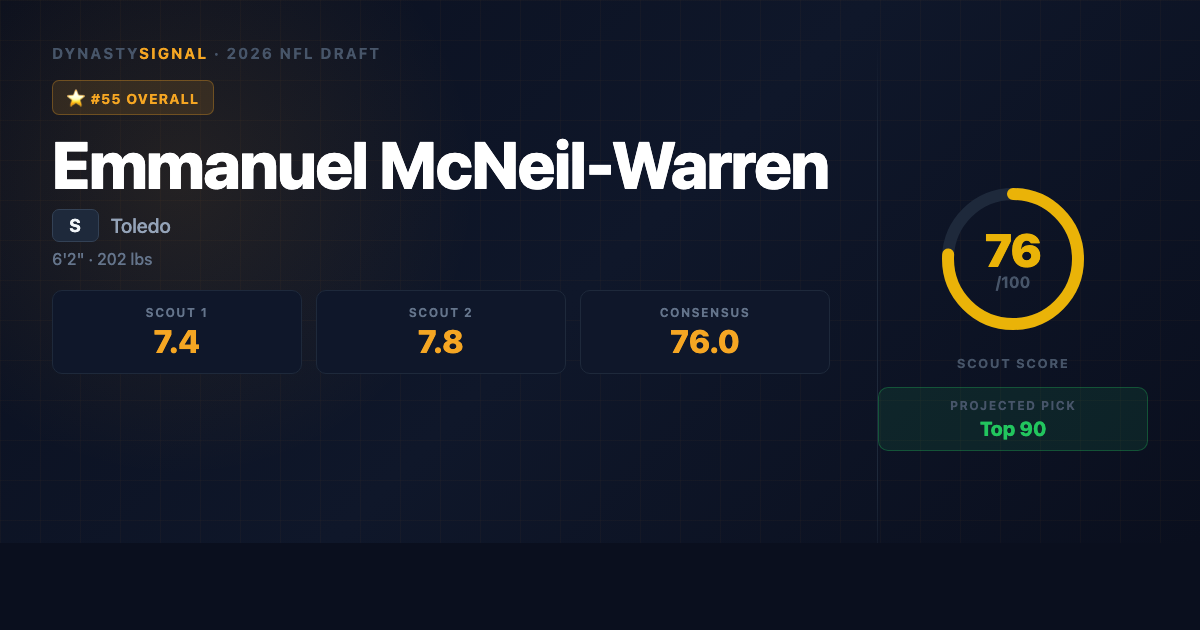
Scout 1 graded McNeil-Warren at 74/100 with a R2, Pick 45-62 projection, specifically citing the forced fumble rate, scheme versatility, and range as elite traits while flagging MAC competition and man coverage as the primary unknowns. Scout 2 came in at 78 but with a more conservative Pick R3, 70-90 projection, rating his athleticism at 7/10 and noting below-elite top-end speed that could be exposed against faster NFL perimeter threats. The scouts diverge on pick range but converge on the archetype: a do-everything zone safety with elite run instincts who needs combine testing to fully validate the athleticism claims. Scout 1 comps him to LaRon Landry at the ceiling; Scout 2 goes Jayron Kearse at the floor and Xavier McKinney-lite at the ceiling.
PROJECTION
McNeil-Warren's dynasty timeline is Year 1 contributor at a real snap count. Even as a rookie, his run-support ability and scheme versatility will put him on the field in base packages on a team that values those traits. The development curve is about man coverage and NFL-weight adjustment — both addressable within two seasons. By Year 2-3, the realistic ceiling is a three-down starting safety in a zone-heavy defense who logs 90-110 tackles, multiple forced fumbles, and develops into a playmaking backend piece.
For IDP dynasty purposes, McNeil-Warren's tackle volume and forced fumble rate make him a legitimate target at safety. His floor is a rotational safety who contributes 50-70 tackles and 2-3 forced fumbles annually; his ceiling is a lead-tackle machine with 100+ tackle seasons and the playmaking disruption rate to differentiate him in IDP scoring.
View Emmanuel McNeil-Warren's full player profile, measurables, and scouting breakdown →