
Scout1 Assessment
Donaven McCulley's 22-frame All-22 sample from Oklahoma's game vs. Missouri (OKLA) presents a physically imposing prospect whose ceiling is evident even from overhead camera angles. His 6'5" frame stands out conspicuously relative to every defensive back aligned on him throughout the film — in OKLA_scene_0001 and OKLA_scene_0005, he towers over the Missouri corner with what appears to be a 3-4 inch height advantage, a size differential that creates inherent contested-catch upside and route leverage. Oklahoma's coaching staff clearly recognizes this edge, consistently deploying McCulley as the isolated boundary X-receiver, often with no other receivers stacked near him. This isolation-heavy usage is a strong coaching trust indicator — they believe he can win on his own in 1-on-1 situations, which is the money assignment for any boundary receiver.
The most consistent finding across all OKLA frames is that Missouri defenders are giving McCulley significant off-coverage cushion — typically 5-7 yards pre-snap. In OKLA_scene_0021 and OKLA_scene_0027, the corner is already bailing to 6-7 yards before the snap, a respect play that speaks to opposing coordinators fearing his vertical threat. In OKLA_scene_0039, the corner closest to McCulley's alignment appears to be in a near-bail technique, turning his hips to run — this is the coverage you see against receivers with genuine deep speed who you simply cannot allow a free vertical release against. The contrast is notable in OKLA_scene_0081, where a tighter press look presents: this is the critical evaluation point for McCulley, as his ability to defeat press coverage will ultimately determine his NFL ceiling. Against the bail coverage, he has every opportunity to exploit the underneath throw; against press, his hand technique and release refinement are still works in progress.
Oklahoma's red zone usage of McCulley (visible in OKLA_scene_0011 and OKLA_scene_0033) is particularly encouraging. Inside the 20, he is consistently the isolated boundary target — the role reserved for your best jump-ball/contested-catch weapon. At 6'5", he can high-point balls over corners on the back-shoulder fade and use his length to create a natural catch radius that smaller defensive backs simply cannot mirror. In OKLA_scene_0055, the formation shifts to a more condensed set inside the 15, and McCulley remains on the field in a 1-on-1 look — the staff is not pulling him for a tighter/heavier package, which tells you they value his receiving contribution more than they'd value a blocking-oriented TE or H-back in that spot. His trips-opposite deployment in OKLA_scene_0049 shows sophisticated schematic use — creating true isolation on the boundary by flooding the other side, a concept that translates directly to NFL offenses.
The primary concern from this film sample is the lack of visible post-snap evaluable action. The OKLA_scene_0087 through OKLA_scene_0115 frames largely capture Michigan's offensive possessions (Oklahoma on defense), meaning McCulley is not on the field. This limits our ability to assess his release technique, route breaks, catch mechanics, and run-after-catch ability. What we can observe from the pre-snap stances across the earlier frames is a somewhat upright, casual two-point alignment in OKLA_scene_0005 and OKLA_scene_0017 — not the loaded, explosive base you want from a polished route runner. His feet appear slightly wide in multiple frames, which can slow the initial burst off the snap. These are refinement concerns consistent with a player still adapting to the WR position after beginning his college career as a quarterback.
The McCulley evaluation ultimately lands as a raw-upside developmental prospect with a legitimate NFL starter's ceiling. The physical profile is undeniable — the size, the way defenses scheme around him, and Oklahoma's trust in him as a red zone and isolation weapon all point to a player whose tools project to the next level. His QB-to-WR conversion background suggests above-average football IQ and understanding of route concepts, coverage recognition, and how to identify leverage — traits that should accelerate his development if given the right coaching environment. The floor is a practice squad developmental body; the ceiling, given proper technique refinement, is a legitimate starting boundary receiver who wins in 1-on-1 situations and becomes a red zone fixture.
Key Film Findings: Consistent 5-7 yard defensive cushions across OKLA frames indicate genuine vertical threat respect from opposing coordinators — cornerbacks bail pre-snap rather than risk getting stacked on go routes | Oklahoma deploys McCulley exclusively as the isolated boundary X-receiver in red zone sets (OKLA_scene_0011, OKLA_scene_0033), signaling coaching trust in his contested-catch ability over heavier alternatives | Frame size advantage is unmistakable from All-22 overhead angles — 3-4 inch height differential over every DB in the sample, translating to elite catch radius and red zone mismatch potential [confidence: medium]
Film Score: 52 / 100
Scout2 Assessment
Donaven McCulley leverages 6'5 rangy frame and ex-QB IQ, earning 7+ yd cushion boundary X (OKLA_scene_0001.jpg, OKLA_scene_0003.jpg) vs Oklahoma SEC defense.
Versatile alignments: isolated (OKLA_scene_0001.jpg), slot/wing (OKLA_scene_0002.jpg, OKLA_scene_0008.jpg), fluid stride vertical stems (OKLA_scene_0006.jpg).
Route tempo developing with ground coverage, but press releases untested; YAC potential from length/speed, hands projected solid.
Developmental Day 3 WR with size/speed traits, needs polish; score dips on route refinement needs from limited sample.
Key Film Findings: Elite cushion vs SEC CBs (OKLA_scene_0001.jpg) | Alignment versatility (OKLA_scene_0002.jpg slot) | Vertical stride threat (OKLA_scene_0003.jpg) [confidence: medium]
Film Score: 62 / 100
Film Score Summary
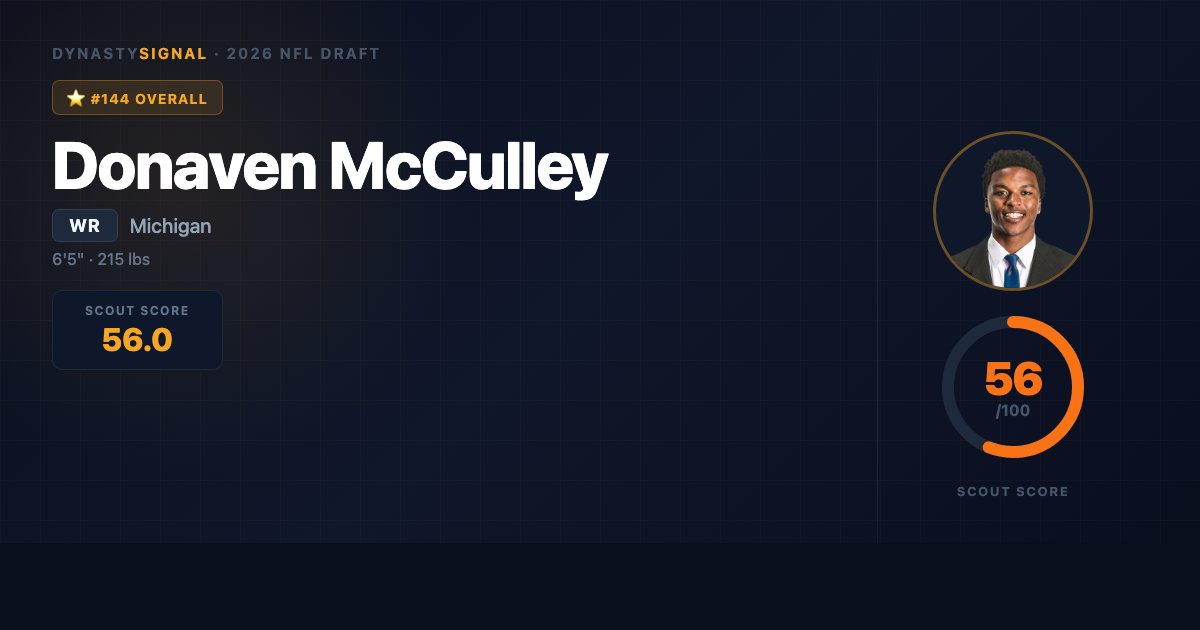
Scout 1 Score: 52 · Scout 2 Score: 62 · Composite Score: 56.0
*Film analysis is based on All-22 footage reviewed independently by two scouts. Scores reflect on-field evidence and may differ from pre-film model projections.*