
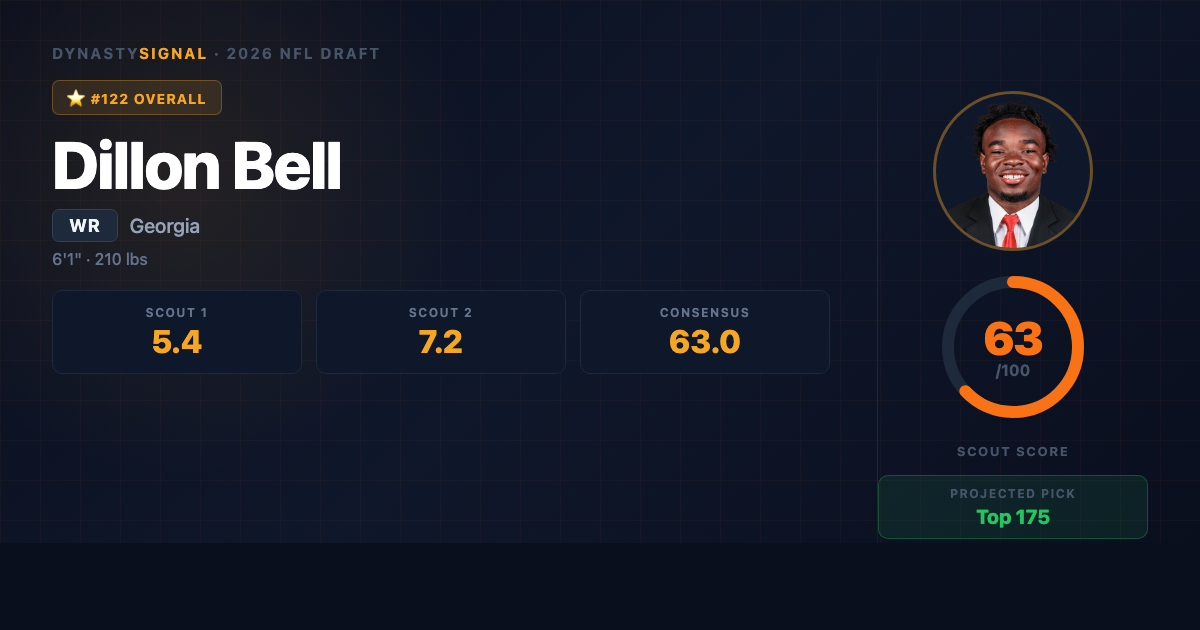
Dillon Bell is one of the more fascinating dart throws in the 2026 class — a player whose statistical line at Georgia dramatically undersells what he actually is. The 6'1", 210-pound receiver spent four years in Athens operating as Kirby Smart's Swiss Army knife, collecting gadget carries, blocking assignments, and opportunistic targets in a system that never needed him to be a true WR1. The result is a deceptively thin receiving résumé — 119 career catches, 1,269 yards, 11 TDs across four seasons — that masks a physical profile built for the modern NFL's hybrid offensive demands.
What makes Bell worth watching isn't the counting stats; it's the usage. He piled up 51 career carries at a ridiculous 7.3 yards per clip alongside his receiving work, finished as Georgia's third-leading rusher in 2024 despite getting just nine handoffs, and even threw a touchdown pass in 2023. He declined the 2025 draft to return for his senior year and polish his case for 2026. The question isn't whether Bell has NFL traits — he does — it's whether the right offense will unlock them.
STRENGTHS
Bell's most translatable NFL skill is the one that rarely shows up in dynasty rankings: his physicality after contact. For a player listed as a wide receiver, he plays through arm tackles and breaks down-field contact with the consistency of a fullback. Georgia deployed him in jet sweeps and designed runs precisely because he's dangerous in space with the ball in his hands, and that 7.3 YPC career average on 51 carries isn't scheme-only padding — it reflects a runner who plays through contact and leverages his 210-pound frame at the point of impact. Film shows him grinding for extra yards rather than going down easy, which projects to meaningful YAC value in the NFL.
His blocking grades are outright elite for a wide receiver. Both scouting evaluations noted Bell sealing edges and driving defenders off the ball in the run game — the kind of perimeter blocking that earns roster spots and snaps in run-first systems. Coaches in Shanahan/McVay-style offenses specifically covet receivers willing and able to crack-block at the line, and Bell does it at an A-minus level. Add in legitimate short-area quickness off the line of scrimmage — explosive first-step burst consistent with his track background (11.34/23.68 HS splits) — and you have a receiver whose pre-snap motion and run-threat capacity creates genuine defensive conflict on every play.
His scheme versatility is the final piece. Bell aligned at receiver, in the slot, in the backfield, and as an H-back at Georgia, giving NFL coordinators multiple deployment options without a positional pigeonhole. He's a clean fit in RPO-heavy and 12-personnel offenses where a physical mover who can catch, run, and block on the same drive is more valuable than a pure pass-catcher. The Shanahan/McVay tree of offenses is precisely where Bell's multidimensional profile belongs.
CONCERNS
The clearest knock on Bell is the 2024 drop issue. In a 43-catch season — already a thin target volume for a college receiver — documented drops are an alarming signal. Hands issues tend to compound under NFL speed and pressure, and until Bell shows clean ball security at the Senior Bowl or combine practices, the concern remains live. His overall catching grade of C from one evaluator reflects this: for a player whose role requires reliable hands in traffic and on screens, any doubt about ball security is a significant draft-day risk factor.
The volume concern is equally real. Bell's best collegiate receiving campaign was 466 yards in 2024 — a number that most legitimate WR3 candidates clear in a single Power Five season. His 2025 return, meant to build his draft résumé, actually saw him step backward to 27 catches and 268 yards. Some of this is legitimately attributable to Georgia's run-dominant scheme and elite competition for targets (Ladd McConkey, Brock Bowers), but NFL evaluators will still want to see consistent production, and Bell never provided it. His dynasty ceiling is further capped by his likely NFL role: a hybrid gadget piece doesn't generate the target volume that powers fantasy rosters.
SCOUT GRADES
Scout 1 graded Bell at 54/100 with a projected landing spot of Round 5, picks 150–175. The evaluation centered on Bell's genuine dual-threat utility and physical frame as his best traits, while flagging the drop rate, limited speed ceiling (projecting a 4.47–4.52 combine range for his size), and 2025 senior-season regression as meaningful negatives. Scout 1's NFL comp — Ty Montgomery's receiver-to-hybrid arc in Green Bay — captures the archetype well: a player who finds his role not as a traditional WR but as a chess piece in a creative scheme.
Scout 2 landed meaningfully higher at 72/100 and projects Bell as a Round 4 pick (100–120). The contrarian lean here was that Georgia's conservative deployment was actively suppressing a more talented player than the numbers suggest — specifically citing elite blocking (9/10, A-minus), solid hands in traffic (7/10), and that RB-like burst off the line of scrimmage. Scout 2's comp of Gerald Everett as the ceiling and a Zach Ertz-lite move-weapon floor is telling: both comps are players who carved out NFL careers by being useful in multiple ways, not by posting WR1 receiving lines. The divergence between scouts on pick range (R4 vs. R5) is worth monitoring as the combine approaches.
PROJECTION
For dynasty, Bell is a late-round stash with genuine upside conditioned on landing spot. The ideal scenario: an analytically driven offense (San Francisco, Detroit, Miami-adjacent) that deploys him as an H-back/slot hybrid, where his blocking earns him 300–400 snaps per year and his run-threat forces defensive adjustments that open the passing game for others. In Year 1 he's a core special-teamer with gadget usage; in Year 2 he's fighting for WR3/flex snaps in a run-first scheme; by Year 3 the ceiling is 40–50 catches in the right system if he's secured a role.
Don't buy Bell as a traditional WR riser in re-draft formats — the target volume simply isn't there in any realistic NFL deployment. But in dynasty leagues that value versatility and roster depth, he's the kind of player worth a pick in rounds 15–20 of rookie drafts. The physical tools, scheme fit, and Georgia pedigree give him a higher probability of sticking on a 53-man roster than most WRs taken in the same draft range. His floor is a core special-teamer who gets a look; his ceiling is a WR3/gadget weapon who's quietly useful for two or three years on the right team.
View Dillon Bell's full player profile, measurables, and scouting breakdown →
🎬 All-22 Film Analysis Update
*Updated after All-22 film review by Scout1 and Scout2.*
Film Score: 63.0/100 (→ No change from base score of 63.0)
Composite Score: 63
Scout1 Assessment **Position:** WR | **School:** Georgia | **Class:** Senior (2026 draft) **Report Date:** February 2026
Scout2 Assessment **The Short Version** Bell's no alpha X receiver—don't buy the "primed for larger role" hype from 2023 previews. He's a thick slot mover with FB traits in a WR body: elite blocker who can catch underneath but lacks separator juice. Contrarian take: Forget WR1 dreams; he's a Day 2 weapon in 12 personnel offenses, not a fantasy stud.
*Film analysis is based on All-22 footage reviewed independently by two scouts. Scores reflect on-field evidence and may differ from pre-film model projections.*