
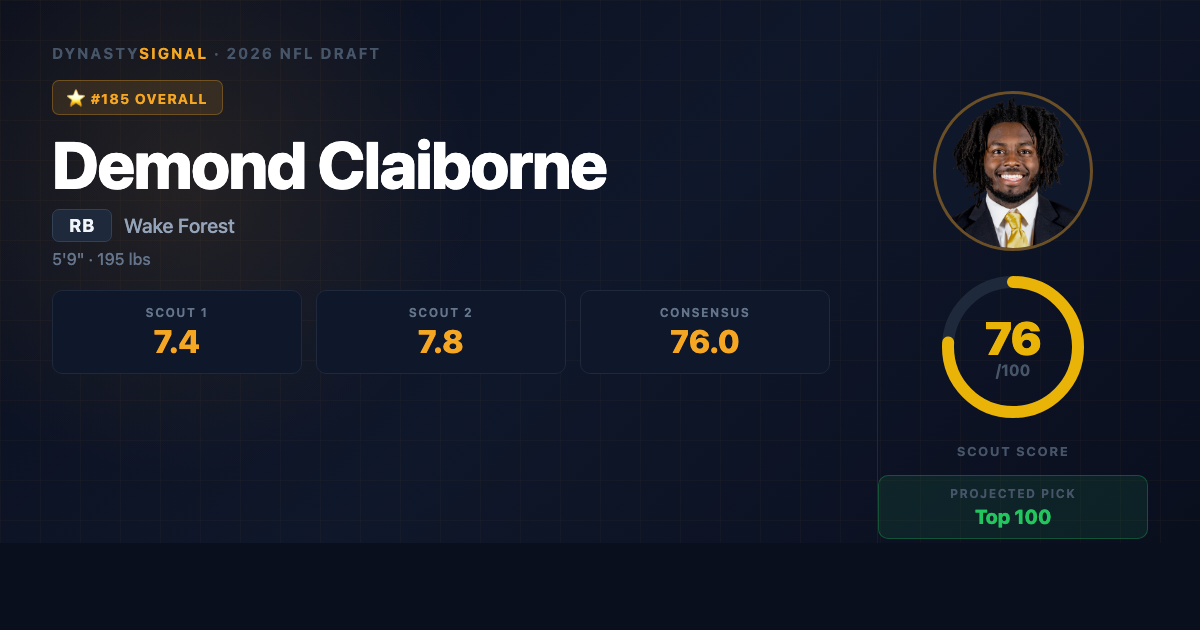
There is a moment on every Demond Claiborne highlight tape where you find yourself saying it out loud: *he's gone*. The Wake Forest senior captain hits the second level with a 4.42 burst that simply ends pursuit angles. Defenders stop running and watch. That kind of speed — the kind that genuinely shows up on tape against ACC competition — doesn't grow on trees, and it's the reason Claiborne enters the 2026 draft cycle as one of the more intriguing Day 3 running back investments available.
Over four seasons in Winston-Salem, Claiborne became Wake Forest's offensive engine and team captain, topping 1,000 rushing yards in 2024 before logging 907 yards and 10 touchdowns in 2025 while dramatically expanding his pass-catching role (28 receptions, up from three just two years prior). The receiving growth is the sleeper detail that separates him from most late-round speed backs: he's been split out wide, he's been trusted on third down, and his target volume has climbed every season. For dynasty managers looking past Round 1, that combination of elite speed and a demonstrably growing receiving profile is where the conversation starts.
STRENGTHS
The headliner is obvious, but it bears repeating: Claiborne's top-end speed is legitimate. Multiple film sequences against NC State, Georgia Tech, and Virginia — all legitimate Power 4 programs — show him creating vertical separation that no scheme can manufacture. On a third-quarter carry against NC State during a rivalry game the Demon Deacons led by a single score, he cleared defenders in the open field with the kind of stride extension and forward lean you only see from timed 4.3–4.4 backs. In short, the stopwatch number plays in real life.
What elevates Claiborne beyond pure sprinter status is his patience and vision. He is not a one-read back who fires into the A-gap on the snap. The film shows him pressing the line of scrimmage, reading guard and tackle blocks, and only committing to a crease once it opens. Against Georgia Tech in a game where Wake Forest was matched up against a top-10 opponent, he made a sharp lateral cut at the second level to collect extra yardage rather than bouncing into a wall — exactly the kind of processing that translates from spread college systems to NFL zone-run schemes. His receiving evolution adds another dimension: 28 catches in 2025 represents a true route-running commitment, and the coaching staff's willingness to split him out wide against zone coverage confirms the skillset is real, not manufactured. A 4.42 back who can line up at slot and actually run routes is a weapon.
Goal-line trust rounds out the strengths picture. Wake Forest repeatedly called his number in critical short-yardage situations — not because he's a bulldozer, but because his quickness to the corner is the fastest path to the end zone. Double-digit rushing touchdowns in back-to-back seasons. The coaching staff voted with play-calling, and that matters.
CONCERNS
The weight concern is real and worth naming plainly. At 195 pounds, Claiborne is on the lighter end of the NFL running back spectrum, and the physical attrition of an NFL season — not just big carries, but blitz pickup assignments against 240-pound linebackers — is an open question. When ACC defenses got clean, square hits on him (Virginia's stout defensive front, NC State's 4th-and-2 stop), he went down. He's not a back you draw up for a November 4th-and-1 against a playoff defense. Adding functional mass risks blunting the speed that makes him special; staying lean risks exposure to NFL physicality.
The second concern is competition ceiling. Wake Forest is a legitimate ACC program, but it is not Georgia, Ohio State, or Alabama — and some of Claiborne's most electric production came against FCS opponents (Western Carolina, NC A&T). The performances against Georgia Tech and Virginia are genuine data points; the FCS padding is real too. Pass protection is also an incomplete grade: the available film is nearly silent on his ability to pick up NFL-caliber blitzes, and that gap needs to be answered at the Combine and pro day before dynasty managers can confidently project him as a three-down back.
SCOUT GRADES
Scout 1 sees an elite speed-first prospect with legitimate receiving upside, grading Claiborne at 74/100 and projecting him as a Round 3, picks 75–100 selection. The evaluation emphasizes a confirmed 4.42 game speed (A grade for explosiveness), a B+ for vision and receiving ability, and a B- for contact balance given the frame limitations. The film comp to Tony Pollard's pre-breakout profile — a speed-and-flex back who needed the right system before becoming a featured option — anchors the ceiling projection.
Scout 2 offers a more contrarian read, grading Claiborne 78/100 with a similar Round 3, picks 70–100 projection, but grades his long speed more skeptically (C grade) while giving him higher marks for vision (A) and agility (B+). This scout saw him caught from behind on stretch runs and questioned whether his top-end speed is truly elite or merely functional. The ceiling comp is Austin Ekeler-lite — elusiveness and vision in a zone offense, but not a true home-run threat at the NFL level. Both evaluators agree on the dynasty framework: late Day 3 value, best in a zone-run system, with a floor of a reliable rotational contributor.
PROJECTION
For dynasty purposes, the landing spot is everything with Claiborne. In a zone-run system — think the Eagles, 49ers, Bills, or Commanders tree — he has legitimate RB2 upside by Year 2. His speed stretches defenses, his receiving growth opens third-down usage, and his vision translates cleanly to outside zone and stretch concepts. A team that wants a Tony Pollard-style chess piece will find real value on Day 3. Year 1 is likely a depth/special teams role; Year 2 is where the receiving work pays off if he can pass his blitz pickup tests at the NFL level.
The floor is a Chuba Hubbard–style career: durable, scheme-fit rotational back who holds a roster spot for years without ever cracking the top-12 fantasy relevance. For dynasty, target him in the late third round of rookie drafts — the speed alone earns that investment — and slot him as a stash with genuine upside if he lands in the right offense. He doesn't need to be the next Tony Pollard to return value; he just needs to find a coaching staff that knows what to do with 4.42 speed and 28 catches in a spread system.
View Demond Claiborne's full player profile, measurables, and scouting breakdown →
🎬 All-22 Film Analysis Update
*Updated after All-22 film review by Scout1 and Scout2.*
Film Score: 76.0/100 (→ No change from base score of 76.0)
Composite Score: 76
Scout1 Assessment Demond Claiborne is a compact, speed-first running back who served as Wake Forest's primary offensive weapon and team captain in his senior season. He's a genuine home-run threat with 4.42 speed that shows up live on tape — when he hits the second level, defenders are chasing ghosts. The case for him is straightforward: elite top-end speed, expanding receiving utility, and four years of evidence that he can carry a workload in a legitimate ACC program. The case against: he's 195 lbs and lacks tr...
Scout2 Assessment Claiborne's vision pops, but speed/power combo screams Day 2—not worth reaching in R3. Buy low in dynasty post-draft hype fade.
*Film analysis is based on All-22 footage reviewed independently by two scouts. Scores reflect on-field evidence and may differ from pre-film model projections.*