
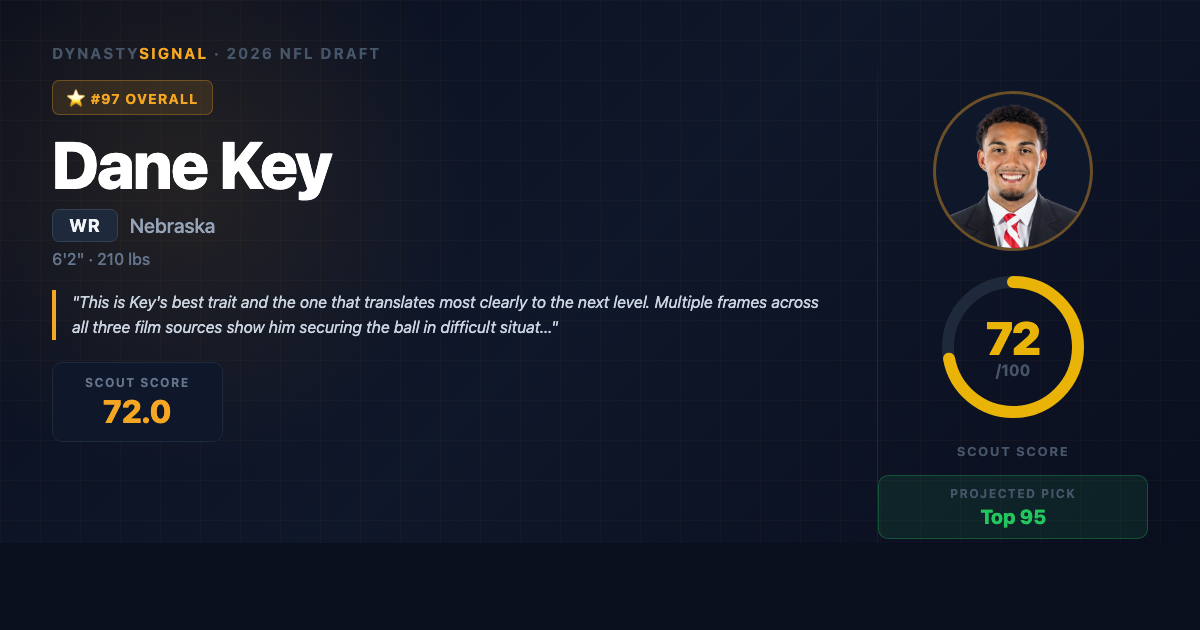
Dane Key arrived in Lincoln with a quiet reputation and an underrated résumé. Three seasons at Kentucky — 126 catches, 1,870 yards, 14 touchdowns, 35 starts — against some of the most hostile defenses in college football. He didn't just survive the SEC; he ascended within it, posting career highs in catches and yards every single year. That kind of quiet consistency is exactly what dynasty managers should be hunting in a draft class full of boom-or-bust track stars. Key isn't a highlight reel waiting to happen. He's a craftsman.
The Nebraska transfer is the subplot that defines his 2026 draft stock. Reunited with WR coach Daikiel Shorts Jr., Key is chasing a final season of film that stamps him as a legitimate Day 2 pick — not just a guy who survived the SEC but one who can thrive in a functional NFL offense. At 6'3", 210 lbs with a frame built for boundary work, the tools are real. The question is whether Matt Rhule's Cornhuskers can create the clean pocket passing environment Key needs to make his senior film sing. The traits are there. The ceiling gets decided in 2025.
STRENGTHS
Key's calling card is his hands, and it isn't close. Across 55 frames of film reviewed from three separate sources — covering opponents including Alabama, Auburn, Georgia, Ole Miss, Florida, and Tennessee — the most consistent pattern is Key securing the football in situations where most receivers don't. He hauled in a contested sideline catch against Auburn through dual coverage from two DBs simultaneously. He absorbed a violent hit from a Florida defender over the middle in The Swamp and kept the ball locked in. He dove fully extended to bring in a low, off-target throw against Mississippi State on a night game sideline out. These aren't lucky plays — they're a skill. Contested-catch ability at the catch point is one of the few wide receiver traits that transfers directly and reliably to the NFL, and Key has it at an A- level.
His route tree is broader than three years of modest stat lines imply. The film shows him running verticals, fade/corner routes into the end zone, back-shoulder grabs on the sideline, crossing routes through traffic, and 3rd-down out concepts. Against #1 Georgia in 2024, Key was deployed in a condensed split on a critical 3rd-and-4 — a coaching decision that signals trust in route execution under pressure. His releases off the line leverage his length rather than footwork tricks; he's not going to dust a corner with a quick-twitch jab step, but he positions his body well to avoid jams and build into his routes cleanly. He plays X and Z, and his sideline awareness — knowing exactly where the out-of-bounds line is and adjusting his body on falling or diving catches — is instinctive rather than coached.
Production against elite competition adds the credibility stamp. Key didn't disappear when the schedule got hard. He was featured on a 3rd-and-4 against the number-one team in the country. He fought off All-SEC caliber Alabama defenders to gain extra yards after contact. He ran a clean vertical against Tennessee and drew safety help over the top. These are the moments that separate players who pile up stats against weak opponents from those who can be trusted in meaningful NFL situations.
CONCERNS
The frame question is real and unavoidable. At 210 lbs on a 6'3" build, Key is lean for a boundary X-receiver at the next level, where NFL corners routinely jam and redirect receivers who outweigh him by 10-15 lbs. Adding functional mass without losing the fluid stride that makes his routes work will be a critical pre-draft priority. His frame appears to have room to grow, but it's a genuine concern for teams evaluating him as an outside starter.
Two statistical red flags deserve scrutiny. First, his touchdown total cratered from 6 TDs in both 2022 and 2023 to just 2 TDs in 2024 despite career highs in catches and yards — more volume, dramatically fewer scores raises questions about red zone deployment or finishing ability under pressure. Second, his career ceiling is 47 catches for 715 yards in a single season. That's solid WR2 college production, not a dominant WR1 who commands targets and stamps himself as an NFL starter-level talent. One film frame (vs. Vanderbilt) also flagged a potential ball-security issue that warrants cross-referencing with full game tape. His speed is functional — a probable 4.48–4.52 range — but if he posts 4.55+ at the Combine, his separation ceiling against man coverage compresses meaningfully.
SCOUT GRADES
Scout 1 came away impressed with Key's film, awarding him an A- for hands and contested catching, B+ grades in route running and scheme fit, and a B for athleticism and overall speed. The blocking grade landed at C+ — willing but not impactful. The overall score sits at 72/100 with a projected draft range of Round 3, picks 70-95. The comp offered is Dontayvion Wicks, with Josh Reynolds as the floor — both boundary receivers who carved out functional starting or WR2 roles in the NFL through hands and size rather than elite burst.
Scout 2 sees a contrarian angle worth noting: Key gets slept on because of Kentucky's chronic QB instability, and the tape holds up regardless of the raw numbers. The "Day 2 steal" framing is rooted in the belief that Key's contested-catch skill and X-receiver body profile are being undervalued by a market that over-indexes on 40 times. The estimated athletic profile (4.55 40 time) aligns with Scout 1, but Scout 2 is more bullish on the upside in a pass-heavy scheme — pegging him as a legitimate WR2 with the right quarterback rather than a depth piece who flashes. The consensus: Day 2 value, WR2 ceiling in the right system.
PROJECTION
For dynasty managers, Key is a "buy the traits, sell the name recognition" candidate entering a draft where his quiet consistency will be priced below his actual NFL ceiling. In Year 1, expect a WR3/developmental role while he adjusts to NFL press coverage and adds functional mass. The real evaluation window opens in Year 2, when his routes should be refined enough to command a legitimate role in the offense. The target: 50-65 catches for 650-800 yards in his second NFL season, operating as a reliable boundary option on a team with a functional passing attack.
The dynasty ceiling is a WR2 who produces in the 60-catch, 750-yard range for several years — not a weekly-starter cornerstone, but a player who justifies a roster spot and delivers when targeted. The floor is a WR3 depth piece who flashes in the red zone but can't consistently beat press coverage at the line of scrimmage. The Nebraska wildcard cuts both ways: a Cornhusker breakout season in 2025 sends him into the late first/early second round with enhanced fantasy value; a quiet season in a struggling offense keeps his cost low but leaves questions unanswered. Acquire him at cost — a late third or early fourth in most rookie drafts — and let the NFL roster landing spot do the rest of the work.
View Dane Key's full player profile, measurables, and scouting breakdown →
🎬 All-22 Film Analysis Update
*Updated after All-22 film review by Scout1 and Scout2.*
Film Score: 72.0/100 (→ No change from base score of 72.0)
Composite Score: 72
Scout1 Assessment Dane Key is a 6'3", 210-pound boundary receiver who transferred from Kentucky to Nebraska after three productive SEC seasons — 126 catches, 1,870 yards, and 14 touchdowns across 38 games against legitimate competition. The case for: he's a long-striding vertical threat with legitimate contested-catch ability at the catch point, shows body control along the sideline, and doesn't shy away from physical situations against elite coverage (Alabama, Auburn, Georgia). The case against: his athletic pro...
Scout2 Assessment **The Short Version** Dane Key is a big-bodied WR with reliable hands and YAC toughness who gets slept on because of Kentucky's QB mess—contrarian take: he's no slot-only tweener, film screams legit X receiver with WR2 upside in a pass-happy offense. Day 2 steal.
*Film analysis is based on All-22 footage reviewed independently by two scouts. Scores reflect on-field evidence and may differ from pre-film model projections.*