
When North Texas lined up against a 5-1 Memphis squad with a legitimate defense in October 2024, D.T. Sheffield did what he does best — he made everyone in the secondary look slow. A short or intermediate catch turned into a 70-plus yard touchdown, defenders trailing by four or five yards, celebration already forming before he crossed the goal line. That's not a fluke; that's a calling card. Sheffield finished 2024 with 66 receptions, 882 yards, and 11 touchdowns against AAC competition — numbers that demanded attention regardless of the level. He then did the smart thing: transferred to Rutgers to prove it on a bigger stage.
At 5'10" and 170–175 lbs, Sheffield is undersized by every conventional NFL standard. But the dynasty market doesn't always reward the conventional — it rewards upside, and Sheffield's speed profile is uncommon enough to force teams to act. The 2026 class is flush with receiver talent, but few players in this draft can simply outrun a defense the way Sheffield can. His Big Ten audition at Rutgers is the final proof-of-concept moment before teams commit a Day 3 pick to the gamble. The film from North Texas is already compelling. What happens in the fall could make him legitimately interesting.
STRENGTHS
The defining trait here is straight-line speed that doesn't require a qualifier. In the Memphis game footage, Sheffield is visibly pulling away from a Division I corner who had proper positioning and a clean angle — the defender never closed the gap. His acceleration to top speed is quick, not the kind that takes 15 yards to build; that matters because it means his burst translates to short-area route quickness, not just vertical bomb ability. Multiple film sequences show defenders caught completely flat-footed on deep routes against Wyoming and SF Austin as well, but the Memphis performance carries the most weight since the AAC has produced legitimate NFL corners.
Sheffield's YAC ability separates him from the pure deep-threat archetype. He's not someone who runs go-routes and waits for the ball to fall into his hands — he catches, locates defenders, and makes you miss. The Memphis TD sequence is the best example: he breaks through one arm tackle attempt and then outruns the pursuit angle with the kind of vision and contact balance you'd expect from a slot receiver a class above him. He spins through tackles, hurdles attempts, and drives forward through contact at the sticks when needed. Eleven touchdowns in a season is also a sign that coaches trust him in critical, high-leverage situations — 4th and goal against SF Austin, trailing in the 4th quarter at FAU, 3rd and goal against Memphis in a four-point game. Speed guys who can also produce in the red zone have real value.
His separation ability underneath is another genuine weapon. Both film sessions show him winning quickly in the short area against off-coverage with twitchy hip movement that shakes linebackers consistently. He gets into routes fast, doesn't telegraph direction easily, and his releases off the line show enough quickness that he's not a complete liability against press. The quick-twitch separator trait — freezing a safety with a clean break in the Tulsa game — is the kind of thing that pops on tape for NFL personnel scouts.
CONCERNS
The 170-lb frame is the elephant in the room, and it's not a minor one. Sheffield will be physically disrupted by NFL press corners who can match his burst and outweigh him by 30-plus pounds. Film shows him getting jammed at the line of scrimmage and bodied in contested situations when opponents apply physicality — traits that G5 competition doesn't always punish, but NFL secondaries will exploit systematically. His entire value proposition depends on scheme getting him into space before contact, and that won't always be available. The blocking grades from both film sessions are equally concerning: he's not a contributor in the run game, which is a liability on teams that value perimeter blocking and will force coaches to hide him on run downs.
Route running is functional but speed-reliant, and that creates a real ceiling question. The film doesn't show nuanced stem-work, double-moves, or the kind of route-depth manipulation that separates NFL WR2s from gadget players. The route tree appears shallow — primarily slants, screens, go-routes, and curls — and there's limited evidence of contested-catch ability that would allow him to function when coverage takes away the scheme-created space. If NFL defensive coordinators bracket his speed or commit to physical press, the counter-punch has to be technique, and that part of the game needs development.
SCOUT GRADES
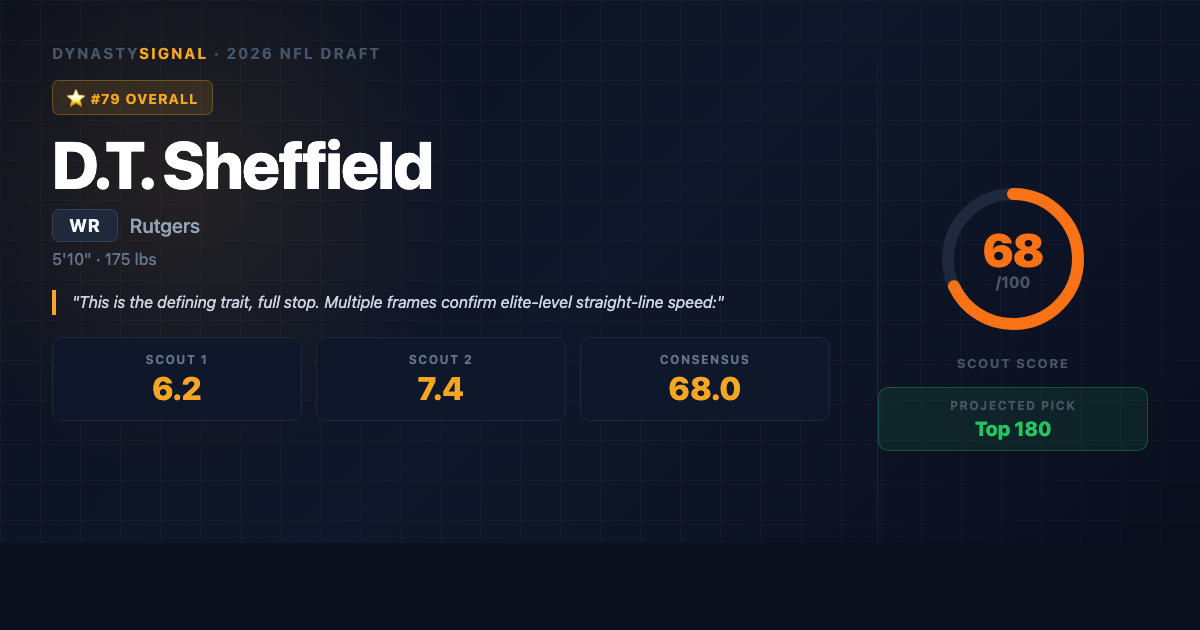
Scout 1 graded Sheffield at 62/100 and projects a Round 5–6 pick (picks 140–180). The evaluation is anchored by an elite athleticism grade (A-, 8.5/10) and strong YAC ability (B+, 7.5/10), with meaningful deductions for route running (C+, 5.8/10), hands in contested situations (B-, 6.2/10), and blocking (D+, 3.5/10). The primary NFL comp is Tutu Atwell — a 5'9", speed-first receiver whose value is entirely scheme-dependent — with a secondary framing as a potential WR3/WR4 with 40–60 reception upside if the route tree expands in the pros.
Scout 2 was more bullish, grading Sheffield at 74/100 with a Day 3 projection of Round 6–7 and an overall B- grade. The second evaluation was notably higher on hands (A-, 9/10) and YAC (A-, 9/10) — calling him a "nightmare after the catch" — while arriving at a similar conclusion on physicality/blocking (C-, 5/10) and flagging the shallow route tree as a development concern. The comp range offered: Braxton Berrios as the floor (shifty, size-limited slot), Marquise Brown as the ceiling (quicks and hands that pop, but requiring scheme support to maximize). The two evaluations land in the same general zip code on draft day, even if Scout 2 sees more refinement in the hands and separation than Scout 1 does.
PROJECTION
For dynasty managers, Sheffield is a late-round dart throw with a real upside scenario. The pick range (Round 5 through undrafted) means the acquisition cost is minimal, and the skill set — elite speed, explosive YAC, slot separation — is exactly what modern spread-passing NFL offenses pay to deploy. If he lands with a scheme-friendly team (Chiefs, Dolphins, Rams, or any McVay/Shanahan-derivative offense that manufactures touches), Year 1 looks like a WR4/5 rotational role with big-play flashes. That's manageable dynasty stash territory.
Year 2–3 is where the range widens. In the right situation, a 600–800 yard, 6-touchdown season is realistic — not a stretch comp, but a real outcome if he's the designated speed option and route tree development comes. The concern is the alternate timeline: he lands in a run-heavy or physically demanding system, struggles to win at the line consistently, and never escapes the gadget-player label. The Rutgers Big Ten season in 2025 is the key variable. If he produces against Power Four defenses the way he did against Memphis in the AAC, the ceiling rises and the stock climbs before the draft. Stash him cheap, watch the fall tape, and revisit before the 2026 draft.
View D.T. Sheffield's full player profile, measurables, and scouting breakdown →