
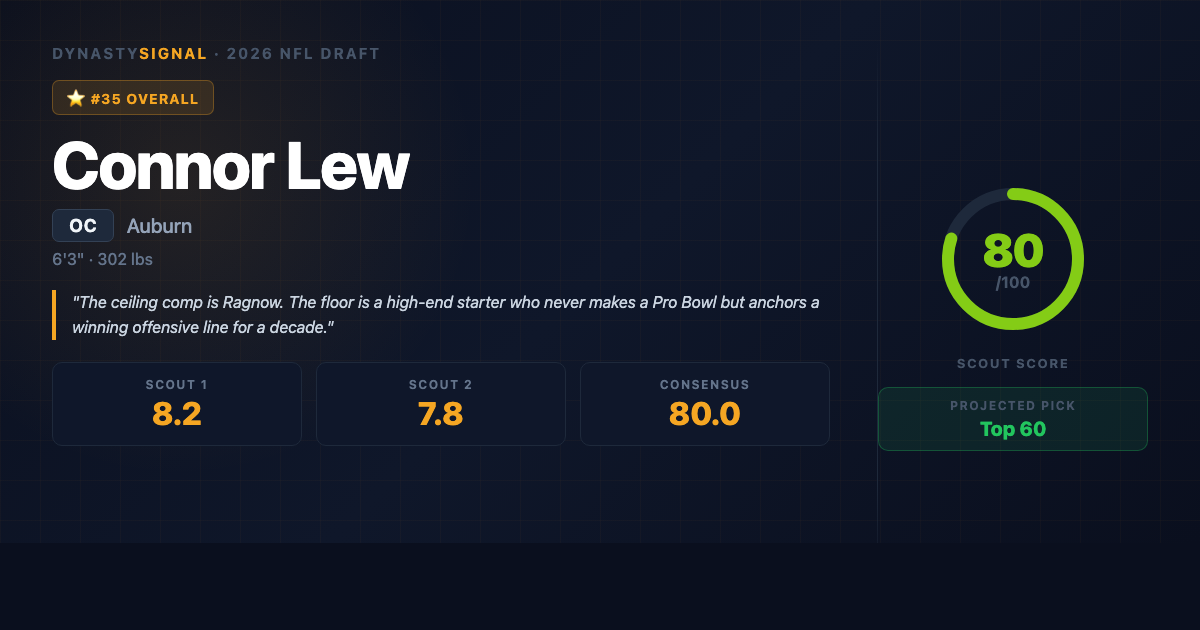
When you scan the 2026 NFL Draft's interior offensive line landscape, one name keeps floating to the top of the consensus boards: Connor Lew, the Auburn center who has quietly constructed a résumé that demands respect. Ranked #1 on at least one prominent IOL big board and #2 on another, Lew has done it the hard way — earning those rankings by lining up against Alabama, Texas A&M, and Oklahoma week after week in the SEC's unforgiving trenches. At 6'3"/300 lbs, he doesn't look the part of a dominant NFL center, but the film tells a different story from the tape measure.
What makes Lew genuinely compelling as a dynasty-relevant prospect is his blend of cognitive sophistication and movement quality that most interior linemen simply don't possess. In just 23 games of elevated competition, he's flashed the traits of a player who could anchor a winning offensive line for a decade. The conversation isn't whether he's a Day 2 pick — both scouting reports land him comfortably in Round 2, picks 45-60 range — it's whether his ceiling reaches Frank Ragnow or stops closer to a smart, scheme-dependent starter. That gap is worth understanding before the draft.
STRENGTHS
The most eye-catching element of Lew's film package is his open-field athleticism — a trait that is genuinely rare at the center position. Multiple film sources captured him working 15-20 yards downfield, tracking defenders in space with the urgency and spatial awareness of a much lighter player. This isn't a fluke; it shows up across games against Missouri, Texas A&M, and in film room zoom-ins that specifically highlight his second-level range. His zone-run acumen is advanced for a junior — he reads the combo block timing, stays engaged at the right moment, and releases cleanly to linebackers without hesitation. That cognitive-physical combination is exactly what modern NFL zone-run offenses are built on.
Lew's pre-snap intelligence is a consistent theme across every film source reviewed. Frame after frame shows him surveying defensive fronts, making protection calls, and identifying stunts before the snap — in one notable rep against Texas A&M, he spots a twisting DT, communicates the adjustment, and handles the block cleanly. This is center-level processing, not guard processing, and it's evident even through broadcast angles. In a 3rd-and-2 rep against California highlighted by a prominent film analyst, the camera operator chose his pre-snap process specifically to illustrate what separates him. That kind of film-room credibility matters.
His run-blocking tape against elite competition is legitimately impressive. Against Texas A&M — working in overtime, 2nd-and-2, the game on the line — Lew and an adjacent guard generate a clean surge in a combination block, and Auburn converts. Against the same Aggie front in 1st-and-10 situations, he latches a nose tackle and drives him three yards off the ball. He wasn't just surviving against future NFL defenders; he was winning against them with technique and timing. The high-leverage SEC résumé is a real credential, not padding.
CONCERNS
The weight concern is real and shouldn't be dismissed. At 300 lbs, Lew sits on the lighter end of the NFL center spectrum, and elite nose tackles in the 340-350 lb range will test his anchor in ways SEC defenders simply couldn't. Scout 2's film review flagged specific reps — a push-back of two gap widths in overtime against Texas A&M, a play where he was driven upright against Alabama — where power rushers stressed his leverage. His technique must be fundamentally sound on every single snap; there's no mass reserve to absorb a bad rep. His lateral quickness and recovery athleticism also drew B- grades from Scout 2, who noted stiff hips in a late-sliding rep against Missouri's edge loop. These aren't disqualifying flaws, but they define him as a finesse-system fit rather than an every-scheme anchor.
There's also a legitimate question about his precise NFL position. At least one prominent scouting film source listed him as a guard despite his operating as a center, and his 6'3"/300 frame is undersized for a pure guard by NFL standards as well. The dual-listing reflects genuine versatility, but it also creates pre-draft ambiguity — NFL teams will want clarity through combine interviews on where he fits best. A junior with only 23 college starts doesn't have the error-correction sample of a four-year starter, which adds developmental projection risk to an already small frame.
SCOUT GRADES
Scout 1 came away impressed enough to assign an 82/100 score with a projected landing spot of Round 2, picks 45-60. The film summary points to Lew's combination of elite second-level athleticism and pre-snap intelligence as the driving forces, drawing a ceiling comp of Frank Ragnow — the Detroit Lions' elite center who similarly won through cognitive sophistication and zone-scheme movement quality coming out of Arkansas. Scout 1 acknowledges the weight and junior class concerns but characterizes them as modest risks against a clearly identifiable ceiling, calling him a "legitimate early-to-mid Day 2 target."
Scout 2 is more measured, landing at 78/100 with the same Round 2 window (picks 45-55) but a notably different framing. The grades break down as: Awareness/Intelligence 9/10 (A-), Run Blocking 8/10 (A-), Technique/Footwork 8/10 (B+), Pass Blocking 7/10 (B), Anchor/Strength 6/10 (B-), and Lateral Quickness 6/10 (B-). Scout 2's ceiling comp is Ryan Kelly — a five-year solid contributor who won through technique — and the floor is Drew Dalman, a smart, scheme-versatile average starter. The overall takeaway from Scout 2 is a player who "thrives in gap/zone but is exposed vs. athletic 3-techs," with a caution against reaching into the top 40.
PROJECTION
For dynasty purposes, Lew's NFL landing spot matters enormously. In a zone-blocking system — think Los Angeles Rams, Seattle Seahawks, or any team that values mobility and pre-snap processing over raw power — he projects as a legitimate Day 1 starter within one to two seasons. Both scouts agree that his Year 1 outlook is probably rotational or developmental, with a clear path to everyday starter status by Year 2 if he lands in the right scheme. The Frank Ragnow comp, if it materializes even partially, represents Pro Bowl upside; Ragnow has been one of the league's better centers for years on the back of similar traits.
The dynasty capital calculus on centers is always limited compared to skill positions, but Lew has real value as a late-round stash in formats that roster offensive linemen, and his profile is the type that produces long, stable careers. The ceiling debate between scouts — Ragnow vs. Ryan Kelly — is actually a comfortable range. Either outcome produces a decade-long starting center. The key variable is scheme fit on draft day: watch where he lands, and if it's a finesse-friendly system, the Ragnow ceiling is worth believing in.
View Connor Lew's full player profile, measurables, and scouting breakdown →
🎬 All-22 Film Analysis Update
*Updated after All-22 film review by Scout1 and Scout2.*
Film Score: 80.0/100 (→ No change from base score of 80.0)
Composite Score: 81.5
Scout1 Assessment Connor Lew is a technically sound, scheme-versatile interior lineman who has made his mark at Auburn playing center in one of the most demanding conference environments in college football. He's the archetype of an intelligent, functionally athletic center — not a physical freak, but a guy who consistently wins through anticipation, combination-block execution, and the ability to reach linebackers that most 300-pounders can't get to. The case for him is legitimate: he ranked #1 and #2 on two sep...
*Film analysis is based on All-22 footage reviewed independently by two scouts. Scores reflect on-field evidence and may differ from pre-film model projections.*