
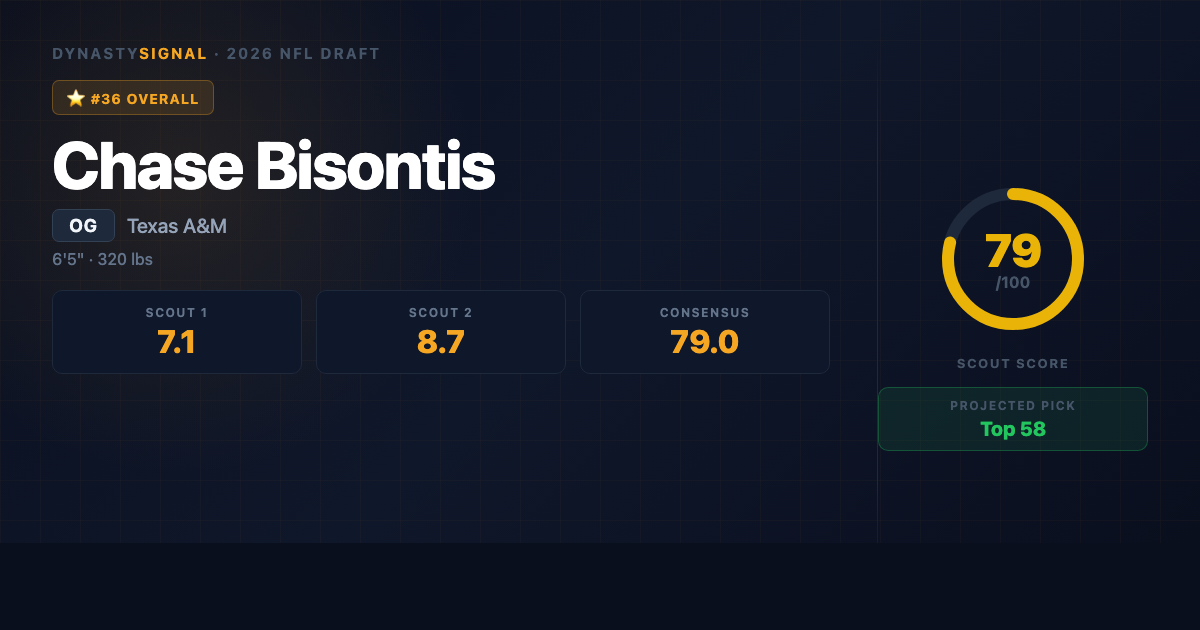
If you've spent any time in draft circles this winter, you've heard the hype: Chase Bisontis might be the best offensive guard in the 2026 NFL Draft class. The Texas A&M redshirt sophomore spent two seasons starting at left guard in the SEC — the most competitive conference for interior linemen in college football — logging snaps against future NFL starters from LSU, Auburn, Florida, Arkansas, and Notre Dame. At 315-322 lbs with a frame built for the trenches, Bisontis enters the draft as one of the most SEC-battle-tested interior prospects in recent memory, and the tape largely backs up the attention.
The question isn't whether Bisontis can play in the NFL — he absolutely can. The real question is *how good* he can be, and in *what system*. Our two scouts watched the same film and came back with meaningfully different grades: one sees a steady B-grade starter whose limitations are as real as his strengths, while the other projects a mauler who grades into the top-15 OG conversation in the right power scheme. That divergence tells you everything you need to know about Bisontis: he's a player whose ceiling is entirely scheme-dependent, and landing spot is going to define his career more than any other prospect in this class.
STRENGTHS
The crown jewel of Bisontis's game is his stunt and blitz recognition — both scouts flagged it, and the film is unambiguous. He processes interior line twists faster than nearly any guard in this class, rarely getting caught on late exchanges, and his clean transfers on stunts without losing his landmark show an interior IQ that translates directly to the NFL. Multiple film sequences show him reading complex pressure packages pre-snap and adjusting his hand placement before the rusher even commits to a move. For NFL teams running sophisticated interior pressure packages — which is essentially every team now — this trait alone justifies a Day 2 investment.
His anchor in pass protection is the complementary trait that makes the recognition work. At 315-plus pounds with consistently engaged hips and a wide base, Bisontis makes bull-rushing him a losing proposition. His strike timing grades out above average — he punches before the rusher can load, disrupting the timing of speed-to-power and rip counters. His initial punch is well-placed and tight, striking the chest rather than the outside of the jersey, which limits inside counters and keeps defenders off his frame. The technical refinement in his hand placement suggests genuine coaching absorption and film work, not just raw strength.
In the run game, Scout 2 was emphatic about what Bisontis does in gap and power schemes: violent hand fits, elite torque, and a mauler mentality that generates multiple pancakes on tape. His combo block work is particularly polished — seamless A/B gap executions that create cutback lanes and demonstrate the kind of interior cooperation that offensive coordinators in power systems prize. Scout 1 was more measured here, grading his drive power at B- and noting that initial movement doesn't always convert to a finished block, but even the more skeptical read acknowledges that when Bisontis gets his hands inside and drives through contact, he can absolutely move defenders.
CONCERNS
The concerns are real and both scouts identified them independently. His first-step quickness grades slow, and his athleticism is the primary ceiling-capper in this profile. Against quick interior rushers who win with burst before the punch can land, Bisontis can be a half-beat late getting his body into the right position. His reach blocks to the backside are legitimately below average, and his second-level work in space — climbing to linebackers on pull assignments or zone stretches — lacks the foot speed to consistently arrive before the linebacker can set his feet. In any zone-heavy run scheme (inside zone, outside zone), these deficiencies will be exposed regularly.
Technique inconsistencies compound the athletic limitations. At 6-foot-0.5 inches, Bisontis has to be disciplined about pad level every snap — when he plays even slightly high, longer-armed defensive tackles can neutralize his power advantage at the point of attack. Scout 2 noted his hands occasionally punch wide and his pad level rises in sustained blocks, allowing counters that cleaner technique would prevent. The leverage concern is particularly acute given his height: he doesn't have the frame to absorb mistakes the way a 6-4 guard might. The floor is solid enough that these concerns won't end his career, but they cap his schematic versatility and limit the offense types where he can thrive.
SCOUT GRADES
Scout 1 came in at 71/100 with a Round 2 projection of picks 40-58. The grade reflects a player whose pass protection (B/B+) is his carrying trait — anchored by an A-grade stunt and blitz recognition — while his run-blocking sustain (C), reach blocks (C-), and second-level work (C-) keep the overall ceiling in check. Scout 1 was direct that the "best guard in the draft" narrative overstates what the film shows: a steady, reliable starter in the right scheme, not a team-defining lineman. The NFL comp offered was Ben Powers of the Detroit Lions — above-average pass protector, functional gap-scheme run blocker, limited zone-scheme weapon.
Scout 2 graded significantly higher at 87/100 with a Round 2 projection of picks 35-50, crediting Bisontis's run-blocking power as elite (A- drive/anchor) and his second-level pull blocking as a genuine weapon (B+). Where Scout 1 saw inconsistent sustain, Scout 2 saw a "road-grading" mentality with violent finishes on tape. Both scouts converge on the same schematic conclusion — gap and power schemes unlock this player, zone-heavy offenses expose him — and both project a Day 2 landing in the 35-58 range. The grade spread (71 vs 87) reflects a genuine disagreement about how much his run-game upside compensates for athletic and technique limitations, and underscores that Bisontis is a player who will divide evaluators right up to draft night.
PROJECTION
For dynasty managers, Bisontis is a landing-spot play, full stop. The floor is legitimately high: he'll start within two years regardless of where he lands, and both scouts project a 7-10 year starter profile at minimum. The teams whose systems unlock his ceiling — Ravens, Steelers, Lions, Titans, Cowboys — are the same franchises that will give their skill players a reliable interior presence to run behind. If you're rostering a running back or tight end on a team that lands Bisontis in a gap/power system, the downstream fantasy value of that interior upgrade is meaningful and durable.
Years one through three project as: Year 1 — rotational guard with increasing snaps as he adjusts to NFL speed and complexity; Year 2 — full-time starter in the right scheme, competing for all-conference consideration; Year 3-plus — top-15 OG in run-heavy offenses, fading in pass-first schemes if his technique isn't refined. He's not a quarterback protector who will single-handedly save a bad pocket — he's the guard you want when the play is designed to go through him. Monitor the landing spot obsessively: a zone-heavy team largely wastes this pick, while a power-gap offense may have just found their next decade-long starter.
View Chase Bisontis's full player profile, measurables, and scouting breakdown →
🎬 All-22 Film Analysis Update
*Updated after All-22 film review by Scout1 and Scout2.*
Film Score: 79.0/100 (→ No change from base score of 79.0)
Composite Score: 80.5
Scout1 Assessment Chase Bisontis is a big, technically sound interior guard who wins with his hands rather than his feet. He's a stout pass protector with an excellent feel for stunts and blitz pickups — the kind of player that keeps quarterbacks clean in the pocket on passing downs. The case for him is simple: his anchor, timing, and hand technique grade out well at the guard position, and he played in the SEC against legitimate competition. The case against is equally straightforward: his run blocking consisten...
Scout2 Assessment Bisontis is a plug-and-play power guard for the right system, but calling him the draft's best ignores real athletic and technique red flags—take him late R2 and watch him grind into a 10-year vet.
*Film analysis is based on All-22 footage reviewed independently by two scouts. Scores reflect on-field evidence and may differ from pre-film model projections.*